


Industrial Laser Quenching & Laser Hardening Solutions
Delivering advanced high-energy laser surface hardening technologies, Greenstone provides industrial-grade solutions for precision heat treatment, selective surface strengthening, wear resistance enhancement, and component lifespan extension. Our systems are engineered for demanding global industries requiring minimal thermal distortion, superior hardness control, and continuous high-performance manufacturing.
What Is Laser Quenching (Laser Hardening) Technology?
Laser quenching, also known as laser hardening or laser heat treatment, is an advanced surface strengthening technology that uses a high-energy laser beam to rapidly heat the surface of metallic components above the austenitizing transformation temperature, followed by self-quenching through the base material’s internal heat conduction. This rapid thermal cycle transforms the surface microstructure into hardened martensite without the need for external cooling media such as water, oil, or gas.
This precision heat treatment process is widely recognized for significantly improving surface hardness, wear resistance, fatigue strength, and operational durability while preserving the core mechanical properties of the substrate. Compared to conventional hardening technologies such as induction hardening, flame hardening, carburizing, and furnace heat treatment, laser quenching offers superior hardness uniformity, highly localized heat input, reduced distortion, and exceptional control over hardening depth and treatment path.
Advantages of Laser Quenching (Laser Hardening) Technology
Laser quenching technology represents an advanced evolution in precision surface heat treatment, delivering substantial advantages over traditional hardening methods such as induction hardening, flame hardening, carburizing, and furnace-based thermal processing. By using a highly concentrated laser beam for rapid localized heating followed by self-quenching, laser hardening significantly enhances surface performance while minimizing thermal distortion, energy consumption, and environmental impact.
As a modern selective heat treatment and surface strengthening solution, laser quenching is widely recognized for enabling precise hardness control, minimal deformation, superior process automation, and exceptional flexibility for complex industrial components. It is increasingly adopted across aerospace, automotive, mold manufacturing, rail systems, power generation, tooling, and precision engineering sectors where surface durability, dimensional accuracy, and long-term reliability are critical.
Why Laser Quenching Matters
Compared to conventional hardening technologies, laser quenching offers a more precise, efficient, and environmentally sustainable solution for improving component wear resistance, fatigue life, and operational stability. Its ability to selectively strengthen critical surfaces without affecting the core substrate makes it ideal for modern high-value manufacturing and remanufacturing.
By combining localized heating precision, closed-loop temperature control, automation compatibility, and reduced post-processing requirements, laser quenching technology has become a leading solution for advanced industrial surface engineering and high-performance component lifecycle extension.
Eco-Friendly and Clean Process
Laser quenching eliminates the need for water, oil, or chemical quenching media, providing a pollution-free, energy-efficient, and environmentally sustainable hardening solution.
Stable and Precisely Controlled Quenching Temperature
Advanced infrared monitoring and closed-loop control systems enable real-time temperature management, ensuring highly stable quenching quality and repeatable process performance.
Enhanced Residual Compressive Stress Formation
Laser hardening creates beneficial compressive stresses on the material surface, significantly improving fatigue strength, wear resistance, crack resistance, and corrosion protection.
Selective Localized Hardening Capability
The highly focused laser beam allows precise hardening of specific wear zones, edges, or functional surfaces without affecting surrounding material or requiring full-part heat treatment.
Минимальное тепловое искажение
Highly localized heat input minimizes deformation, dimensional changes, and heat-affected zones (HAZ), making it especially suitable for precision molds, tools, and engineered components.
Superior Surface Hardness
Laser quenching can achieve hardness levels typically 1–3 HRC higher than conventional induction hardening while maintaining excellent hardness uniformity.
Closed-Loop Temperature Control System
Integrated process control technologies continuously optimize laser parameters, ensuring consistent hardening depth, thermal stability, and automated process reliability.
Flexible Treatment of Complex Geometries
Unlike induction systems that require specialized coils, laser quenching easily adapts to diverse part sizes, shapes, and complex surface profiles.
Reduced Equipment Constraints
Laser hardening does not require large furnaces or customized induction tooling, enabling more flexible manufacturing, lower setup costs, and easier scalability.
High Automation and Process Integration
Laser quenching is highly compatible with robotic systems, CNC automation, and intelligent manufacturing lines for repeatable, large-scale industrial deployment.
Extended Component Lifespan
By improving wear resistance, fatigue resistance, and operational reliability, laser hardening significantly extends service intervals and reduces lifecycle maintenance costs.
Improved Manufacturing Efficiency
Fast processing speed, minimal finishing requirements, and simplified system integration reduce total production time and improve operational productivity.
Технические характеристики
Система управления температурой LASCON® с замкнутым контуром (контроль, оптимизация и мониторинг лазерных процессов в режиме реального времени)
A laser controller software independently developed by us for temperature-controlled laser processing detects the processing temperature through a two-color thermometer. The main applications include: laser quenching, micro-hardening, laser welding (especially laser welding of plastics) and any other causes. Processes that increase the temperature of the workpiece, such as induction heating. LASCON® uses a concise laser process scripting language to control, optimize and supervise the laser process, making it easy to pick out defective parts in laser-supported production. LASCON® supports hardware components such as the LPC04 controller to easily integrate high-speed infrared pyrometers, laser processing heads, calibration units and adapters into machines and factory equipment. The entire software package is divided into different units and communicates via TCP/IP protocol.
Тестирование процесса
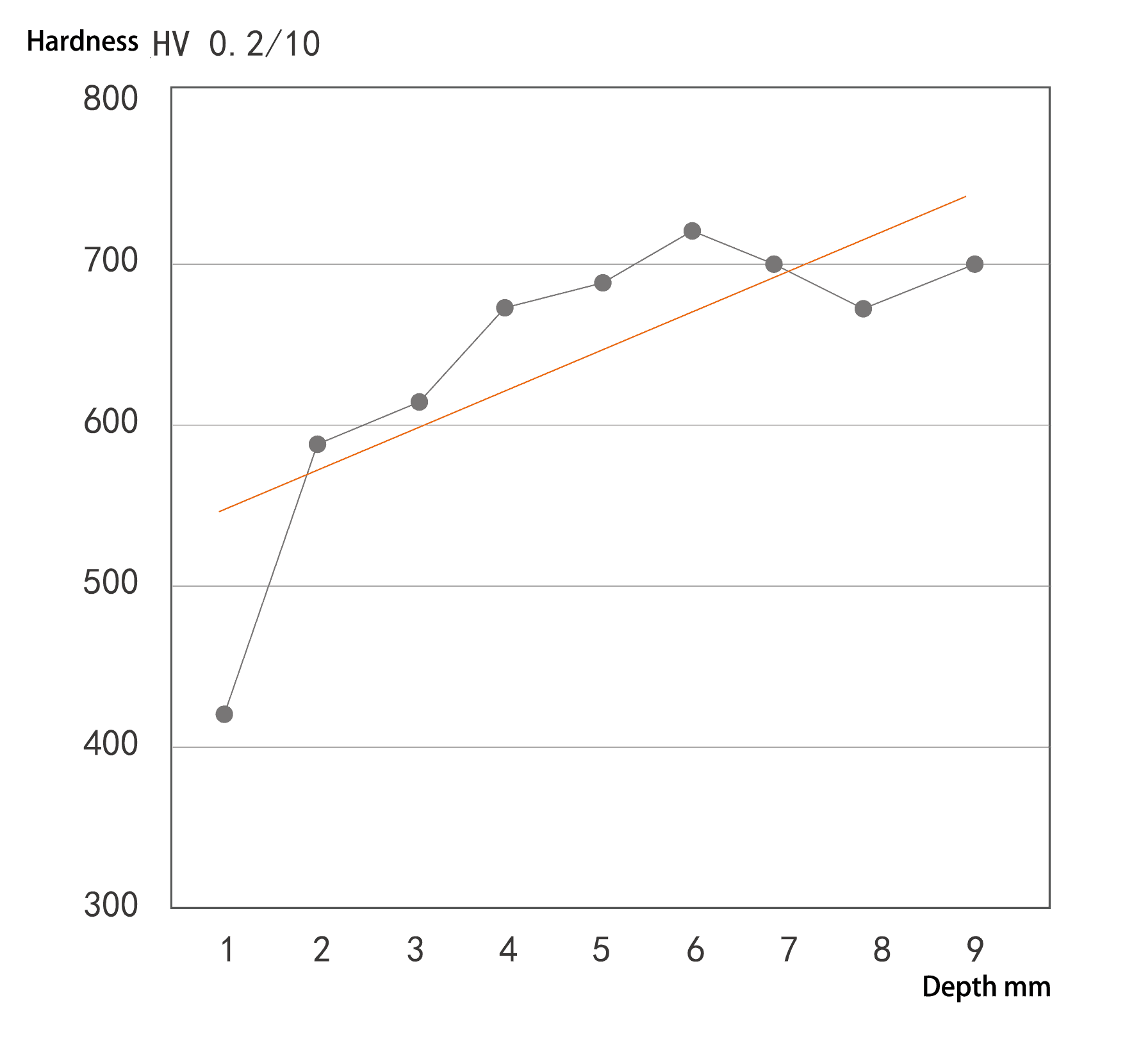
Путем установки различных температур закалки отслеживаются изменения твердости и глубины закалочного слоя материала; одновременно программное обеспечение для управления температурой рассчитывает коэффициент преобразования и отображает фактическую выходную мощность лазера в режиме реального времени. Максимальная твердость может достигать HRC60,2, а среднее значение — HRC58,9.. Путем измерения поперечного сечения закалки за один проход и проверки его твердомером Виккерса мы можем определить изменение твердости HV в зависимости от глубины.
Экспериментальные материалы
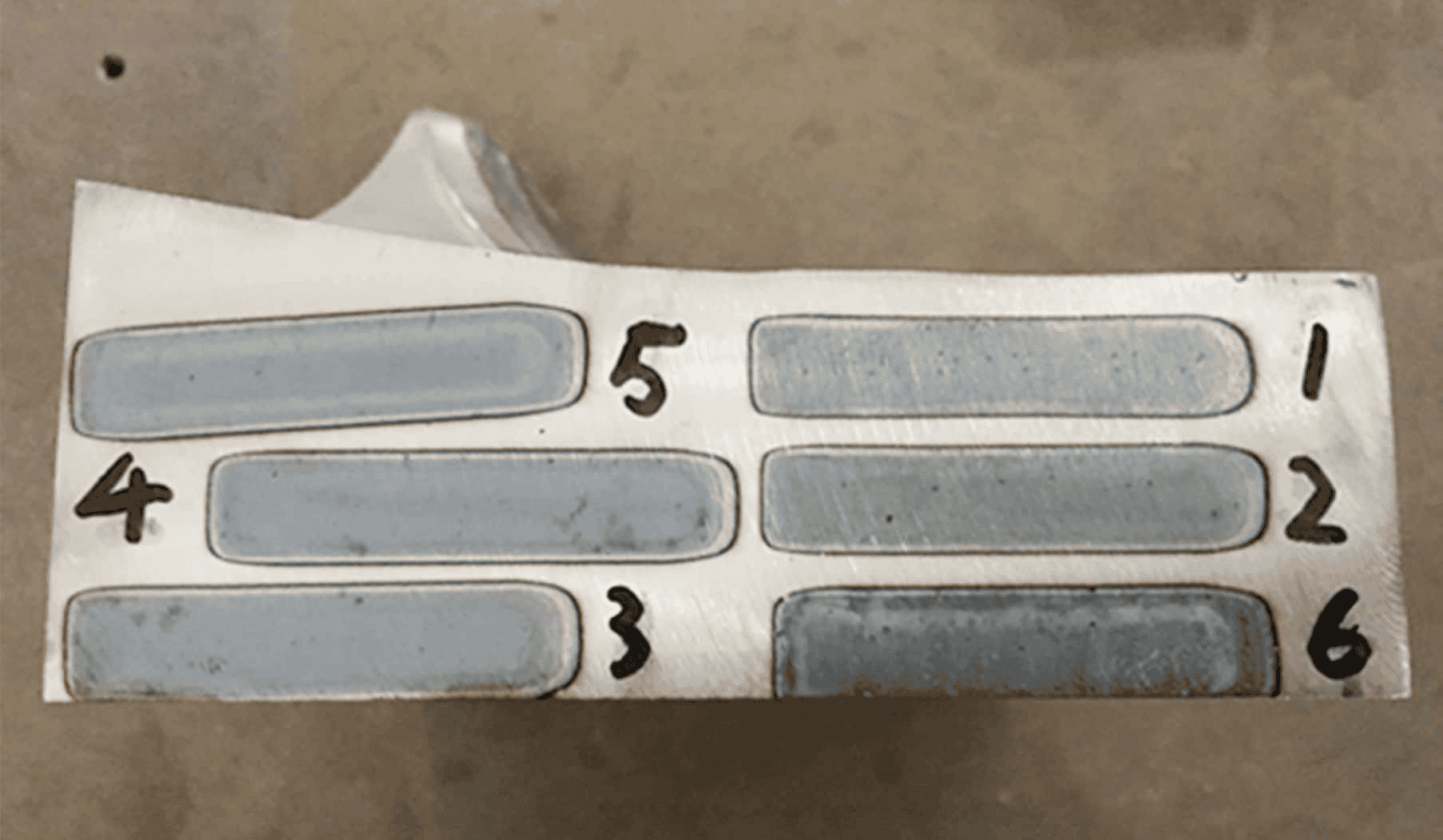
Предварительно закаленная пластиковая формовочная сталь 2738, твердость в закаленном состоянии 29-33 HRC.
Параметры процесса тестирования
Диапазон температур закалки (℃) | 1000-1500 |
Диапазон мощности лазера (%) | 46-70 |
Диапазон плотности мощности (Вт/см²) | 1380-2100 |
Диапазон плотности энергии по площади (Дж/см²) | 690-1050 |
Примечание: Полная мощность лазера составляет 3000 Вт.
Глубина затвердевшего слоя
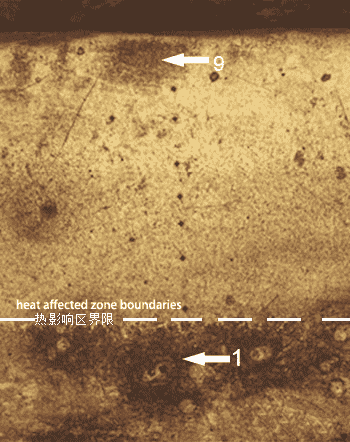
4# образец для измерения твердости по Виккерсу, 50-кратное увеличение
Значение твердости по Виккерсу для образца #4
Испытание твердости поверхности
Серийный номер | 1 | 2 | 3 | 4 | 5 | 6 |
Диапазон твердости (HRC) | 30.3-45.0 | 51.7-54.7 | 55.4-57.9 | 58.1-60.1 | 58.2-59.3 | 57.0-60.2 |
Средняя твердость (HRC) | 36.9 | 52.9 | 57 | 58.6 | 58.9 | 58.6 |
Laser Quenching (Laser Hardening) Application Cases
Laser quenching technology is widely applied across modern industrial sectors for precision surface strengthening, selective hardening, wear resistance enhancement, and component lifespan extension. By delivering highly localized heat treatment with minimal deformation, laser hardening provides an ideal solution for critical components that require improved hardness, fatigue resistance, and dimensional stability without compromising core structural integrity.
As an advanced surface engineering process, laser quenching is particularly valuable for high-load, high-wear, and precision-manufactured components in industries such as construction machinery, automotive manufacturing, aerospace, heavy equipment, mold production, rail transportation, power systems, and mechanical engineering.
Industry Application Advantages
Laser quenching enables manufacturers to selectively strengthen high-stress surfaces, improve operational durability, reduce friction-related failures, and significantly extend maintenance intervals. Compared to conventional induction hardening or furnace heat treatment, laser hardening offers greater flexibility for complex geometries, reduced tooling constraints, and highly automated precision processing.
Construction and Heavy Equipment Components
- Excavator hydraulic parts
- Bucket teeth and wear plates
- Heavy-duty shafts
- Engineering machinery wear surfaces
Gear and Transmission Systems
- Helical gears
- Transmission shafts
- Gear teeth strengthening
- Spline shafts
- Motorcycle transmission rods
Automotive Components
- Piston rings and piston pins
- Cylinder liners
- Camshafts
- Crankshafts
- Valve train components
- Steering and suspension wear parts
Mold and Tooling Industry
- H13 steel molds
- Die-casting molds
- Stamping dies
- Injection molds
- Forming tools
- Precision mold cavities
Rail and Transportation Systems
- Rail contact surfaces
- Wheel hubs
- Transmission rods
- Brake system wear components
Power and Industrial Equipment
- Turbine shafts
- Bearing seats
- Hydraulic cylinders
- Compressor parts
- Pump shafts
General Precision Engineering
- Linear guides
- Mechanical wear tracks
- Bearing journals
- Surface reinforcement of custom industrial parts
Representative Laser Quenching Workpiece Cases
- Reinforcement of excavator wear components
- 42Cr helical gear surface hardening
- Cylinder liner strengthening
- Industrial mold surface hardening
- закалка формы H13
- Automotive piston component quenching
- Motorcycle transmission rod hardening
- Precision shaft and guide rail strengthening
Technical Application Features
- Precision Surface Hardening for Critical Wear Zones
Laser quenching selectively treats functional surfaces, edges, grooves, and localized wear areas without affecting surrounding structures. - Minimal Component Distortion
Rapid localized heating and self-quenching greatly reduce deformation, making it highly suitable for precision mechanical parts and molds. - Superior Hardness and Fatigue Strength
Laser-hardened surfaces provide enhanced wear resistance, crack resistance, and fatigue life for demanding industrial environments. - Flexible Automation for Complex Components
Integrated CNC and robotic systems allow laser hardening of large, irregular, or high-value workpieces with excellent repeatability. - Environmentally Friendly Manufacturing
No oil, water, or chemical quenching media are required, reducing environmental impact and simplifying production. - High Productivity and Cost Efficiency
Reduced post-processing, lower tooling costs, and longer component service life significantly improve lifecycle economics.
Why Laser Quenching Is Ideal for Modern Industrial Applications
By combining selective hardening precision, minimal distortion, intelligent automation, and exceptional surface performance, laser quenching technology has become one of the most effective solutions for improving component reliability, reducing operational downtime, and extending the service life of mission-critical industrial systems. It is increasingly recognized as a core technology for advanced manufacturing, high-performance tooling, and sustainable industrial surface engineering.