


Molds often fail after long-term use due to surface wear, corrosion, and other factors. Traditional methods typically involve scrapping the molds, leading to resource wastage. Using appropriate repair technologies to extend the life of molds is crucial. Among various mold repair techniques, laser cladding has emerged as an efficient and effective surface engineering technology, becoming increasingly popular. Currently, laser cladding is widely applied in the field of mold repair, with the following key applications:


1. Die-Casting Mold Repair
Die-casting, particularly light alloy die-casting, is widely used in industries like automotive and telecommunications. During the die-casting process, molten metal fills the mold cavity under high pressure and speed, causing the mold to repeatedly contact high-temperature metals, leading to issues such as thermal fatigue, wear, and corrosion. While surface enhancement techniques are commonly used to treat molds, a significant number of die-casting molds still fail each year due to surface wear, thermal cracking, and corrosion. Laser cladding with high-performance nano-coatings is highly suitable for repairing these molds. The rapid solidification of laser cladding, combined with the excellent properties of nano-coatings, results in repair surfaces that can even outperform new molds. For example, a company specializing in aluminum die-casting saw its mold life increase by 1.5 times after applying laser cladding for repair.
2. Sand Casting Mold Repair
Sand casting has a long history, but manual molding is inefficient. For mass production, such as automotive components, metal molds are often used. Like die-casting molds, metal molds in sand casting also experience wear, which can be effectively repaired using laser cladding technology. Compared to other molds, sand casting molds have lower precision requirements and are easier to repair. While quick fixes using putties or resins are common in practical production, laser cladding coatings are far superior in terms of long-term performance.
3. Plastic Mold Repair
Plastic molds, such as injection molds and blow molds, also suffer from issues like thermal fatigue, wear, and corrosion. Due to the complex structure and high precision required for plastic molds, they are more costly to manufacture, making repair and reinforcement highly beneficial from an economic perspective. Laser cladding can effectively restore and enhance the performance of worn-out plastic molds, improving both their functional lifespan and cost-effectiveness.
4. Forging Mold Repair
Forging processes, including hot and cold forging, require molds to perform under extreme conditions, making them prone to damage and failure. Laser cladding technology can effectively repair cracks, defects, and wear on the surface of forging molds, while simultaneously strengthening the surface by cladding high-performance alloy layers. This ensures molds can withstand the high demands of forging applications.
5. Stamping Die Repair
In the cold stamping of metal materials, molds undergo significant wear due to the pressure exerted on them during the material forming process. Laser cladding is an effective solution for repairing worn-out or defective stamping dies. For example, heat cracks and bridge collapses in hammering die punches can be repaired using laser cladding. Additionally, laser cladding can restore the size and enhance the performance of worn stamping die punches. A successful example involves repairing cracks and edge peeling on Cr12 punching dies used for cutting 4 mm thick Q235 steel plates, achieving excellent results.
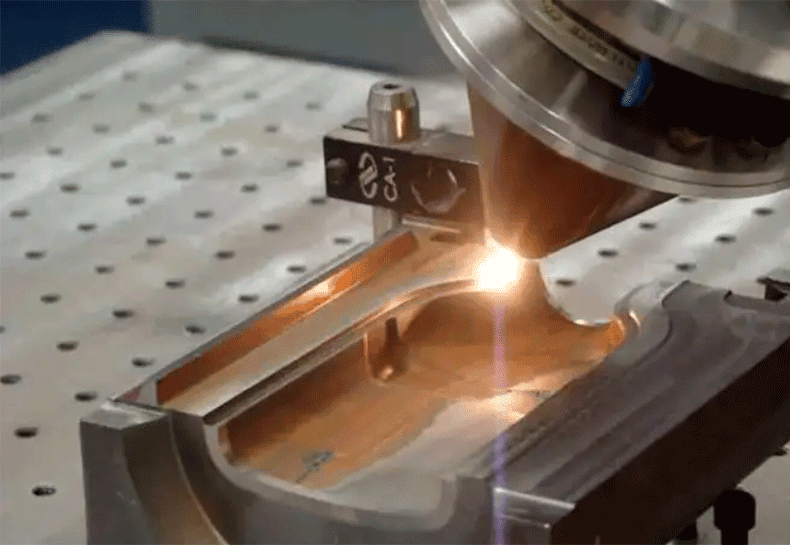

6. Other Applications
In addition to the aforementioned mold repairs, laser cladding can be widely applied to other molds or parts in industries such as metallurgy. Examples include repairs for rollers in the metallurgy industry, turbine blades, valves, and more.
Current Challenges and Future Development
Laser cladding technology has developed rapidly and is increasingly being applied in mold repair. However, several common technical issues still need to be addressed, such as:
- Crack control in cladding: Managing the formation of cracks during the cladding process remains a challenge.
- Development of cladding materials: New materials with superior properties are necessary for expanding the range of repair applications.
- Establishment of cladding process databases: Comprehensive databases to guide the cladding process and optimize parameters are needed.
As laser cladding technology continues to evolve, it holds great potential for enhancing mold repair processes, reducing costs, and improving overall performance and reliability.
Sheldon Li
Dr. Sheldon Li - Chief Engineer, Additive Manufacturing Equipment Development Dr. Sheldon Li is een topingenieur en technisch leider, gespecialiseerd in onderzoek en ontwikkeling van additive manufacturing apparatuur. Als expert met een Ph.D. in Nonferro Metals biedt zijn diepgaande kennis van materiaaleigenschappen een uniek voordeel op het gebied van apparatuurontwikkeling. Zijn expertise concentreert zich op het ontwerpen en ontwikkelen van geavanceerde apparatuur voor additieve productie, met een bijzondere specialisatie in depositieapparatuur voor speciale functionele metaalcoatings. Dit omvat technologieën zoals Laser Metal Deposition (LMD), Cold Spray of Physical Vapor Deposition (PVD) om coatings te maken voor slijtvastheid,...


