
PVS Wire-Fed Laser Cladding Head | High-Precision Laser Metal Deposition (LMD) Nozzle
Product Overview
Wire-fed laser cladding technology uses metal wire as the cladding material and is primarily applied in the production of protective surface coatings, laser remanufacturing of damaged or worn components, and the cladding of slender shafts, thin-walled structures, and other deformation-sensitive parts.
This cladding head is compatible with a wide range of cold-wire and hot-wire materials and specifications, ensuring excellent adaptability for diverse industrial applications involving wear resistance, dimensional restoration, and precision surface enhancement.
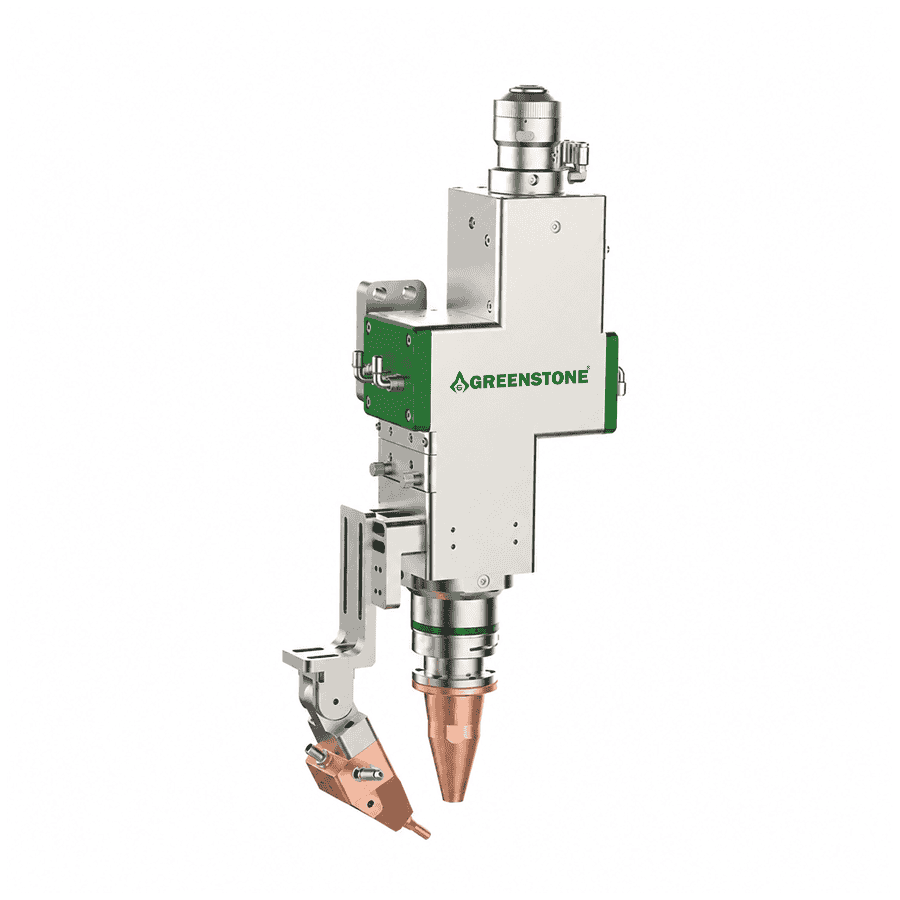
High Material Utilization
The wire-fed process features excellent material utilization, minimal heat input, and low thermal distortion. It produces smooth and uniform cladding layers with refined microstructures, high bonding strength, low dilution rates, and reduced defect levels.
High Deposition Rate
Featuring an optimized hot-wire feeding system, the cladding head achieves significantly higher deposition rates—up to 2.5× faster—improving productivity for large-area and high-volume manufacturing.
Optimized Water-Cooling Structure
A highly efficient water-cooling design ensures stable thermal management and supports 24-hour continuous and reliable operation, even under long-duration industrial workloads.
Four-Dimensional Adjustment
The advanced multi-axis wire-feeding mechanism enables precise four-dimensional positional adjustment, ensuring accurate wire delivery into the melt pool for improved process stability and cladding quality.
Extended Service Life
Integrated coaxial shielding gas modules enhance melt pool protection and reduce oxidation, while superior thermal design prolongs the service life of critical optical components and protective lenses.
Rich Functionality
The cladding head supports a wide range of functions and can be quickly adapted to switch between metal wire cladding, powder cladding, and other hybrid processing modes, delivering high flexibility for diverse industrial applications.
Typical Applications
Shaft and journal repair
Mold refurbishment and edge rebuilding
Laser hardfacing and wear-resistant coating
Structural additive manufacturing
Hydraulic components and energy equipment restoration
Precision repair of aerospace and automotive parts
| Item | Specification |
|---|---|
| Laser Interface | QBH, QD, LLK-D, LOE, etc. |
| Optical Path Structure | Reflective optical path |
| Protective Lens Group | 3 layers |
| Cooling Method | Water cooling |
| Rated Power | ≤12,000 W |
| Stand-off Distance | 150 mm |
| Collimation Distance | 300 mm |
| Focusing Optics | Rectangular Spot: 3 × 3 mm, 4 × 4 mm Circular Spot: 2–5 mm (adjustable) |
| Applicable Wavelength | 900–1080 nm |
| Laser Transmission Efficiency | ≥99.25% |
| Temperature Sensor | Protective lens temperature monitoring |
| Wire Feeding Structure | Four-axis wire feeding |
| Cladding Layer Thickness | 0.1–3.0 mm |
| Wire Feeding Speed | 0–100 mm/s (cold wire) 0–200 mm/s (hot wire) |
| Compatible Wire Materials | Stainless steels, structural steels, nickel-based alloys, cobalt-based alloys, copper alloys, etc. |
| Applicable Wire Diameter | Ø0.8 mm – Ø1.6 mm |
| Material Utilization Rate | 100% |
| Weight | 7.5 kg |
| Optional Features | CCD monitoring, laser rangefinder |
Recommended Advanced Manufacturing Solutions
Explore Greenstone’s related portfolio of high-performance industrial equipment, engineered to complement your manufacturing objectives across laser cladding, DED additive manufacturing, laser cleaning, surface engineering, precision automation, and advanced material processing. Each solution is strategically designed to expand production capabilities, enhance process efficiency, and support scalable industrial innovation.
From modular laser systems to fully integrated intelligent manufacturing platforms, Greenstone provides customers with interconnected technologies that deliver greater flexibility, precision, and operational excellence for modern global manufacturing environments.


