
Nickel-Based Alloy Powder for Glass Mold Repair & Glass Container Manufacturing – Laser Cladding, PTA and Oxy-Fuel Powder Welding
Product Overview
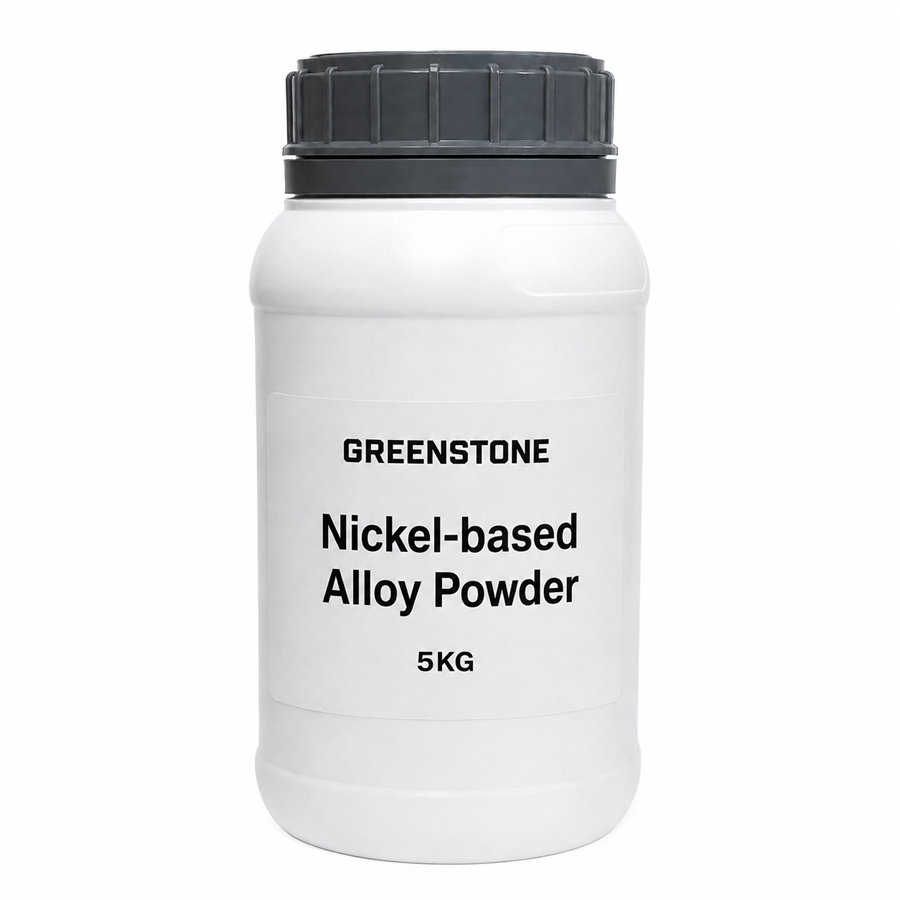
GREENSTONE Nickel-Based Alloy Powder for Glass Mold Repair and Glass Container Manufacturing is a specialized range of self-fluxing metal powders developed for the surface repair, dimensional restoration and functional coating of glass molds and glass-forming components.
Based primarily on Ni-B-Si and Ni-Cr-B-Si alloy systems, these powders provide a controlled combination of moderate hardness, wear resistance, oxidation resistance, thermal stability, machinability and metallurgical bonding. They are particularly suitable for glass mold components that operate under repeated heating and cooling cycles and require reliable surface performance without excessive coating brittleness.
The powder series is designed for laser cladding, PTA plasma transferred arc welding, oxy-fuel powder welding and compatible thermal deposition processes. Typical applications include molds used for glass bottles, beverage containers, pharmaceutical glass containers, cosmetic bottles, tableware and other molded glass products.
GREENSTONE can provide different hardness levels, chemical compositions and particle-size distributions according to the mold substrate, repair location, deposition process and service conditions.
Designed for Glass Mold Manufacturing and Repair
Glass molds experience repeated thermal cycling, mechanical contact, oxidation and localized wear during production. The alloy deposited on the mold must therefore provide more than simply high hardness.
GREENSTONE glass industry alloy powders are formulated to achieve a practical balance of wear resistance, thermal stability, oxidation resistance, machinability and resistance to cracking under cyclic thermal loading.
They can be used for both new mold manufacturing and worn mold remanufacturing, helping restore dimensions and reinforce critical working surfaces.
Ni-B-Si Self-Fluxing Alloy Powder
Low- and medium-hardness Ni-B-Si self-fluxing powders provide good melting and wetting behavior together with relatively low coating brittleness.
Typical hardness is approximately HRC 22–30, depending on composition and deposition parameters.
These powders are suitable for applications where machinability, thermal cycling performance and controlled hardness are more important than maximum abrasion resistance.
Ni-Cr-B-Si Alloy Powder
The addition of chromium improves oxidation, corrosion and wear resistance while maintaining the favorable processing characteristics of a nickel-based self-fluxing system.
GREENSTONE Ni-Cr-B-Si powders are suitable for glass mold edges, neck-ring areas, guide surfaces, contact surfaces and other localized wear zones.
Typical hardness ranges from approximately HRC 25–32 for the compositions represented in this product family.
Laser Cladding Powder for Glass Molds
Laser cladding provides controlled heat input and a relatively small heat-affected zone, making it particularly useful for precision restoration of high-value glass mold components.
GREENSTONE laser cladding powders are available with controlled particle-size distributions suitable for automated powder feeding. The process can produce a metallurgically bonded functional layer while minimizing unnecessary thermal influence on the mold substrate.
Typical applications include localized dimensional restoration, edge rebuilding, worn-surface repair and preventive surface reinforcement.
PTA Powder for Glass Mold Hardfacing
PTA welding provides efficient metallurgical deposition and is suitable for larger repair areas or applications requiring relatively high deposition efficiency.
Selected Ni-Cr-B-Si compositions are available for PTA hardfacing of glass mold components, offering good wetting behavior and stable processing characteristics.
Oxy-Fuel Powder Welding
Fine nickel-based self-fluxing powders can also be supplied for oxy-acetylene / oxy-fuel powder welding, a well-established process for localized glass mold repair.
These compositions are designed to provide good fusion and wetting characteristics while maintaining the moderate hardness and machinability required for subsequent finishing.
Suitable for Cast-Iron Glass Molds
Many container-glass molds use cast-iron-based substrates. The relatively moderate hardness and controlled melting characteristics of these nickel-based powders make them suitable for appropriately prepared cast-iron glass mold components.
Final alloy selection should consider the substrate grade, mold geometry, repair depth, preheating conditions, deposition method and required post-machining.
Key Advantages
- Specially suited to glass mold repair and remanufacturing
- Typical hardness range of approximately HRC 22–32
- Good resistance to thermal cycling and oxidation
- Good wetting and self-fluxing characteristics
- Controlled hardness helps reduce excessive brittleness
- Good machinability for post-cladding finishing
- Suitable for laser cladding, PTA and oxy-fuel powder welding
- Strong metallurgical bonding on compatible substrates
- Suitable for both localized repair and preventive surface reinforcement
- Multiple particle-size distributions available for different deposition technologies
- Chemistry and particle size can be customized according to glass mold application
GREENSTONE Glass Industry Alloy Powder Series
| Alloy System | Typical Chemical Composition (wt.%) | Typical Hardness | Typical Particle Size | Recommended Process | Typical Application |
|---|---|---|---|---|---|
| Ni-B-Si Low-Hardness Alloy | B ~1.5, Si ~2.9, Fe ~0.8, Ni Bal. | ~HRC 25 | 53–150 μm | Laser Cladding | Glass mold repair and dimensional restoration |
| Ni-Cr-B-Si PTA Alloy | Cr ~5.0, B ~1.0, Si ~3.2, Fe ~0.8, Ni Bal. | ~HRC 25 | 53–150 μm | PTA Welding | Glass mold hardfacing and repair |
| Ni-Cr-B-Si Medium-Hardness Alloy | Cr ~0.3, B ~1.2, Si ~3.2, Fe ~0.8, Ni Bal. | ~HRC 30 | 53–150 μm | Laser Cladding | Wear-prone glass mold surfaces |
| Ni-Cr-B-Si-P Low-Hardness Alloy | Cr ~4.5, B ~0.8, Si ~2.1, P ~2.0, Fe ~0.8, Ni Bal. | ~HRC 22 | Fine Powder* | Oxy-Fuel Powder Welding | Local glass mold repair |
| Ni-B-Si-P Alloy | B ~0.9, Si ~2.7, P ~2.0, Fe ~0.8, Ni Bal. | ~HRC 25 | Fine Powder* | Oxy-Fuel Powder Welding | Mold edge and surface restoration |
| Ni-Cr-B-Si-P Medium-Hardness Alloy | Cr ~3.6, B ~0.9, Si ~3.2, P ~2.0, Fe ~0.8, Ni Bal. | ~HRC 32 | Fine Powder* | Oxy-Fuel Powder Welding | Higher-wear glass mold areas |
* Fine powder size should be selected according to the powder torch, feeder and deposition process. Custom particle-size distributions are available.
General Technical Specifications
| Parameter | Specification |
|---|---|
| Product Category | Glass Industry Nickel-Based Alloy Powder |
| Primary Alloy Systems | Ni-B-Si / Ni-Cr-B-Si / Ni-Cr-B-Si-P |
| Matrix Material | Nickel-Based Alloy |
| Typical Hardness Range | HRC 22–32 |
| Typical Laser Cladding Size | 53–150 μm |
| PTA Powder Size | Process-specific / customizable |
| Oxy-Fuel Powder Size | Fine powder, process-specific |
| Available Processes | Laser Cladding / PTA Welding / Oxy-Fuel Powder Welding |
| Primary Function | Repair / Dimensional Restoration / Wear Protection / Surface Reinforcement |
| Typical Substrates | Cast Iron and compatible glass mold materials |
| Powder Characteristics | Controlled composition and particle-size distribution |
| Post-Machining | Applicable depending on deposited alloy and process |
| Composition Customization | Available |
| Particle Size Customization | Available |
| Packaging | Sealed moisture-resistant packaging; customized weight available |
| Brand | GREENSTONE |
Typical Applications in the Glass Industry
| Application | Recommended Alloy System | Main Requirement |
|---|---|---|
| Glass Bottle Mold Repair | Ni-B-Si / Ni-Cr-B-Si | Thermal cycling + dimensional restoration |
| Container Glass Mold | Ni-Cr-B-Si | Wear and oxidation resistance |
| Glass Mold Edge Repair | Ni-B-Si / Ni-Cr-B-Si-P | Machinability + localized deposition |
| Neck Ring / Finish Mold Components | Ni-Cr-B-Si | Wear resistance + thermal stability |
| Pharmaceutical Glass Container Molds | Ni-Based Self-Fluxing Alloy | Precision repair + surface stability |
| Cosmetic Bottle Molds | Ni-B-Si / Ni-Cr-B-Si | Precision restoration |
| Tableware Glass Molds | Ni-Cr-B-Si | Thermal and wear resistance |
| Laser Repair of Cast-Iron Glass Molds | Ni-B-Si / Ni-Cr-B-Si | Controlled heat input + metallurgical bonding |
| PTA Glass Mold Hardfacing | Ni-Cr-B-Si | Efficient surface deposition |
| Oxy-Fuel Glass Mold Repair | Ni-B-Si-P / Ni-Cr-B-Si-P | Wetting + localized repair |
Recommended Advanced Manufacturing Solutions
Explore Greenstone’s related portfolio of high-performance industrial equipment, engineered to complement your manufacturing objectives across laser cladding, DED additive manufacturing, laser cleaning, surface engineering, precision automation, and advanced material processing. Each solution is strategically designed to expand production capabilities, enhance process efficiency, and support scalable industrial innovation.
From modular laser systems to fully integrated intelligent manufacturing platforms, Greenstone provides customers with interconnected technologies that deliver greater flexibility, precision, and operational excellence for modern global manufacturing environments.


