
MIM Metal Powders for Automotive, Medical, Electronics, Aerospace & Precision Industrial Components
Product Overview
Stainless Steel, Tool Steel, Low-Alloy Steel, Fe-Ni, Co-Based and Controlled-Expansion Alloy Powders for Metal Injection Molding (MIM)
GREENSTONE MIM Metal Powders are high-quality fine metal powders engineered for Metal Injection Molding (MIM) and other precision powder metallurgy applications requiring excellent flowability, high packing density, controlled particle size distribution and reliable sintering performance.
The product portfolio covers a broad range of internationally recognized material systems, including 316L, 304L, 17-4PH, 15-5PH, 410, 430, 440C stainless steels; 4605 and 8620 low-alloy steels; Fe-Ni alloys; M2 and H13 tool steels; KOVAR (4J29) controlled-expansion alloy; and cobalt-based alloys.
With fine and controlled powder particle distributions, GREENSTONE MIM powders are designed to support the manufacture of small, complex and high-precision metal components with excellent surface quality, dimensional consistency and mechanical properties after debinding and sintering.
Typical industries include automotive, medical devices, consumer electronics, aerospace, electrical systems, telecommunications, precision machinery, industrial tools, hardware and high-performance engineering components.
Particle size distribution, alloy composition and powder characteristics can also be customized according to customer requirements and specific MIM feedstock systems.
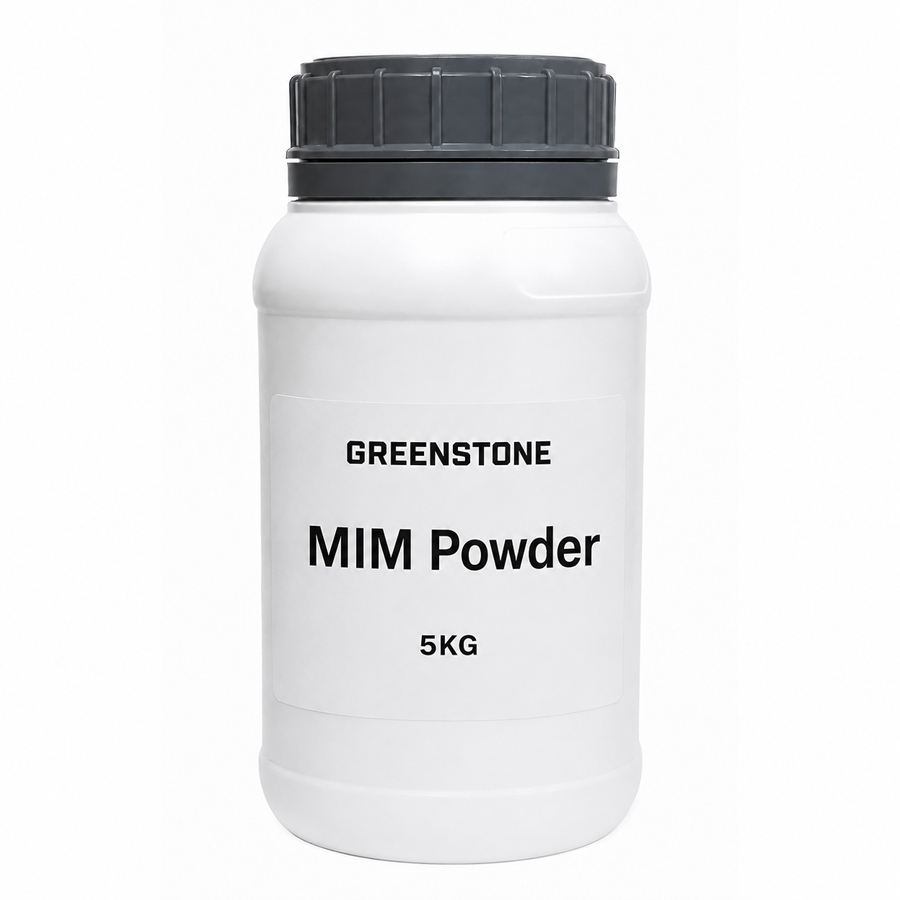
Stainless Steel MIM Powders
GREENSTONE provides multiple stainless steel powder systems for applications requiring corrosion resistance, mechanical strength, dimensional stability or wear resistance.
316L and 304L are suitable for corrosion-resistant precision components used in medical, electronics, consumer products, food-processing and industrial applications.
17-4PH and 15-5PH precipitation-hardening stainless steels provide higher strength and hardness while maintaining good corrosion resistance, making them suitable for automotive, aerospace, medical and high-strength structural components.
410 and 430 stainless steels provide economical solutions for applications requiring moderate corrosion resistance and magnetic characteristics.
440C provides high hardness and wear resistance for precision components exposed to demanding mechanical conditions.
Low-Alloy Steel MIM Powders
Low-alloy steel powders such as 4605 and 8620 are suitable for structural MIM components requiring high strength, toughness and good heat-treatment response.
These materials are widely applicable to:
- Automotive transmission and engine components
- Mechanical locking components
- Precision gears and structural parts
- Power-tool components
- Industrial machinery
- High-strength hardware
Heat treatment and carburizing can be applied according to the selected alloy and final component requirements.
Tool Steel MIM Powders
GREENSTONE M2 and H13 tool steel powders are designed for applications requiring high hardness, wear resistance, thermal stability and mechanical strength.
M2 high-speed steel is suitable for small cutting, wear and tooling components, while H13 hot-work tool steel provides excellent thermal-fatigue resistance and is suitable for components subjected to elevated temperatures and repeated thermal loading.
Fe-Ni Alloy MIM Powders
Fe-Ni alloy powders provide controlled combinations of strength, toughness, magnetic characteristics and thermal behavior.
Different nickel levels can be selected according to the final application, making Fe-Ni powders suitable for electronic components, magnetic components, precision mechanical parts and specialty engineering applications.
KOVAR (4J29) Controlled-Expansion Alloy Powder
KOVAR, also internationally known as ASTM F15 / UNS K94610, is an Fe-Ni-Co controlled-expansion alloy designed to provide thermal-expansion behavior compatible with certain glasses and ceramics.
MIM processing enables complex KOVAR components to be manufactured economically at volume, making the material particularly useful for:
- Electronic packaging
- Hermetic sealing components
- Glass-to-metal seals
- Semiconductor packages
- Sensor housings
- Vacuum electronic components
- Aerospace electronics
Cobalt-Based MIM Powders
Cobalt-based alloy powders can be supplied for specialized MIM components requiring combinations of wear resistance, corrosion resistance, elevated-temperature performance and mechanical strength.
Typical applications include medical, industrial, aerospace and precision wear-resistant components.
Exact alloy specifications should be selected according to the required international standard and application.
Fine Particle Size Distribution
MIM requires substantially finer powders than many conventional powder metallurgy processes. GREENSTONE MIM powders can provide controlled fine particle distributions optimized for feedstock preparation, injection molding, debinding and sintering.
Typical reference distribution:
D10: 2–3 μm
D50: 8–11 μm
D90: 19–22 μm
Particle-size distribution can be adjusted according to alloy type, feedstock formulation and molding requirements.
Key Advantages
Excellent MIM Processability
Controlled powder morphology and particle-size distribution support uniform mixing with binders, stable injection molding and consistent debinding behavior.
High Sintered Density
Fine particles promote efficient densification during sintering, supporting high mechanical performance and good surface quality.
Excellent Surface Finish
Fine powders are suitable for manufacturing intricate components requiring smooth surfaces and reduced post-processing.
High Dimensional Consistency
Controlled chemistry and powder characteristics help maintain predictable sintering shrinkage and dimensional repeatability.
Wide Material Portfolio
Multiple stainless steels, low-alloy steels, tool steels, Fe-Ni alloys, controlled-expansion alloys and cobalt-based materials can be supplied from one product platform.
Complex Geometry Manufacturing
MIM is particularly suitable for components with thin walls, holes, internal features, complex surfaces and geometries that would be expensive to manufacture by conventional machining.
Mass-Production Capability
Optimized for high-volume manufacturing of small and medium-sized precision metal components.
Customized Powder Solutions
GREENSTONE can customize alloy chemistry, particle-size distribution and other powder characteristics according to customer requirements.
| Material Grade | Material Family | Typical Characteristics | Typical MIM Applications |
|---|---|---|---|
| 316L | Austenitic Stainless Steel | Excellent corrosion resistance, good ductility | Medical, electronics, consumer products, industrial components |
| 304L | Austenitic Stainless Steel | Corrosion resistance, good formability | Electronics, hardware, general precision components |
| 15-5PH | Precipitation-Hardening Stainless Steel | High strength, hardness, corrosion resistance | Aerospace, automotive, structural components |
| 17-4PH | Precipitation-Hardening Stainless Steel | High strength and good corrosion resistance | Automotive, medical, aerospace, industrial components |
| 410 | Martensitic Stainless Steel | Moderate corrosion resistance, heat treatable | Mechanical parts, hardware, industrial components |
| 430 | Ferritic Stainless Steel | Magnetic, corrosion resistant | Electronics, appliances, industrial parts |
| 440C | High-Carbon Stainless Steel | High hardness and wear resistance | Wear components, precision mechanical parts |
| 4605 | Low-Alloy Steel | High strength and toughness after heat treatment | Automotive and structural components |
| 8620 | Ni-Cr-Mo Low-Alloy Steel | Tough core, suitable for carburizing | Gears, mechanical components, automotive parts |
| M2 | High-Speed Tool Steel | High hardness and wear resistance | Cutting and wear-resistant components |
| H13 | Hot-Work Tool Steel | Thermal-fatigue and wear resistance | High-temperature tooling and industrial components |
| Fe-Ni | Iron-Nickel Alloy | Controlled mechanical/magnetic properties | Electronics, magnetic and precision components |
| KOVAR / 4J29 | Fe-Ni-Co Controlled-Expansion Alloy | Controlled thermal expansion | Hermetic seals, electronic packaging, sensors |
| Co-Based Alloy | Cobalt Alloy | Wear, corrosion and temperature resistance | Medical, aerospace and industrial wear components |
Typical Chemical Composition
| Grade | C wt.% | Cr wt.% | Ni wt.% | Mo wt.% | Other Key Elements | Fe |
|---|---|---|---|---|---|---|
| 316L | ≤0.03 | 16–18 | 10–14 | 2–3 | Si ≤1.0, Mn ≤2.0 | Balance |
| 304L | ≤0.03 | 18–20 | 8–11 | — | Si ≤1.0, Mn ≤2.0 | Balance |
| 15-5PH | ≤0.07 | 14–15.5 | 3.5–5.0 | — | Cu 2.5–4.5, Nb 0.25–0.45 | Balance |
| 17-4PH | ≤0.07 | 15–17.5 | 3–5 | — | Cu 3–5, Nb 0.25–0.45 | Balance |
| 440C | 1.0–1.2 | 16–18 | ≤0.5 | ~0.65 | Si 0.7–0.9, Mn ≤1.0 | Balance |
| 430 | ≤0.10 | 16–18 | — | — | Si ≤1.0, Mn ≤1.0 | Balance |
| 410 | ≤0.15 | 12–14 | — | — | Si ≤1.0, Mn ≤2.0 | Balance |
| M2 | 0.78–1.05 | 3.75–4.50 | — | 4.5–5.5 | W 5.5–6.5, V 1.75–2.20 | Balance |
| H13 | ~0.40 | ~5.10 | ≤0.30 | ~1.30 | Si ~1.0, V ~1.0 | Balance |
| KOVAR / 4J29 | ≤0.03 | ≤0.20 | 28–30 | ≤0.20 | Co 16–18 | Balance |
Note: Chemical values shown are representative specifications. Final composition is confirmed according to the applicable material standard and customer requirements.
Typical Powder Physical Properties
| Grade / Material Family | D10 | D50 | D90 | Typical Tap Density | Reference Solid Density |
|---|---|---|---|---|---|
| 316L | 2–3 μm | 8–11 μm | 19–22 μm | ~4.85 g/cm³ | ~7.85 g/cm³ |
| 304L | 2–3 μm | 8–11 μm | 19–22 μm | ~4.80 g/cm³ | ~7.80 g/cm³ |
| 15-5PH | 2–3 μm | 8–11 μm | 19–22 μm | ~4.70 g/cm³ | ~7.75 g/cm³ |
| 17-4PH | 2–3 μm | 8–11 μm | 19–22 μm | ~4.70 g/cm³ | ~7.75 g/cm³ |
| 440C | 2–3 μm | 8–11 μm | 19–22 μm | ~4.60 g/cm³ | ~7.65 g/cm³ |
| 430 | 2–3 μm | 8–11 μm | 19–22 μm | ~4.60 g/cm³ | ~7.60 g/cm³ |
| 410 | 2–3 μm | 8–11 μm | 19–22 μm | ~4.50 g/cm³ | ~7.60 g/cm³ |
| 4605 | 2–3 μm | 8–11 μm | 19–22 μm | ~4.50 g/cm³ | ~7.60 g/cm³ |
| 8620 | 2–3 μm | 8–11 μm | 19–22 μm | ~4.65 g/cm³ | ~7.60 g/cm³ |
| M2 | 2–3 μm | 8–11 μm | 19–22 μm | ~4.80 g/cm³ | ~7.85 g/cm³ |
| H13 | 2–3 μm | 8–11 μm | 19–22 μm | ~4.65 g/cm³ | ~7.60 g/cm³ |
| KOVAR / 4J29 | 2–3 μm | 8–11 μm | 19–22 μm | ~5.00 g/cm³ | ~7.90 g/cm³ |
General Supply Specifications
| Parameter | GREENSTONE MIM Powder Specification |
|---|---|
| Product Type | Metal Injection Molding (MIM) Powder |
| Main Materials | Stainless Steel, Low-Alloy Steel, Tool Steel, Fe-Ni, Fe-Ni-Co, Co-Based Alloys |
| Typical D10 | 2–3 μm |
| Typical D50 | 8–11 μm |
| Typical D90 | 19–22 μm |
| Powder Morphology | Spherical / Near-Spherical |
| Particle Distribution | Controlled for MIM feedstock preparation |
| Manufacturing Application | Metal Injection Molding / Precision Powder Metallurgy |
| Suitable Components | Small, complex, high-precision metal parts |
| Customization | Alloy composition and particle-size distribution available on request |
| Typical Industries | Automotive, Medical, Electronics, Aerospace, Industrial, Consumer Products |
| Brand | GREENSTONE |
Technical Note: The powder parameters shown above are representative values rather than guaranteed values for every production batch. Final chemical composition, particle-size distribution, oxygen content, apparent/tap density and other specifications should be confirmed according to the selected alloy, applicable international standard and customer’s MIM process requirements.
Recommended Advanced Manufacturing Solutions
Explore Greenstone’s related portfolio of high-performance industrial equipment, engineered to complement your manufacturing objectives across laser cladding, DED additive manufacturing, laser cleaning, surface engineering, precision automation, and advanced material processing. Each solution is strategically designed to expand production capabilities, enhance process efficiency, and support scalable industrial innovation.
From modular laser systems to fully integrated intelligent manufacturing platforms, Greenstone provides customers with interconnected technologies that deliver greater flexibility, precision, and operational excellence for modern global manufacturing environments.


