
Iron-Based Alloy Metal Powder for Laser Cladding, DED Additive Manufacturing, Thermal Spray & Industrial Remanufacturing
Product Overview
GREENSTONE Iron-Based Alloy Powder is a comprehensive range of Fe-based metal powders engineered for laser cladding, Directed Energy Deposition (DED), PTA hardfacing, thermal spray, induction remelting, centrifugal casting and industrial surface engineering.
The product portfolio covers stainless steel powders, martensitic and precipitation-hardening stainless steels, Fe-Cr-B-Si self-fluxing alloys, Fe-Cr-Ni alloys, high-hardness Fe-Cr-C systems and wear-resistant Fe-based alloy formulations. Depending on alloy chemistry and processing conditions, available grades can provide hardness ranging from relatively ductile corrosion-resistant deposits to approximately 65 HRC or higher for specialized wear-resistant formulations.
GREENSTONE iron-based powders are developed for applications requiring a practical combination of wear resistance, corrosion resistance, hardness, metallurgical bonding and cost efficiency. Compared with many nickel- and cobalt-based hardfacing materials, iron-based alloys can provide an economical solution for large-area surface modification and industrial component repair where extreme high-temperature or chemical-corrosion performance is not required.
Typical industries include oil & gas, mining, agricultural machinery, automotive, mold and die manufacturing, marine engineering, metallurgy, chemical processing, power generation, heavy machinery and general industrial remanufacturing.
Particle size distribution and alloy composition can be selected according to the deposition process, equipment configuration and required coating properties.
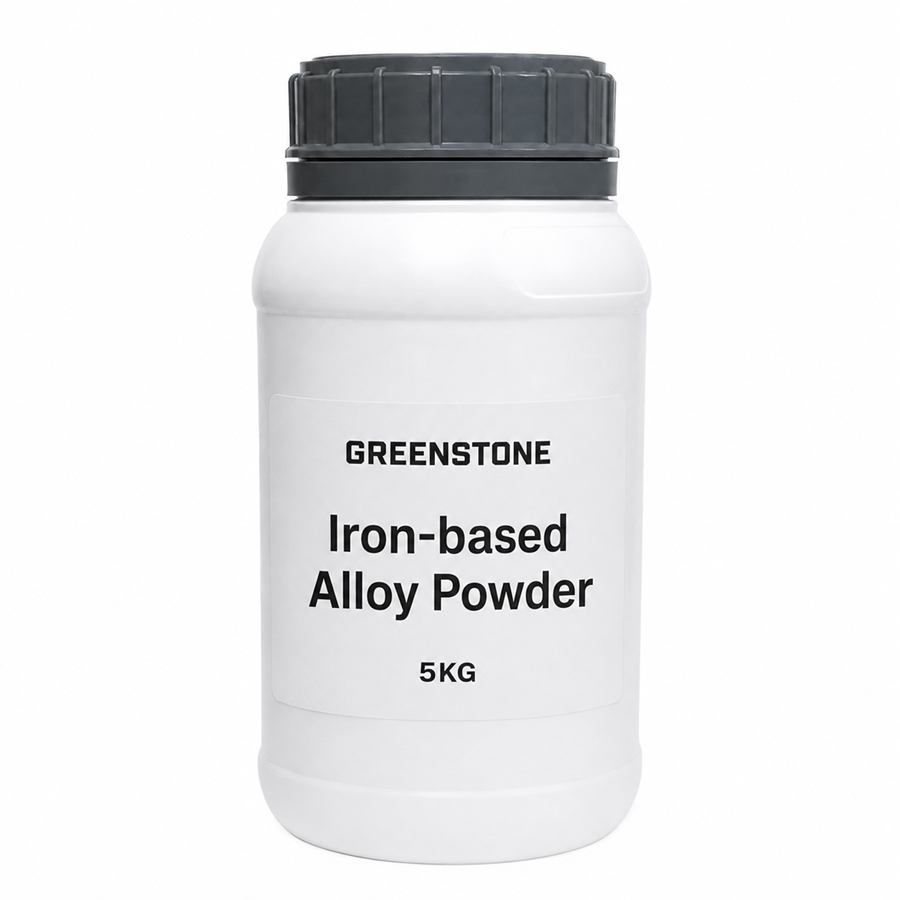
GREENSTONE supplies several major families of iron-based alloy powders for different industrial operating conditions.
Stainless Steel & Corrosion-Resistant Iron-Based Powders
Standard grades including 304, 316L, 17-4PH and 410L are suitable for applications requiring corrosion resistance, structural restoration and functional surface modification.
304 and 316L provide good general corrosion resistance and are widely used for chemical equipment, marine components, valves, pumps and industrial components. 316L, with molybdenum addition, provides improved resistance in chloride-containing environments.
17-4PH precipitation-hardening stainless steel combines corrosion resistance with relatively high strength and hardness and is suitable for industrial components requiring both mechanical performance and environmental resistance.
410L martensitic stainless steel powder is commonly considered for wear- and corrosion-resistant surface restoration, valves, machinery components and other engineering applications.
Fe-Cr-B-Si Self-Fluxing Alloy Powders
Fe-Cr-B-Si and related Fe-Cr-Ni-B-Si formulations are designed for surface engineering where higher hardness and wear resistance are required.
Chromium contributes to oxidation, corrosion and wear resistance, while boron and silicon improve melting behavior and help reduce oxide formation during deposition. Carbon and carbide-forming elements can be adjusted to develop harder microstructures for abrasive and sliding-wear environments.
These powders are particularly suitable for laser cladding, PTA hardfacing, thermal spray followed by remelting and industrial component remanufacturing.
High-Hardness & Wear-Resistant Iron-Based Powders
High-carbon and high-chromium Fe-based alloy systems can develop hard carbide-reinforced microstructures for severe wear conditions. Selected formulations may also incorporate Mo, V, W, Nb or Ni to optimize hardenability, toughness, corrosion resistance and high-temperature stability.
Typical applications include:
- Oil drilling and petroleum machinery
- Mining and mineral-processing components
- Agricultural wear parts
- Screws and extrusion components
- Shafts and rollers
- Valve components and valve seats
- Pumps and impellers
- Dies, molds and industrial tooling
- Heavy machinery repair
- Wear-resistant industrial surfaces
Optimized for Laser Cladding and DED
Powder morphology and particle-size distribution can be optimized for stable powder feeding and repeatable deposition. Common laser-cladding fractions include approximately 45–106 μm and 53–150 μm, while finer or coarser distributions can be supplied according to the deposition technology and powder feeder.
Suitable powder characteristics contribute to:
Stable Powder Feeding – Controlled particle-size distribution supports consistent delivery through coaxial and lateral powder-feeding systems.
Strong Metallurgical Bonding – Laser cladding and DED produce metallurgically bonded deposits with significantly stronger substrate adhesion than mechanically bonded coatings.
High Wear Resistance – Alloy chemistry can be selected for sliding, abrasive, erosive and combined wear conditions.
Corrosion Protection – Cr-, Ni- and Mo-containing iron-based alloys provide improved resistance to industrial corrosive environments.
Wide Hardness Range – Available alloy families cover relatively ductile stainless deposits through high-hardness wear-resistant layers.
Cost-Effective Surface Engineering – Iron-based materials are particularly attractive for large components and large-area cladding where nickel- or cobalt-based alloys may not be economically necessary.
Repair & Remanufacturing Capability – Suitable for restoring worn dimensions while simultaneously upgrading component surface properties.
Custom Alloy & Particle Size Options – Chemical composition and powder-size distribution can be selected according to substrate material, service environment, deposition process and required final properties.
| Product / Standard Grade | Alloy Type | Typical Key Composition | Typical Hardness* | Typical Particle Size | Recommended Process | Typical Applications |
|---|---|---|---|---|---|---|
| 304 Stainless Steel Powder | Austenitic Fe-Cr-Ni | Cr ~18%, Ni ~8–10.5%, Fe Bal. | Application dependent | 45–106 / 53–150 μm | Laser Cladding, DED, Thermal Spray | General industrial repair, corrosion-resistant surfaces, food-processing and machinery components |
| 316L Stainless Steel Powder | Austenitic Fe-Cr-Ni-Mo | Cr ~16–18%, Ni ~10–14%, Mo ~2–3%, Fe Bal. | Application dependent | 15–45 / 45–106 / 53–150 μm | DED, Laser Cladding, AM, Thermal Spray | Marine, chemical, valves, pumps, corrosion-resistant components |
| 17-4PH Stainless Steel Powder | Precipitation-Hardening Stainless Steel | Cr ~15–17.5%, Ni ~3–5%, Cu ~3–5%, Nb/Ta addition | ~36–44 HRC after suitable heat treatment** | 15–45 / 45–106 / 53–150 μm | DED, Laser Cladding, Metal AM | Oil & gas, tooling, shafts, valves, industrial components |
| 410L Stainless Steel Powder | Martensitic Stainless Steel | Cr ~11.5–13.5%, low C, Fe Bal. | Process dependent | 45–106 / 53–150 μm | Laser Cladding, Thermal Spray | Valves, machinery parts, wear/corrosion restoration |
| Fe-Cr-Ni-B-Si Alloy Powder | Self-Fluxing Iron-Based Alloy | Fe-Cr-Ni-B-Si | ~20–60 HRC | 45–106 / 53–150 μm | Laser Cladding, PTA, Thermal Spray | Shafts, rollers, molds, valves, general remanufacturing |
| Fe-Cr-B-Si Alloy Powder | Self-Fluxing Wear-Resistant Alloy | Fe-Cr-B-Si-C | ~30–65 HRC | 45–106 / 53–150 μm | Laser Cladding, PTA, Spray & Fuse | Wear parts, machinery, agricultural components, tooling |
| High-Cr Fe-Based Alloy Powder | High-Wear Iron Alloy | Fe-Cr-C with optional B/Si/Mo | ~50–65+ HRC | 45–106 / 53–150 μm | Laser Cladding, PTA | Mining, oilfield tools, agricultural machinery, severe wear surfaces |
| Fe-Cr-Mo Alloy Powder | Wear & Corrosion Resistant Iron Alloy | Fe-Cr-Mo based | ~35–60 HRC | 45–106 / 53–150 μm | Laser Cladding, DED, PTA | Pumps, valves, petrochemical components, industrial repair |
| Fe-Cr-V Alloy Powder | Carbide-Strengthened Iron Alloy | Fe-Cr-V-C | ~55–65 HRC | 45–106 / 53–150 μm | Laser Cladding, PTA | Cutting/wear surfaces, agricultural parts, mining components |
| Fe-Cr-W Alloy Powder | High-Wear Iron Alloy | Fe-Cr-W-C | ~58–67 HRC | 45–106 / 53–150 μm | Laser Cladding, PTA | Severe abrasive wear, oilfield and mining components |
| Fe-Ni-Cr Alloy Powder | Toughness & Corrosion Resistant Iron Alloy | Fe-Ni-Cr based | ~20–55 HRC | 45–106 / 53–150 μm | Laser Cladding, DED | Industrial repair, valves, shafts, corrosion/wear surfaces |
| Custom Fe-Based Alloy Powder | Application-Specific Alloy | Fe-Cr-Ni-Mo-B-Si-C-V-W-Nb systems | Up to ~65+ HRC | Customized | Laser Cladding, DED, PTA, Thermal Spray | Application-specific wear, corrosion and remanufacturing solutions |
* Hardness values are typical reference ranges rather than guaranteed values. Final coating hardness depends on chemical composition, substrate material, dilution ratio, deposition parameters, cooling rate, layer thickness and post-processing.
* For precipitation-hardening alloys such as 17-4PH, final mechanical properties depend strongly on heat-treatment condition.
Available Powder Size Options
| Powder Size | Typical Application |
|---|---|
| 15–45 μm | Metal additive manufacturing and selected fine-powder processes |
| 20–53 μm | Metal AM / fine deposition applications |
| 45–106 μm | Laser cladding and powder-fed DED |
| 53–150 μm | Laser cladding, DED and PTA |
| 75–150 μm | PTA and selected hardfacing processes |
| Customized Distribution | Available according to equipment, powder feeder and process requirements |
Recommended Advanced Manufacturing Solutions
Explore Greenstone’s related portfolio of high-performance industrial equipment, engineered to complement your manufacturing objectives across laser cladding, DED additive manufacturing, laser cleaning, surface engineering, precision automation, and advanced material processing. Each solution is strategically designed to expand production capabilities, enhance process efficiency, and support scalable industrial innovation.
From modular laser systems to fully integrated intelligent manufacturing platforms, Greenstone provides customers with interconnected technologies that deliver greater flexibility, precision, and operational excellence for modern global manufacturing environments.


