
High-Performance Soft Magnetic Alloy Powders for Inductors, Power Electronics, EV, Energy Storage & Magnetic Powder Cores
Product Overview
Fe-Si, Fe-Si-Cr, Fe-Si-Ni, Fe-Ni, Fe-Ni-Mo and Fe-Si-B Soft Magnetic Metal Powders for High-Frequency Inductors, Chokes, Magnetic Cores and Power Conversion Systems
GREENSTONE High-Performance Soft Magnetic Alloy Powders are engineered for the production of magnetic powder cores, molded inductors, power inductors, chokes, transformers and high-frequency magnetic components used in modern power electronics.
The product portfolio includes Fe-Si, Fe-Si-Cr, Fe-Si-Ni, Fe-Ni, Fe-Ni-Mo and Fe-Si-B amorphous alloy powder systems, providing different combinations of permeability, saturation magnetic flux density, core loss, DC bias capability, electrical resistivity and frequency performance.
Through controlled alloy composition, powder morphology and particle-size distribution, GREENSTONE soft magnetic powders can provide stable electromagnetic performance for applications ranging from conventional industrial power supplies to high-frequency and high-power-density electronic systems.
Typical application industries include electric vehicles (EV/HEV), automotive electronics, renewable energy, photovoltaic inverters, energy storage systems (ESS), charging infrastructure, data centers, telecommunications, consumer electronics, industrial automation and high-frequency power conversion equipment.
Particle size, alloy composition and magnetic characteristics can be optimized according to the customer’s powder-core manufacturing process and target electrical performance.
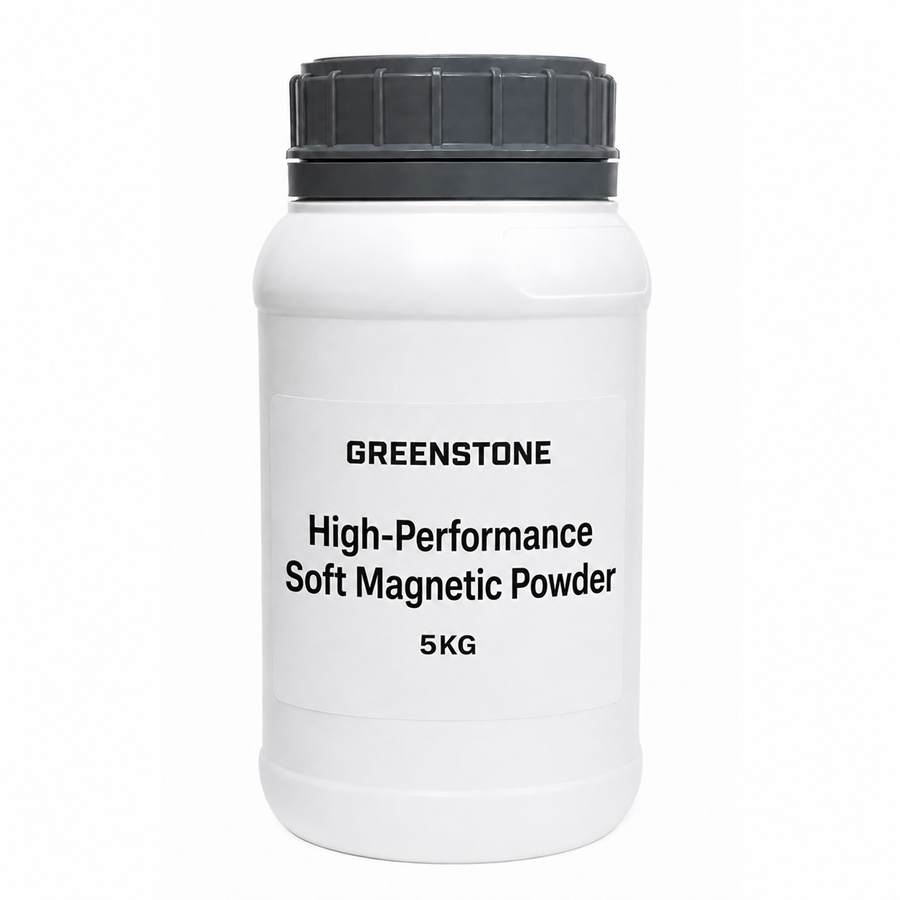
Fe-Si Soft Magnetic Powder
Fe-Si is one of the fundamental iron-based soft magnetic material systems. Silicon increases electrical resistivity and helps reduce eddy-current losses compared with pure iron, while maintaining relatively high saturation magnetic flux density.
GREENSTONE Fe-Si powders are suitable for magnetic powder cores, inductors, reactors, filters and general industrial power-electronics components where high saturation performance and cost efficiency are important.
Typical silicon levels can be selected around 3–7 wt.%, depending on the required balance between magnetic performance, resistivity and processing characteristics.
Fe-Si-Cr Soft Magnetic Powder
Fe-Si-Cr powder combines the magnetic properties of Fe-Si alloys with chromium additions that improve electrical resistivity, oxidation resistance, corrosion resistance and powder insulation compatibility.
Typical GREENSTONE Fe-Si-Cr systems contain approximately 3–8.5 wt.% Si and 1–6 wt.% Cr, depending on the required magnetic characteristics.
These powders are particularly suitable for molded power inductors, integrated inductors, high-current chokes and compact electronic magnetic components.
Applications include automotive electronics, telecommunications, servers, DC-DC converters, power supplies and other compact high-frequency electronic systems.
Fe-Si-Ni Soft Magnetic Powder
Fe-Si-Ni alloys provide a balanced combination of permeability, saturation characteristics, DC bias performance and core-loss control.
They can be used for power inductors, magnetic cores, filters and high-frequency power conversion components where improved electromagnetic stability is required.
Typical applications include EV power electronics, charging systems, renewable-energy converters, industrial power supplies and high-current electronic systems.
Fe-Ni Soft Magnetic Powder
Fe-Ni soft magnetic alloys are known for their high magnetic permeability and low magnetic loss characteristics.
Depending on nickel content, their magnetic behavior can be tailored for applications requiring enhanced permeability and controlled core loss.
GREENSTONE Fe-Ni powders are suitable for precision inductive components, magnetic powder cores, filters, current-related magnetic components and high-frequency power electronics.
Fe-Ni-Mo Soft Magnetic Powder
Fe-Ni-Mo alloy systems provide excellent soft magnetic characteristics, particularly where high permeability, low core loss and stable frequency performance are required.
These materials are commonly associated with high-performance powder-core applications used in telecommunications, aerospace electronics, precision power supplies, high-frequency filters and advanced power-conversion systems.
They are particularly suitable for applications where electromagnetic efficiency takes priority over raw-material cost.
Fe-Si-B Amorphous Soft Magnetic Powder
Fe-Si-B amorphous alloy powders feature a non-crystalline atomic structure that can significantly reduce magnetic hysteresis and eddy-current losses.
The combination of low core loss, high electrical resistivity and good high-frequency characteristics makes amorphous soft magnetic powder suitable for high-efficiency power conversion.
Typical applications include high-frequency inductors, PFC chokes, renewable-energy converters, EV power electronics, energy-storage systems and high-efficiency switching power supplies.
Key Advantages
High Saturation Magnetic Flux Density
Selected iron-based alloy systems provide high saturation performance for high-current and high-power-density applications.
Low Core Loss
Optimized Fe-Ni-Mo and amorphous alloy systems can provide particularly low core loss for high-frequency power conversion.
Excellent DC Bias Performance
Suitable material systems maintain stable inductance under increasing DC magnetization, making them suitable for high-current inductors and power chokes.
Controlled Permeability
Different alloy systems can provide permeability ranges suitable for a wide variety of magnetic core designs.
High-Frequency Capability
Controlled particle size and increased electrical resistivity help suppress eddy-current losses at elevated operating frequencies.
Fine and Controlled Particle Distribution
Different powder grades are available for molded inductors, pressed powder cores and other magnetic-component manufacturing processes.
Multiple Soft Magnetic Alloy Families
GREENSTONE provides Fe-Si, Fe-Si-Cr, Fe-Si-Ni, Fe-Ni, Fe-Ni-Mo and amorphous Fe-Si-B materials under one product platform.
Application-Specific Customization
Chemical composition, particle size, apparent density and magnetic characteristics can be adjusted according to the customer’s manufacturing process and target electrical specifications.
| Material System | Typical Composition / Characteristics | Typical Powder Size | Key Magnetic Characteristics | Typical Applications |
|---|---|---|---|---|
| Fe-Si | Fe balance, Si approx. 3–7 wt.% | D50 approx. 9–70 μm* | High saturation, good DC bias, economical | Inductors, reactors, magnetic powder cores |
| Fe-Si-Cr | Fe balance, Si approx. 3–8.5%, Cr approx. 1–6% | D50 approx. 9–50 μm* | High resistivity, good saturation, reduced eddy-current loss | Molded inductors, power chokes, automotive electronics |
| Fe-Si-Ni | Fe balance, Si approx. 6–7%, Ni approx. 1–3% | D50 approx. 50–70 μm* | Balanced permeability and DC bias | Power inductors, filters, power conversion |
| Fe-Ni | Fe-Ni alloy system; Ni content selected by magnetic requirement | D50 approx. 45–60 μm* | High permeability, low magnetic loss | Precision magnetic cores, filters, inductors |
| Fe-Ni-Mo | Fe-Ni-Mo alloy system | D50 approx. 65–80 μm* | High permeability, very low core loss | High-performance powder cores, telecom, precision electronics |
| Fe-Si-B Amorphous | Fe-Si-B amorphous alloy | Typically customized | Low hysteresis loss, high resistivity, good high-frequency performance | PFC chokes, EV, ESS, high-frequency power electronics |
*Particle-size distribution is application dependent and can be customized.
Typical Fe-Si-Cr Powder Parameters
| Parameter | Typical Range |
|---|---|
| Fe | Balance |
| Si | 3.0–8.5 wt.% |
| Cr | 1.0–6.0 wt.% |
| Ni | ≤0.20 wt.% for selected compositions |
| C | ≤0.03 wt.% |
| Oxygen | Approx. ≤0.06–0.30 wt.% depending on grade |
| D10 | Approx. 3.0–5.0 μm |
| D50 | Approx. 9.0–12.0 μm for fine grades |
| D90 | Approx. 18.5–28.0 μm |
| Typical Permeability | Approx. 30–35 |
| Typical Saturation Flux Density (Bs) | Approx. 120–130, based on original reference test system |
| Insulation / Rust Resistance | Good to excellent |
Typical Powder-Core Performance
| Material System | Typical Permeability Range | Typical DC Bias Retention* | Relative Core-Loss Performance | Recommended Application |
|---|---|---|---|---|
| Fe-Si | 26–90 | Approx. 68–73% | Standard | General power inductors and reactors |
| Fe-Si-Cr | 26–60 | Approx. 70% | Medium-Low | Molded inductors and high-frequency power electronics |
| Fe-Si-Ni | 60–130 | Approx. 82% | Low | High-current power conversion |
| Fe-Ni | 60–180 | Approx. 85% | Very Low | Precision and high-efficiency magnetic components |
| Fe-Ni-Mo | 60–300 | Approx. 85% | Very Low | Premium low-loss magnetic powder cores |
| Fe-Si-B Amorphous | Application dependent | Application dependent | Very Low | High-frequency and high-efficiency conversion |
*Actual DC bias performance depends on permeability, core geometry, compaction density, insulation treatment and test conditions.
General Technical Specifications
| Parameter | GREENSTONE Specification |
|---|---|
| Product Category | High-Performance Soft Magnetic Alloy Powder |
| Material Families | Fe-Si, Fe-Si-Cr, Fe-Si-Ni, Fe-Ni, Fe-Ni-Mo, Fe-Si-B Amorphous |
| Powder Morphology | Spherical / Near-Spherical / Application-Specific |
| Particle Size | Fine and medium particle distributions available |
| Particle Size Customization | Available |
| Primary Magnetic Characteristics | High Permeability, High Saturation, Low Core Loss, Good DC Bias |
| Typical Manufacturing Processes | Powder Core Pressing, Molded Inductor Manufacturing, Insulated Magnetic Powder Processing |
| Typical Components | Power Inductors, Chokes, Reactors, Filters, Magnetic Powder Cores |
| Primary Industries | EV/HEV, Energy Storage, Solar, Power Electronics, Telecom, Data Centers, Industrial Electronics |
| Composition Customization | Available according to magnetic and processing requirements |
| Brand | GREENSTONE |
Technical Note: Magnetic properties such as permeability, core loss, saturation flux density and DC bias are not fixed powder constants. They are affected by alloy composition, particle-size distribution, insulation treatment, compaction pressure, annealing, core geometry, operating frequency and test conditions. Final specifications should therefore be confirmed according to the customer’s target magnetic component.
Recommended Advanced Manufacturing Solutions
Explore Greenstone’s related portfolio of high-performance industrial equipment, engineered to complement your manufacturing objectives across laser cladding, DED additive manufacturing, laser cleaning, surface engineering, precision automation, and advanced material processing. Each solution is strategically designed to expand production capabilities, enhance process efficiency, and support scalable industrial innovation.
From modular laser systems to fully integrated intelligent manufacturing platforms, Greenstone provides customers with interconnected technologies that deliver greater flexibility, precision, and operational excellence for modern global manufacturing environments.


