
Aluminum Alloy Metal Powder for Laser DED, Additive Manufacturing, Aerospace, Automotive & Industrial Applications
Product Overview
GREENSTONE Aluminum Alloy Metal Powder
GREENSTONE aluminum alloy metal powders are high-quality spherical powders developed for metal additive manufacturing, laser Directed Energy Deposition (DED), laser cladding, powder metallurgy and advanced industrial manufacturing. The product range includes widely used aluminum-silicon and high-strength aluminum alloys such as AlSi10Mg, AlSi12, 6061, 7050 and 7075, providing material solutions for applications requiring low density, high specific strength, good corrosion resistance and excellent manufacturing performance.
Produced using controlled atomization and powder classification processes, GREENSTONE aluminum alloy powders feature high sphericity, controlled particle size distribution, low oxygen content and excellent powder flowability. Different particle size ranges can be supplied according to the requirements of laser DED, laser cladding, powder bed fusion and other powder-based manufacturing processes.
Aluminum alloy powders combine lightweight characteristics with good thermal conductivity, corrosion resistance and mechanical performance, making them particularly suitable for aerospace structures, aircraft components, automotive lightweight parts, marine engineering, industrial machinery, heat-management components, tooling, prototyping and metal additive manufacturing applications.
GREENSTONE can also provide customized particle size distributions and alloy compositions according to specific equipment, process and application requirements.
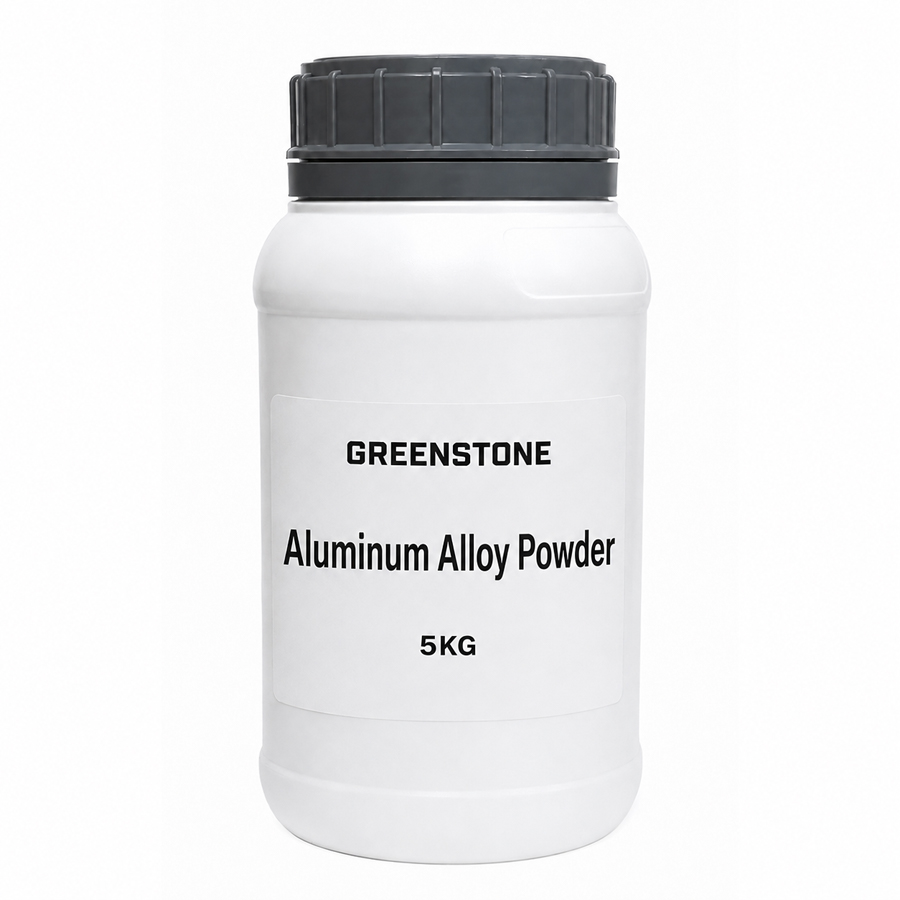
Aluminum Alloy Powder for Advanced Manufacturing
Aluminum alloys are among the most important lightweight structural materials used in modern industry. With a density of approximately 2.7 g/cm³, aluminum is significantly lighter than steels and nickel-based alloys while providing an excellent strength-to-weight ratio.
GREENSTONE aluminum alloy powders are designed to provide stable powder delivery, consistent melting behavior and reliable processing performance for advanced laser and additive manufacturing systems.
High Sphericity and Excellent Powder Flowability
Controlled atomization produces highly spherical powder particles with smooth surfaces and good flow characteristics. Stable powder flow is especially important for laser DED and powder-fed laser processing, where consistent powder delivery directly affects deposition stability, layer geometry and material utilization.
Low Oxygen and Controlled Impurities
Aluminum powder is highly reactive with oxygen. GREENSTONE therefore applies controlled production and handling processes to minimize oxidation and maintain stable powder quality.
Typical oxygen levels can be controlled according to alloy grade, particle size and application requirements. Low oxygen content contributes to improved melting behavior, reduced oxide-related defects and better metallurgical performance.
Controlled Particle Size Distribution
Multiple particle size ranges are available for different manufacturing processes, including:
- 15–45 μm – suitable for fine powder additive manufacturing applications
- 15–53 μm – commonly used for laser powder bed fusion
- 45–105 μm – suitable for selected laser DED and powder-fed processes
- 53–150 μm – widely applicable to laser DED and laser cladding
- 105–250 μm – available for specialized deposition and powder metallurgy applications
Customized particle size distributions can be supplied according to the powder feeder, nozzle design and laser processing requirements.
Excellent Lightweight Performance
Aluminum alloys provide an outstanding combination of low density and mechanical strength. High-strength grades such as 7050 and 7075 are particularly attractive for structural applications where weight reduction is critical.
Good Corrosion Resistance
Many aluminum alloys naturally develop a protective oxide layer that provides good resistance to atmospheric corrosion. This makes selected aluminum alloy powders suitable for components used in transportation, marine, industrial and outdoor environments.
Good Thermal Conductivity
The relatively high thermal conductivity of aluminum alloys makes them suitable for thermal-management components, heat exchangers, cooling structures and lightweight components requiring efficient heat dissipation.
Multiple Alloy Families
GREENSTONE supplies different aluminum alloy powder families for different engineering requirements:
AlSi10Mg offers excellent castability, good processability and a favorable balance between strength and ductility. It is widely used for complex additive-manufactured components.
AlSi12 contains a higher silicon level and provides excellent fluidity and manufacturing characteristics, making it suitable for geometrically complex parts.
6061 is a versatile Al-Mg-Si alloy offering good corrosion resistance, moderate-to-high strength and broad industrial applicability.
7050 is a high-strength Al-Zn-Mg-Cu alloy developed for demanding structural applications requiring high strength and good resistance to stress-corrosion cracking.
7075 is one of the best-known high-strength aluminum alloys and provides an excellent strength-to-weight ratio for aerospace, transportation and high-performance engineering components.
Optimized for Multiple Powder-Based Processes
Depending on alloy chemistry and particle size specification, GREENSTONE aluminum alloy powders can be supplied for:
Laser Directed Energy Deposition (DED), Laser Cladding, Laser Metal Deposition (LMD), Laser Powder Bed Fusion (LPBF), Selective Laser Melting (SLM), Powder Metallurgy, Metal Injection and Advanced R&D Applications.
Because aluminum alloys differ substantially in laser absorptivity, solidification behavior and cracking susceptibility, the appropriate powder grade and processing window should be selected according to the specific manufacturing process.
| Alloy Grade | Al | Si (%) | Mg (%) | Cu (%) | Zn (%) | Fe (%) | Mn (%) | Cr (%) | Typical Particle Size | Typical Applications |
|---|---|---|---|---|---|---|---|---|---|---|
| AlSi10Mg | Bal. | 9.0–11.0 | 0.20–0.45 | ≤0.05 | ≤0.10 | ≤0.55 | ≤0.45 | — | 15–45 / 15–53 / 45–105 μm | Aerospace components, automotive lightweight parts, heat exchangers, complex AM components |
| AlSi12 | Bal. | 11.0–13.0 | ≤0.10 | ≤0.05 | ≤0.10 | ≤0.55 | ≤0.35 | — | 15–45 / 15–53 / 45–105 μm | Thin-wall components, complex geometries, automotive parts, industrial additive manufacturing |
| 6061 | Bal. | 0.40–0.80 | 0.80–1.20 | 0.15–0.40 | ≤0.25 | ≤0.70 | ≤0.15 | 0.04–0.35 | 15–53 / 45–105 / 53–150 μm | Automotive, marine, industrial structures, machinery and lightweight components |
| 7050 | Bal. | ≤0.12 | 1.9–2.6 | 2.0–2.6 | 5.7–6.7 | ≤0.15 | ≤0.10 | ≤0.04 | 15–53 / 45–105 / 53–150 μm | Aerospace structures, high-strength structural parts and engineering applications |
| 7075 | Bal. | ≤0.40 | 2.1–2.9 | 1.2–2.0 | 5.1–6.1 | ≤0.50 | ≤0.30 | 0.18–0.28 | 15–53 / 45–105 / 53–150 μm | Aerospace, high-performance automotive, structural components and lightweight engineering |
Powder Physical Properties
| Parameter | Typical Specification |
|---|---|
| Material Type | Aluminum Alloy Metal Powder |
| Powder Morphology | Spherical / Highly Spherical |
| Typical Particle Size | 15–45 μm, 15–53 μm, 45–105 μm, 53–150 μm, 105–250 μm |
| Particle Size Customization | Available upon request |
| Powder Production | Controlled Atomization and Classification |
| Apparent Density | Alloy and particle-size dependent |
| Flowability | Optimized for powder feeding and additive manufacturing |
| Oxygen Content | Controlled according to alloy grade and particle size |
| Purity | Controlled according to alloy specification |
| Packaging | Sealed moisture-resistant packaging; customized packaging available |
| Applicable Processes | Laser DED, LMD, Laser Cladding, LPBF/SLM, Powder Metallurgy and R&D |
| Customization | Alloy chemistry and particle size distribution available upon request |
Note: Chemical compositions shown above represent commonly used nominal or specification ranges for the respective alloy families. Exact composition, oxygen level, particle size distribution, apparent density and flowability should be confirmed according to the required international standard, manufacturing process and individual batch Certificate of Analysis (CoA).
Recommended Advanced Manufacturing Solutions
Explore Greenstone’s related portfolio of high-performance industrial equipment, engineered to complement your manufacturing objectives across laser cladding, DED additive manufacturing, laser cleaning, surface engineering, precision automation, and advanced material processing. Each solution is strategically designed to expand production capabilities, enhance process efficiency, and support scalable industrial innovation.
From modular laser systems to fully integrated intelligent manufacturing platforms, Greenstone provides customers with interconnected technologies that deliver greater flexibility, precision, and operational excellence for modern global manufacturing environments.


