
Greenstone RoboClad Robotic Laser Cladding & Laser Metal Deposition (LMD) Cell for Mold Repair
Presentation of the equipment's characteristics
The Greenstone GST RoboClad 3D Mold Laser Cladding System is an industrial robotic laser metal deposition (LMD) / laser cladding solution designed specifically for 3D mold surface strengthening, refurbishment, and precision repair. Built around an 8–10 axis coordinated motion architecture, the system combines a high-power fiber laser, cladding head, powder feeding unit, and robot + positioner into an integrated cell that supports complex curved surfaces, deep contours, edges, and multi-angle features commonly found on stamping molds, casting molds, plastic injection molds, and wear-critical tooling.
To meet real-world production demand, the platform supports dual-station and multi-station configurations for higher throughput and better line balancing—ideal for factories that need stable, repeatable cladding quality across batches while reducing downtime and manual rework. With an integrated compact structure and a small footprint, the GST RoboClad is suitable for both new production lines and retrofit upgrades. It is also designed for future expansion: the system architecture can be upgraded to support deposition-type 3D printing (DED) functions for advanced repair or additive manufacturing workflows.
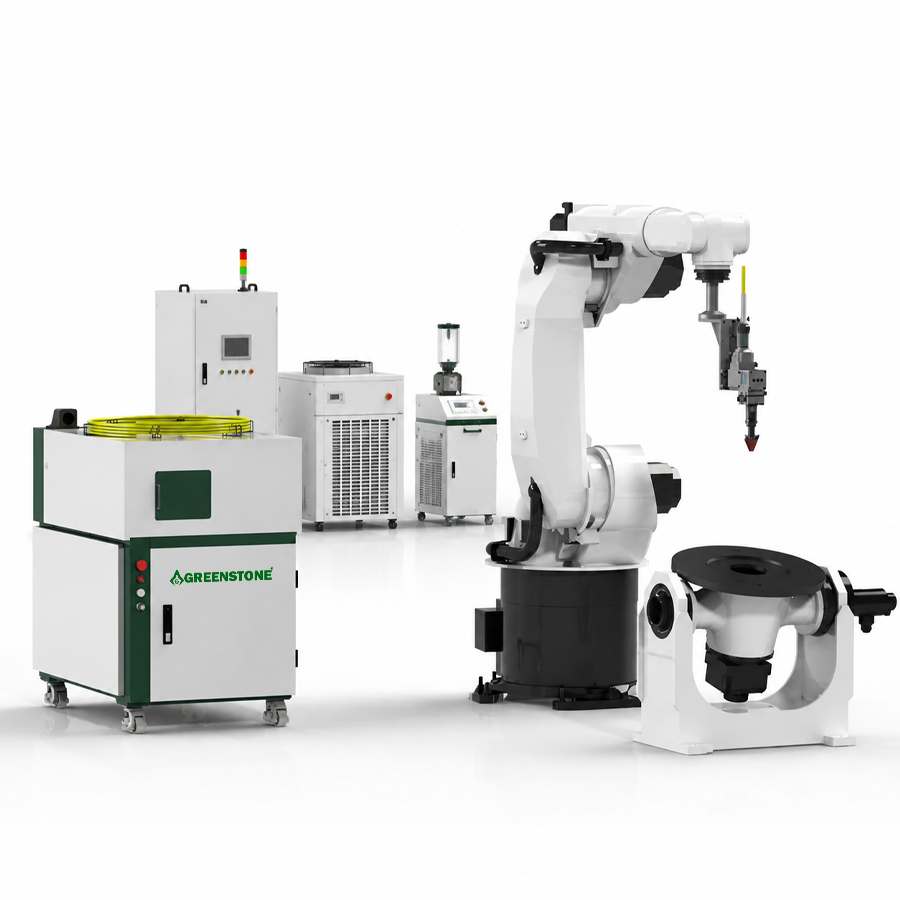
• 8–10 Axis Coordinated Motion for complex 3D molds
The robotic + positioner configuration enables multi-angle access, stable bead formation, and consistent overlap control on irregular mold surfaces—supporting high-quality hardfacing and dimensional restoration.
• Dual-station / Multi-station options for production efficiency
Expandable workstation layouts allow parallel loading/unloading and continuous operation, increasing utilization for mold repair shops and high-mix manufacturing lines.
• Purpose-built for mold strengthening & repair
Optimized for mold surface enhancement and refurbishment—helping extend tool life, reduce replacement cost, and restore worn or damaged areas with controlled heat input.
• Integrated compact cell, small footprint
All key components are integrated into a unified structure for easier installation, easier relocation, and improved workshop space efficiency.
• Flexible powder feeding (3-channel / 6-channel) & single/dual hopper options
Supports different powder delivery strategies and process windows, helping users adapt to varying cladding materials, bead widths, and productivity requirements.
• Siemens S7-1500 electrical/control platform
Industrial-grade reliability and maintainability, suitable for long-cycle, high-duty production environments.
• Future-ready upgrade path to DED (deposition 3D printing)
Designed so customers can expand capabilities as demand grows—from repair and strengthening to additive deposition applications.
| Model (GST-) | Laser Power | Fiber System | Laser Cladding Head | Powder Feeding Mode | Electrical System | Powder Feeding System | Motion System |
|---|---|---|---|---|---|---|---|
| GST-3000LB | 3 kW | 600 μm, 20 m | GR40LD | 3-channel / 6-channel | Siemens S7-1500 | Single hopper / Dual hopper | Robot + Positioner |
| GST-4000LB | 4 kW | 600 μm, 20 m | GR40LD | 3-channel / 6-channel | Siemens S7-1500 | Single hopper / Dual hopper | Robot + Positioner |
| GST-6000LB | 6 kW | 600 μm, 20 m | GR60LD | 3-channel / 6-channel | Siemens S7-1500 | Single hopper / Dual hopper | Robot + Positioner |
| GST-9000LB | 9 kW | 800 μm, 20 m | GR100LR | 3-channel / 6-channel | Siemens S7-1500 | Single hopper / Dual hopper | Robot + Positioner |
Recommended Advanced Manufacturing Solutions
Explore Greenstone’s related portfolio of high-performance industrial equipment, engineered to complement your manufacturing objectives across laser cladding, DED additive manufacturing, laser cleaning, surface engineering, precision automation, and advanced material processing. Each solution is strategically designed to expand production capabilities, enhance process efficiency, and support scalable industrial innovation.
From modular laser systems to fully integrated intelligent manufacturing platforms, Greenstone provides customers with interconnected technologies that deliver greater flexibility, precision, and operational excellence for modern global manufacturing environments.


