Przegląd aplikacji
W produkcji lotniczej silnik lotniczy jest “sercem” samolotu, a jego gorące elementy pracują w ekstremalnie wysokich temperaturach, pod wysokim ciśnieniem i przy dużych prędkościach obrotowych. Krytyczne części, takie jak łopatki turbin, muszą działać stabilnie w temperaturach gazu przekraczających temperaturę topnienia stopu. Ich precyzja obróbki i niezawodność bezpośrednio wpływają na ogólną wydajność i żywotność silnika.
Tradycyjne procesy obróbki skrawaniem napotykają na poważne ograniczenia podczas produkcji precyzyjnych struktur, takich jak otwory do chłodzenia folią i mikro otwory do rozpylania paliwa. Wiercenie mechaniczne może spowodować złamanie narzędzia i uszkodzenie ścianki otworu, podczas gdy EDM cierpi z powodu zużycia elektrody i niskiej wydajności. Słaba kontrola efektu termicznego może prowadzić do mikropęknięć, nadmiernych warstw odlewniczych i innych defektów, znacznie zmniejszając wytrzymałość zmęczeniową i zagrażając bezpieczeństwu pracy.
Ponieważ stosunek ciągu do masy i wymagania dotyczące wydajności termicznej stale rosną, precyzja chłodzenia powietrzem staje się coraz bardziej krytyczna, a tradycyjne metody nie mogą zapewnić jakości i wydajności wymaganej dla gęstych macierzy mikrootworów. Dlatego też opracowanie wysoce precyzyjnej, mało szkodliwej i wysokowydajnej technologii mikro-wiercenia stało się niezbędne, aby spełnić wysokie wymagania dotyczące struktury chłodzenia silników lotniczych nowej generacji.


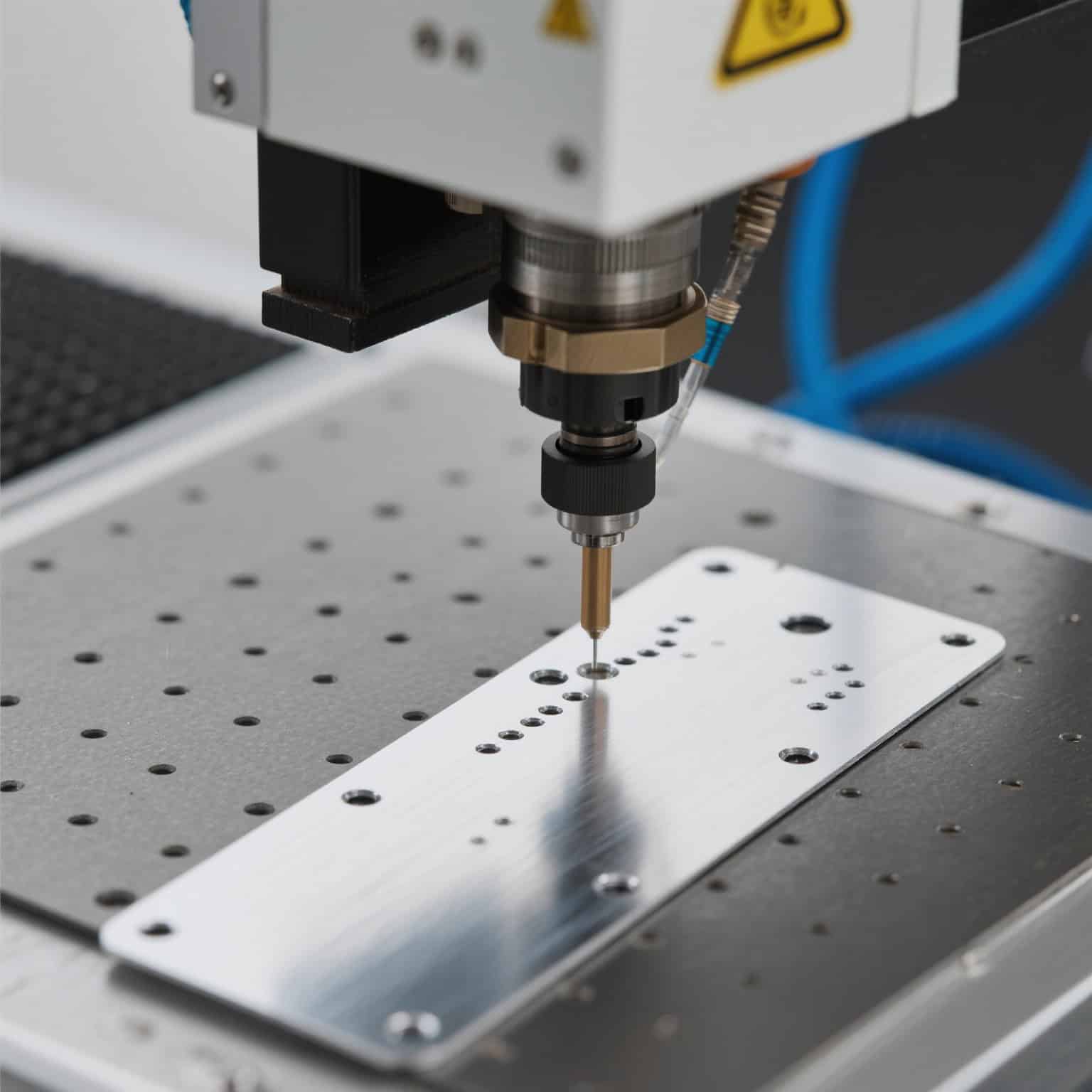
Case Study 1: Film-Cooling Hole Drilling for Aero-Engine Turbine Blades
Wyzwanie techniczne
Turbine blades operate in extreme high-temperature and high-pressure environments, with surface temperatures exceeding 1600 °C—far beyond the material’s inherent limit. Traditional mechanical drilling struggles with micro-holes below a 20° inclination angle, leading to frequent tool breakage, large burrs, and thick recast layers. These defects significantly reduce blade fatigue life and compromise operational safety.
Innowacyjne rozwiązanie
Ultraviolet laser micro-drilling system (355 nm wavelength)
Five-axis precision motion platform with real-time visual alignment
Dedicated process database covering various hole geometries and parameters
Capability to produce 0.2–0.5 mm film-cooling holes with a depth-to-diameter ratio of 15:1
Przełomowe procesy
Drilling efficiency up to 15 holes/second with ±10 μm positional accuracy
Recast layer thickness controlled within 5 μm
Exit burr height less than 8 μm
Stable machining of 3,000+ film-cooling holes on single-crystal turbine blades
This advanced UV-laser micro-drilling technology delivers exceptional precision, efficiency, and surface quality, meeting the demanding thermal-management requirements of next-generation jet engines.


Case Study 2: Multi-Layer Combustor Wall Micro-Hole Array for Aero Engines
Tło aplikacji
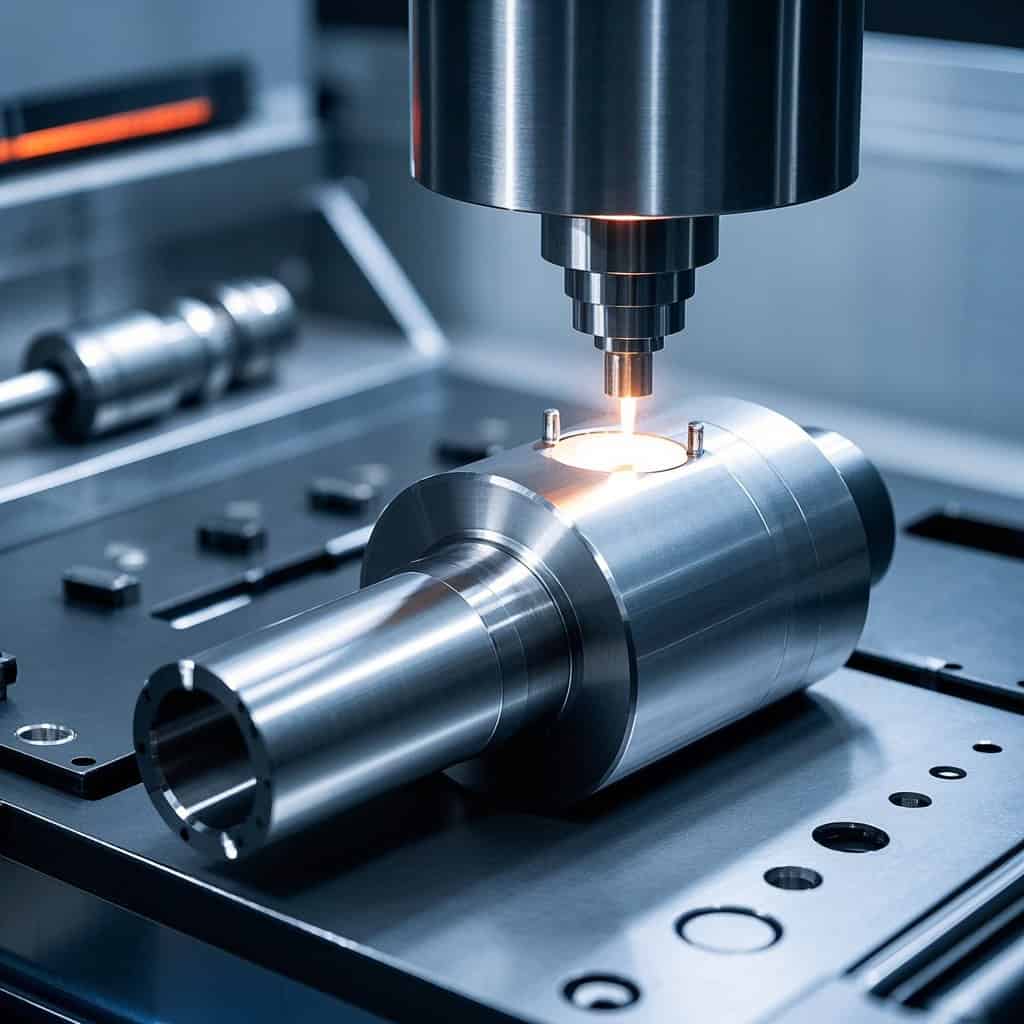
A multi-layer film-cooling combustor structure required machining over 50,000 micro-holes in 0.8 mm-thick Hastelloy X plates to form an efficient cooling film.
Właściwości techniczne
Femtosecond laser ultra-fast micro-machining
Custom beam-splitting optics enabling 32-hole simultaneous drilling
Real-time quality monitoring and adaptive compensation
Active hole-shape control algorithms for film-cooling geometry
Wyniki jakościowe
98.5% process uniformity
Heat-affected zone < 2 μm
Hole taper controlled within ±1°
Overall manufacturing cycle reduced by 40%
Case Study 3: Precision Micro-Holes for Aero Fuel Nozzles
Wymagania techniczne
Fuel-nozzle micro-holes (0.1–0.3 mm diameter) directly affect atomization quality and combustion efficiency. Traditional EDM suffers from electrode wear and low productivity.
Innowacje procesowe
Green-laser precision drilling system
Adaptive multi-parameter matching control
High aspect-ratio micro-holes up to 20:1
Integrated in-line diameter measurement and closed-loop control
Performance Improvements
Atomization uniformity improved by 25%
Combustion efficiency increased by 3%
Yield rate improved from 85% to 99%
Per-part machining cost reduced by 35%
Case Study 4: Thermal-Management Micro-Channels for Avionics
Thermal Challenge
An airborne phased-array radar T/R module required machining 32 micro-channels (0.15 mm × 0.3 mm) inside a Cu-W alloy base (15 mm height, 8 mm width), beyond the capability of traditional methods.
Przełom techniczny
Spiral laser micro-drilling strategy
Short-pulse fiber-laser processing
Deep-hole straightness error < 0.5° per 100 mm
High-pressure assist-gas debris-removal system
Thermal Performance
Heat-dissipation power density up to 150 W/cm²
Temperature rise reduced by 40 K
Device reliability improved three-fold
Successfully passed 2,000-hour endurance validation
Podsumowanie wartości technologii
Laser precision micro-drilling offers unique advantages in aerospace manufacturing:
Breaks conventional machining limits to achieve extreme aspect-ratio micro-holes
Exceptional performance on superalloys, composites, and other difficult-to-machine materials
No tool wear, enabling superior stability and repeatability
Provides critical manufacturing capability for performance and reliability enhancement in aerospace systems
These achievements demonstrate that laser micro-hole machining has evolved into an indispensable core process in aerospace precision manufacturing, delivering irreplaceable benefits in performance enhancement and cost reduction.