


Ultraszybkie napawanie laserowe
Zapewnienie klientom kompleksowych rozwiązań w zakresie technologii napawania laserowego, aby sprostać wyższym wymaganiom klientów w zakresie zaawansowanej technologii produkcji.
Przegląd usług
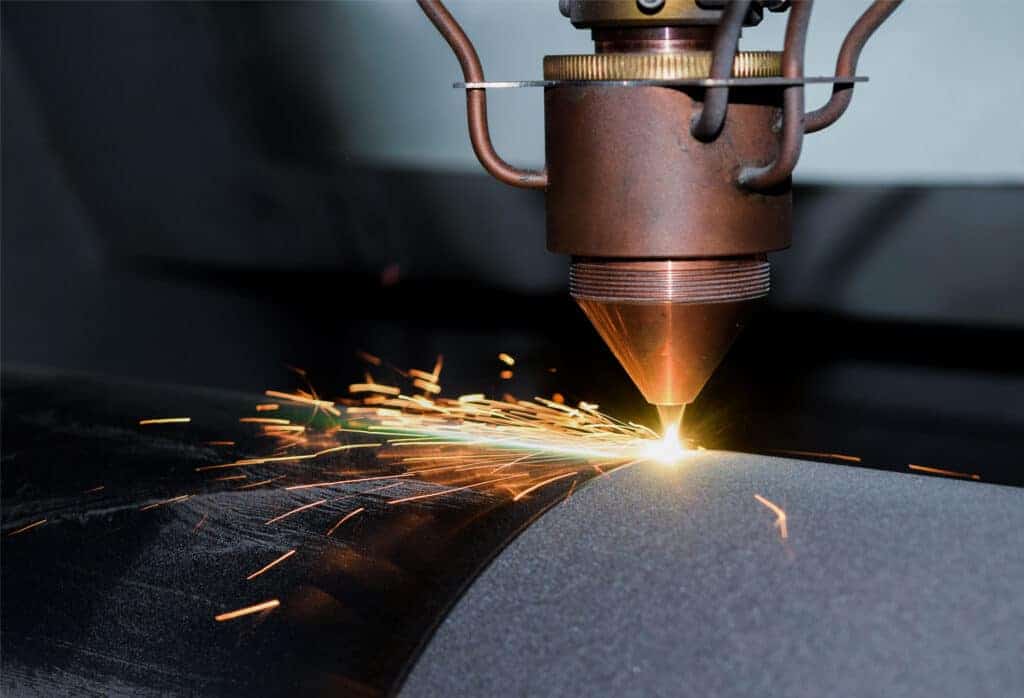
Our ultra-high-speed laser cladding series equipment can meet the application requirements for coating manufacturing and rapid repair of shaft parts of various diameters and lengths. The difference from the ordinary laser cladding process is that the powder melts at a certain distance from the workpiece and is sprayed onto the surface of the workpiece at high speed to form an extremely thin metallurgical layer.
Ultra-high-speed laser cladding technology is an advanced and environmentally friendly remanufacturing processing technology. Its cladding coating has high metallurgical quality, low dilution rate, small deformation and high surface finish. It can quickly prepare large-area coatings in a short time. The coating thickness can be adjusted from 0.1 to 0.25 mm according to process requirements, with basically no damage to the surface of the workpiece. It can greatly reduce the company’s subsequent machining costs, effectively extend the product life cycle, and save the company a lot of later maintenance costs.
Advantages of our ultra-high-speed laser cladding technology: It is currently possible to prepare large-scale coatings of different components on the surface of parts, which will make it possible to produce innovative parts that will not wear out during the life cycle.
Zalety techniczne
Skumulowana baza danych procesów dodatków laserowych dla różnych wysokowydajnych materiałów stopowych
laser direct deposition technology
Surface coating thickness can reach 10 to 500 times that of electroplating technology
Faster cladding speed
Two orders of magnitude faster than traditional laser cladding technology
Cladding costs are lower
The cost of cladding can be reduced to the same cost as hard chrome plating
Dłuższa żywotność powłoki
Coating thickness can reach a minimum of 120μm and a maximum of 1000μm
Not easy to deform and crack
The heat-affected zone and thermal stress on the substrate are smaller than traditional cladding processes
Process the finished product in one go
Hybrid manufacturing combining turning and ultra-high-speed cladding can give full play to efficiency advantages
Ultra-high-speed laser cladding (repair) characteristics
Opanuj podstawową technologię laserowej obróbki termicznej materiałów
Właściwości techniczne:
1. The cooling speed is faster (up to 106°C/s), which is a rapid condensation process. It is easy to obtain fine-grained structures or create new phases that cannot be obtained in equilibrium, such as unstable phases, amorphous states, etc.;
2. The diluent rate of the coating is less than 5%, and it is solid metallurgical industrial fusion or off-page diffusion fusion with the substrate to obtain an excellent cladding layer with controllable coating composition and diluent degree;
3. Thermal typing, thermal hazard zones and bumps are smaller, and high-power rapid cladding can be reduced to within the installation dimensional tolerance of the parts.
4. There are almost no restrictions on powder selection, and high-melting-point aluminum alloys can be deposited on the surface of low-melting-point metal materials;
5. The cladding layer has a wide range of thickness and strength, and can clad a layer with a thickness within 20mm and a strength range of 18-60HRC;
6. The entire process is controlled by CNC machine tools and automated operation, which is convenient, flexible and highly controllable.
