


Explicarea placării cu laser: De la principiile de bază la practica industrială din lumea reală
Learn how laser cladding improves wear, corrosion, heat and oxidation resistance while enabling in-situ repair. This guide covers process principles, key parameters (power, feed, scan speed, step-over, shielding gas), defect diagnostics, and Greenstone-Tech’s intelligent control solutions.
1) Technology Overview & Core Value
Placare cu laser is an advanced surface engineering process. A high-energy laser scans a pre-defined toolpath, melts a thin layer of the substrate and the injected material to form a transient melt pool, then rapidly solidifies into a dense, lipite metalurgic coating with diluare redusă. Results:
- In-situ repair of mechanical parts (shafts, seats, molds, gears, blades).
- Performance upgrades: higher wear, corrosion, heat, și oxidation resistance vs. the base metal.
- Green, smart manufacturing: minimal waste, short heat cycles, easy automation & closed-loop control.
As manufacturers pursue sustainability and digitalization, laser cladding underpins remanufacturare și metal additive strategies. Greenstone-Tech drives adoption with continuous R&D and field-proven solutions.
2) Precision Control of Process Parameters
Laser Power (energy input)
Power sets the melt pool size and deposition rate.
- Too low: powder under-melting → pitting after finishing, weak bond, low hardness.
- Too high: over-melt/undercuts, heat lines or “wrinkles,” geometry drift.
- Best practice: match power to alloy, bead size, and path. Greenstone-Tech’s intelligent power control holds stability within ±1%, improving repeatability.
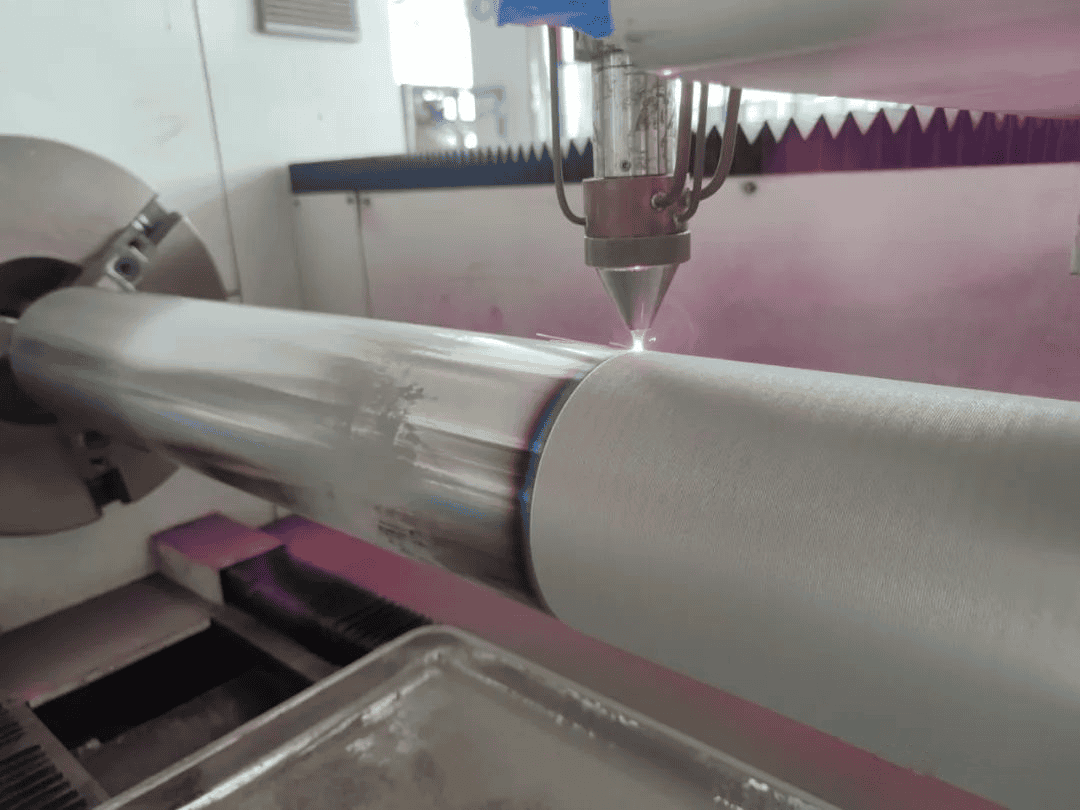

Powder Feed Rate (material input)
Must pair with available laser energy.
- Too high: energy deficit → incomplete fusion, pitting, weak metallurgical bonding, potential spallation.
- Optimized: higher deposition efficiency and dense coating. Greenstone-Tech feeders achieve up to 95% powder utilization with stable mass flow.
Scan/Traverse Speed (line speed)
Controls layer thickness, dilution, and bonding.
- Faster: thinner tracks, but risk insufficient substrate melting and weaker bonding.
- Slightly slower: higher hardness, better utilization—but watch heat build-up. Balance with hatch strategy and interpass temperature.
Step-Over / Hatch Spacing
Determines surface finish and dilution.
- Smaller step-over (higher overlap): smoother surface, fewer valleys, typically lower Ra.
- Larger step-over: visible weld beads/track marks; may raise local dilution. Choose per function (seal surface vs. roughing).
Shielding/Carrier Gas Flow
Dual roles: powder transport + protection from oxidation.
- Argon generally offers better protection than nitrogen for many alloys.
- Too much flow: plume disturbance, spatter; too little: oxidation, porosity.
- Greenstone-Tech gas control enables precise flow tuning for stable plumes and clean metallurgy.
3) Troubleshooting: Root Causes & Corrective Actions
A) Coating Delamination (spallation)
Root causes: insufficient substrate melting (low power/high speed), excessive feed, contaminated surface (oil, plating, rust).
Fix: raise power or reduce speed to form a robust melt pool; optimize feed; mechanically/chemically clean to bare metal.
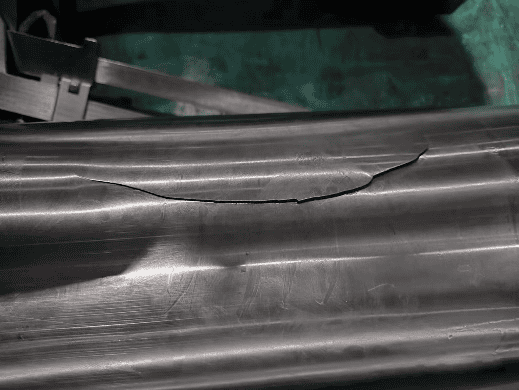
B) Cracks
Root causes: very hard substrates (quenched, carburized/nitrided), fatigued layers, overly hard cladding alloy, Ni-based alloys prone to hot cracking, multi-layer builds with high residual stress.
Fix: preheat/controlled interpass temperature; choose tougher alloy or modify chemistry; adjust heat input and bead strategy; stress-relief/tempering when needed.

C) Porosity
Root causes: substrate rust/oil, powder impurities or moisture, unstable powder stream, excessive feed, low power, improper speed.
Fix: rigorous cleaning; bake/dry powder; stabilize feeder; rebalance power/feed/speed; optimize shielding.
D) Poor Surface (loose powder, dull finish)
Root causes: over-feeding, low power, too fast, nozzle standoff wrong, tiny spot, dirty optics.
Fix: trim feed, increase power or slow traverse, correct standoff (typically 3–8 mm), clean/inspect optics, consider slightly larger spot.
E) Powder Clogging
Root causes: sticky buildup not cleaned, poor flowability, moisture/contamination, uneven multi-port distribution.
Fix: routine nozzle cleaning; use spherical, flow-rated powder; storage with desiccant and pre-bake; calibrate splitter for balanced branches.
F) Abnormal Sounds / Aggressive Spatter
Root causes: damp/contaminated powder, dirty substrate, excessive power density (metal boiling).
Fix: re-qualify powder, re-clean part, slightly reduce intensity and increase spot, refine gas flow.
G) Excessive Sparks & Splash
Root causes: speed too high, power/feed mismatch, shielding flow too high.
Fix: reduce speed, re-match power↔feed, tune gas to laminar regime.


4) Parameter Quick-Reference (Starting Ranges)
Adjust per alloy, nozzle, optics, bead width, and heat sink.
- Power: typically 0.8–3.5 kW (fiber/diode sources); scale with bead size.
- Feed: tune for full fusion with minimal spatter; verify by cross-section.
- Speed: start moderate, then increase until dilution and bond are just right.
- Overlap: 30–70% depending on finish and function.
- Gas: dry Ar (many steels/Ni), Ar+He (superalloys), high-purity Ar with low O₂ for Ti.
Greenstone-Tech systems log power, feed, speed, gas, and temperature to create repeatable “digital recipes.”
5) Where Laser Cladding Delivers Value
- Wear & corrosion upgrades: pumps, valves, shafts, seats, hydraulic rods.
- High-temp/oxidation resistance: turbine/boiler components, hot tooling.
- Dimensional restoration: molds/dies, gear teeth, bearing journals.
- Functionally graded surfaces: transition from wear- to corrosion-resistant chemistries with tailored dilution.
6) What Sets Greenstone-Tech Apart
- ±1% power stability with real-time feedback for consistent melt pools.
- High-efficiency powder delivery (up to 95% utilization) with flow monitoring.
- Closed-loop gas & plume control for clean, dense tracks.
- Process intelligence: in-situ vision/pyrometry, interpass temperature control, recipe management, and analytics for rapid scale-up.
7) Roadmap: Intelligent & Sustainable Laser Cladding
- AI optimization: machine-learning parameter advisors, adaptive control based on melt-pool vision and thermal data.
- Digital twins: virtual process planning to minimize trials and predict distortion/dilution.
- Greener ops: higher utilization, lower energy per cm², recyclable media, and eco-friendly alloy systems.
- New markets: deeper penetration in aerospace, energy, e-mobility, medical, and standardized remanufacturing workflows.
FAQs (Buyer & Engineer Friendly)
Q1: How is laser cladding different from thermal spray?
A: Laser cladding forms a legătură metalurgică cu diluare redusă and low HAZ; thermal spray is primarily mechanical bonding and can be more porous.
Q2: What hardness and thickness can I expect?
A: Single passes commonly 0.3–1.5 mm; multi-layer builds several millimeters. Hardness depends on alloy (e.g., Ni/WC systems > 1000 HV possible).
Q3: Do I need preheat/post-heat?
A: For high-carbon/hard substrates or multi-layer builds, preheat and stress relief reduce cracking and residual stress. Alloy-specific.
Q4: How do I qualify a process?
A: Run a DoE over power–speed–feed–overlap, check cross-sections (dilution, porosity, cracks), hardness map, wear/corrosion tests, and write a frozen recipe.
Bottom line: With tightly controlled power, feed, speed, hatch, and shielding, laser cladding delivers durable, metallurgically bonded surfaces and reliable in-situ repairs. Greenstone-Tech pairs robust hardware with intelligent control to convert recipes into repeatable production—accelerating sustainable, high-performance manufacturing.
Graham Luo
Dr. Graham Luo - Inginer superior, specialist MIM în titan Dr. Graham Luo este o autoritate recunoscută în domeniul turnării prin injecție a metalelor (MIM), cu accent special pe aliajele de titan. În prezent, este inginer principal la un institut de cercetare a metalelor neferoase, deține un doctorat de la Asociația Helmholtz a centrelor de cercetare germane și a fost cercetător postdoctoral, ceea ce îi conferă o bază teoretică profundă și experiență din partea instituțiilor de cercetare europene de prim rang. Cercetările sale pătrund în miezul tehnologiei MIM, concentrându-se pe domenii critice precum reologia materiei prime de titan, procesele de debitare catalitică/termică cu conținut scăzut de carbon/oxigen și...


