Aplicații de întărire cu laser (călire cu laser) pentru anumite componente metalice

începeți
Aplicații de întărire cu laser (călire cu laser) pentru anumite componente metalice

Prezentare generală a cazurilor de aplicare

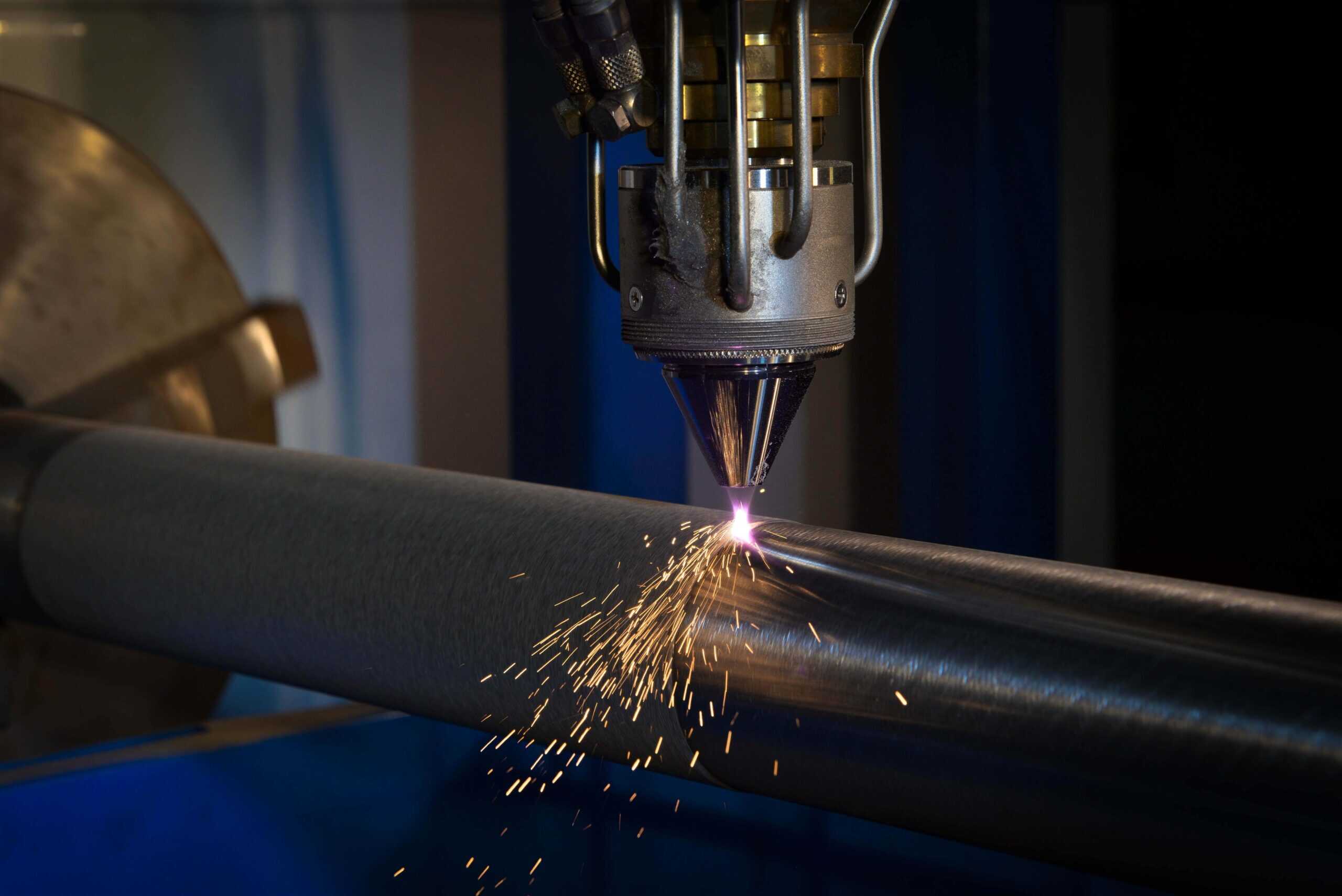
Laser hardening, also known as laser surface heat treatment, is an advanced surface modification process designed to significantly improve wear resistance and extend component service life. It is widely applied to steel and cast-iron parts. During processing, a laser delivers precisely controlled, localized heating that rapidly elevates the material temperature above the austenitizing point but below the melting point. The surface then self-quenches through the thermal conductivity of the base material, rapidly cooling the heated layer and completing the hardening transformation.

This process produces a high-hardness, ultra-fine martensitic microstructure on the treated surface, greatly enhancing surface hardness and wear resistance. In addition, compressive residual stress is introduced at the surface, improving fatigue strength and long-term durability under cyclic loading.

Scenario 1: Mold Laser Hardening

Greenstone-Tech applies advanced laser technology to strengthen mold surfaces, increase hardness, and extend mold service life.

Automotive body panel molds are typically manufactured from alloy cast iron. Due to the characteristics of alloy cast iron, overall heat treatment is not suitable. Traditional flame hardening typically achieves 40–50 HRC surface hardness. With laser hardening, using offline programming, teach programming, and expert programming, complex three-dimensional toolpaths can be planned and executed for parts with intricate geometry. Mold surface hardness can reach 55–65 HRC, with an effective hardened depth of 0.5–0.7 mm. This significantly enhances wear resistance, effectively mitigates part scratching issues, and reduces online mold repair rates to below 4%. Large-area grinding of deep-drawing molds is no longer required; only simple maintenance is needed.

In deep-drawing molds, the heat-affected area is large. Conventional flame or induction hardening often causes substantial thermal deformation, compromising mold accuracy and requiring additional steps. Hardness stability is difficult to maintain and lead times are long. Laser hardening minimizes deformation—often eliminating it entirely—meeting quality requirements without additional processes.

For insert surfaces in automotive molds, such as trim die cutting edges and forming die working surfaces, conventional flame hardening causes severe deformation. Inserts then require corrective machining after hardening, extending production time and making hardness control difficult. Forming inserts are especially challenging due to large hardened surface areas, which are prone to tempering issues leading to failing hardness.

Studies and practical applications at Greenstone-Tech have demonstrated that laser hardening effectively controls insert deformation and hardness accuracy. Inserts treated with laser hardening exhibit stable hardness, minimal deformation, and can be hardened after finish machining. This significantly improves processing efficiency and reduces manufacturing cost.

Aplicații de întărire cu laser (călire cu laser) pentru anumite componente metalice

Aplicații de întărire cu laser (călire cu laser) pentru anumite componente metalice

Aplicații de întărire cu laser (călire cu laser) pentru anumite componente metalice

Aplicații de întărire cu laser (călire cu laser) pentru anumite componente metalice

Aplicații de întărire cu laser (călire cu laser) pentru anumite componente metalice

Aplicații de întărire cu laser (călire cu laser) pentru anumite componente metalice

Scenario 2: Drill Rod Thread Laser Hardening

Greenstone-Tech has conducted extensive testing on laser optics, processing media, and process parameters to master laser hardening technology for threaded drill rods. This capability has been successfully applied to threads of various pipe diameters.

The laser hardening process features rapid heating and cooling, enabling treated threads to be used directly without post-straightening. The hardened layer depth is precisely controlled at 0.4–0.8 mm on the tooth crest and 0.1–0.4 mm at the tooth root. After laser hardening, the thread surface exhibits ultra-refined grain structure, with wear resistance improved by 2–3 times. Mechanical strength fully meets high-torque and long-distance drilling requirements, significantly extending service life.

Key advantages:

  • Very high processing speed, minimal heat-affected zone, and extremely low deformation

  • Higher hardness than conventional hardening methods, with dense martensitic structure and excellent toughness

  • Precise processing of localized areas, grooves, and special profiles not feasible with traditional hardening

  • Clean, environmentally friendly, and efficient process (no water, oil, or quenching fluids required)

  • Generates compressive residual stress, significantly enhancing surface hardness, wear resistance, and corrosion resistance

Aplicații de întărire cu laser (călire cu laser) pentru anumite componente metalice

Aplicații de întărire cu laser (călire cu laser) pentru anumite componente metalice

Aplicații de întărire cu laser (călire cu laser) pentru anumite componente metalice