


Placarea cu laser în tratamentul termic: Control de precizie și inovare tehnologică
Laser cladding in heat treatment involves the use of high-energy laser beams to locally heat the surface of materials, enabling precise control of their microstructure. Compared to traditional heat treatment techniques, such as induction heating or gas flame heating, placare cu laser offers distinct advantages, including high energy density, controlled localized heat input, and minimized heat-affected zones. This article delves into the key applications of placare cu laser in heat treatment, highlighting recent technological advancements and breakthroughs.
1. Laser Hardening: Precision Control in Surface Strengthening
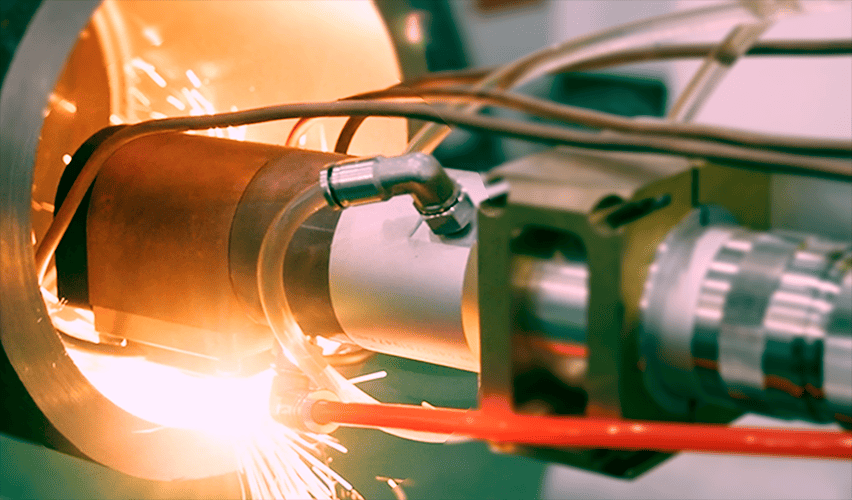
Laser hardening is an advanced method where a laser beam quickly heats the workpiece surface to the austenitization temperature (typically 900°C to 1500°C for steel), followed by rapid self-quenching, forming a martensitic structure. The main advantages of laser hardening include:
- Selective Treatment: Laser beams can precisely target complex geometries (e.g., camshaft lobes or gear tooth roots), avoiding unnecessary heat exposure to non-hardened areas. For example, the cam tracks in automobile engine camshafts need selective hardening to resist cyclic wear, and laser technology allows for hardening depths of just 0.1–0.5 mm while maintaining the core material’s ductility.
- Controlled Heat Input with Low Distortion: Real-time temperature monitoring via integrated thermometers or infrared cameras ensures the laser power and scanning speed are adjusted dynamically to control residual stress și deformation at minimal levels. Studies on EA4T axle steel show that laser cladding followed by heat treatment significantly reduces hardness and residual stress, while maintaining adequate fatigue strength.
- Efficiency and Cost Savings: Unlike traditional methods, laser hardening does not require external cooling media, nor does it need post-processing deformation correction, reducing subsequent processing costs. For instance, laser quenching of large gears has shown more than a 70% reduction in thermal distortion compared to induction quenching, while maintaining a surface hardness in the HRC 35–45 range.
- Technological Advancements: Laser hardening can be combined with composite heat treatment techniques, such as tempering U75V steel rail coatings at 600°C, where the heat-affected zone transforms into tempered martensite, improving wear resistance. Additionally, laser shock peening can convert residual tensile stress into compressive stress, further enhancing fatigue life.

2. Material Softening: Precision Annealing and Toughness Control
Laser softening, also known as laser tempering, involves heating the material to critical temperatures (e.g., 300°C to 600°C) or allowing it to slowly cool after austenitization, resulting in a ferrite-pearlite structure. This process increases plasticity și formability. Key features include:
- Smooth Transition Zones: The laser’s energy distribution ensures a uniform hardness gradient between treated and untreated areas, reducing stress concentrations by 50% compared to induction heating.
- Innovative Applications:
- Automotive Safety Structures: In high-strength steel car bodies, laser tempering of critical areas (e.g., crash beams) forms controlled energy-absorbing zones that absorb impact energy during collisions, protecting occupants.
- Deep Drawing: Aluminum or high-strength steel sheets are laser-softened in the bending areas before stamping, preventing cracking during forming and improving ductility by 20–30%.
- Typical Case: After placare cu laser a NiCrBSi/WC coating on Ti6Al4V titanium alloy, a heat treatment at 700–900°C results in controlled precipitate phases like Cr23C6, increasing the tenacitate la fractură from 3.05 MPa·m¹/² pentru 5.31 MPa·m¹/², while also improving duritate pentru 1395 HV.
3. Technological Advantages: Performance Breakthroughs Beyond Traditional Methods
- Flexibility: The laser optical system (integrated with galvo mirrors și robots) allows processing of complex surfaces, such as turbine blade dovetails or mold cavities, providing unparalleled flexibility for difficult-to-reach areas.
- Composite Process Integration: Combining solid solutioning, aging, or cryogenic treatment with laser cladding optimizes coating performance. For instance, after 700°C annealing de WC@Ni/Ni60 coatings, residual stress is reduced, and wear resistance is significantly improved.
- Environmental and Economic Benefits: Laser cladding is a proces uscat, eliminating chemical pollution. Additionally, the energy consumption of laser systems is 30–50% lower than induction heating, making it a more environmentally friendly and cost-effective solution.
4. Industrial Application Scenarios
Industria aerospațială: In high-temperature turbine blades made from Rene125, laser cladding followed by multi-stage heat treatment (e.g., 1220°C solution + 590°C controlled cooling) reduces residual stress from 253 MPa pentru 4 MPa, enhancing fatigue life nearly fourfold.
Rail Transportation: EA4T axle steel is laser-clad with 24CrNiMo alloy, followed by heat treatment to adjust the proportion of tempered martensite. This process ensures that tensile strength matches the substrate while maintaining fatigue resistance.
Mold Repair: After placare cu laser a cobalt-based alloy on automotive stamping molds, the surface hardness reaches HRC 50 or higher, with no cracks, significantly extending mold life by 3-5 ori.
5. Future Trends and Challenges
- Smart Control: Integrating AI-based real-time analysis of thermal imaging data enables dynamic adjustment of laser parameters for precise control of microstructură și residual stress in heat-treated components.
- Material Innovation: Developing specialized laser heat treatment powders, such as rare-earth-modified powders (e.g., Y₂O₃ sau La₂O₃), can refine grain structure and enhance the high-temperature stability of coatings.
- Cost Optimization: As fiber laser prices continue to decrease, the economic viability of laser heat treatment pentru small and medium-sized component repairs will continue to improve, making it more accessible for a wider range of industries.
Concluzie
Laser cladding for heat treatment provides unmatched precision și efficiency, enabling hardening and softening processes that were previously challenging or impossible with traditional methods. Its applications in aerospace, automotive manufacturing, and high-end equipment industries demonstrate the transformative potential of laser technology in materials engineering. As composite processes și intelligent controls evolve, laser heat treatment is poised to become a key technology in high-end equipment remanufacturing și producție ecologică, ensuring its place at the forefront of modern industry.
Graham Luo
Dr. Graham Luo - Inginer superior, specialist MIM în titan Dr. Graham Luo este o autoritate recunoscută în domeniul turnării prin injecție a metalelor (MIM), cu accent special pe aliajele de titan. În prezent, este inginer principal la un institut de cercetare a metalelor neferoase, deține un doctorat de la Asociația Helmholtz a centrelor de cercetare germane și a fost cercetător postdoctoral, ceea ce îi conferă o bază teoretică profundă și experiență din partea instituțiilor de cercetare europene de prim rang. Cercetările sale pătrund în miezul tehnologiei MIM, concentrându-se pe domenii critice precum reologia materiei prime de titan, procesele de debitare catalitică/termică cu conținut scăzut de carbon/oxigen și...


