


فناوری پوششدهی لیزری با سرعت بالا روی دیوار داخلی: عصری نو در عملیات سطحی لولهها و تیوبها
The internal surface treatment of pipes and tubular components has long been a technical challenge in surface engineering, especially for parts with small inner diameters, large length-to-diameter ratios, or variable-diameter structures.
Electroplating, as one of the earliest applied methods for inner wall surface treatment, has been in use in China for over 40 years. However, electroplated coatings face significant performance limitations and, more critically, cause serious environmental pollution. With increasingly strict environmental regulations, electroplating is gradually being phased out.
In industries such as shipbuilding, petrochemicals, and mining equipment, pipelines are widely used, and their inner walls often suffer from wear and corrosion during service. This not only reduces operational performance but also shortens service life. Enhancing the wear resistance and corrosion resistance of pipe inner walls has thus become a key solution for improving reliability and longevity.
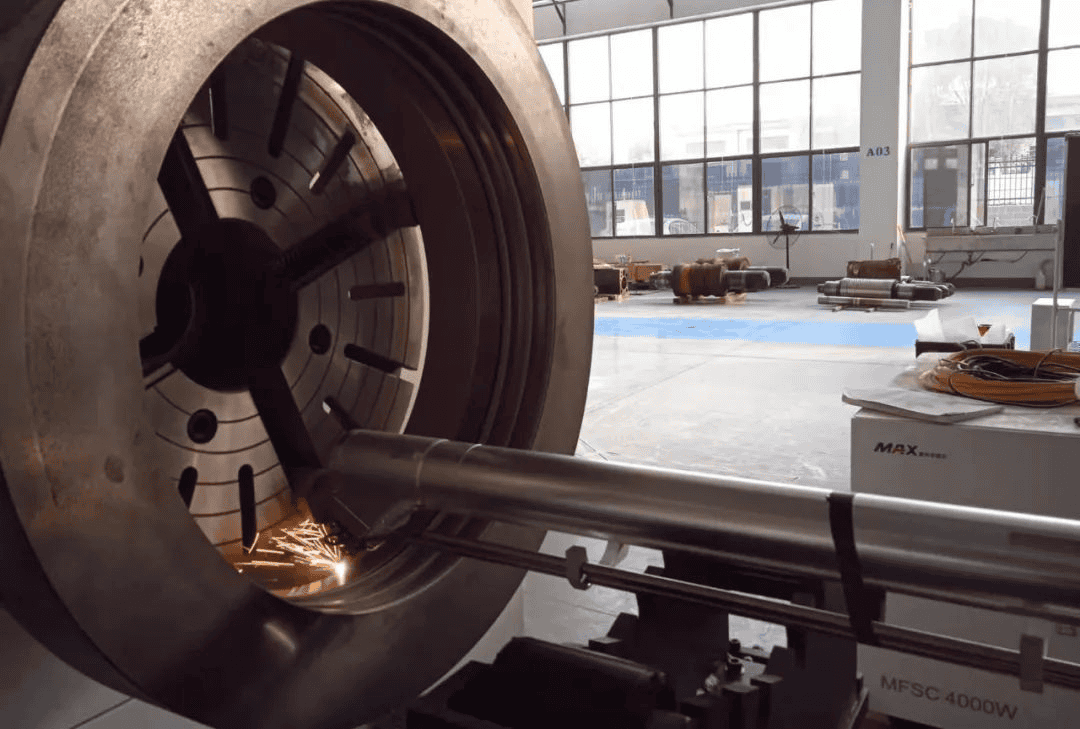

Principle and Advantages of Inner Wall Laser Cladding
Laser cladding is an advanced surface engineering technology that uses high-energy-density laser beams to melt alloy powders, forming a cladding layer that is metallurgically bonded with the substrate. By leveraging the laser’s precision, energy density, and directivity, this method enables accurate treatment of inner walls of pipes and tubular structures.
Key Advantages:
- Significant improvement in hardness, strength, wear resistance, corrosion resistance, and high-temperature performance of inner surfaces.
- Extended service life of pipes and tubes.
- Reduced operating and maintenance costs.
- Environmentally friendly, gradually replacing electroplating as the mainstream solution in repair and remanufacturing.
Technical Challenges and Breakthroughs
Unlike external surface cladding, inner wall laser cladding heads must deliver laser beams, powders, and cooling water through long distances in limited spaces. To meet the needs of smaller diameters and deeper cavities, inner wall laser cladding heads must achieve:
- High integration
- دقت بالا
- High rigidity
Greenstone-Tech has overcome these challenges by continuously optimizing:
- Optical path design
- Lightweight structural rigidity
- Water-cooling system efficiency
- Powder focusing performance
Through these innovations, Greenstone-Tech has expanded the maximum extension length and minimized the applicable inner diameter range, ensuring its equipment meets the needs of most industrial pipe and tube inner-wall processing requirements.
System Design and Application Innovation
Greenstone-Tech’s inner wall laser processing system is designed with modularity and flexibility in mind. It can integrate seamlessly with machine tools, robotic arms, and various motion platforms. With multiple specifications of inner-wall optical systems, the equipment supports both internal and external wall cladding in a single integrated system.
Additionally, Greenstone-Tech has developed a complete process specification system for inner wall laser cladding and repair, tailored to diverse product features and operational demands.
Practical Validation and Performance
Extensive industrial applications have demonstrated that Greenstone-Tech’s high-speed inner wall laser cladding equipment ارائه میدهد:
- High processing efficiency
- ورودی حرارت کم و تغییرشکل حداقلی
- Smooth, uniform, and fine-textured cladding layers
These qualities significantly reduce post-processing (e.g., boring or grinding). Moreover, during long-term continuous production, the equipment shows exceptional reliability and safety, fully meeting the stringent requirements of inner-wall component repair.
Conclusion: A New Era for Pipe and Tube Surface Treatment
Greenstone-Tech’s breakthroughs in inner wall laser cladding technology provide a revolutionary solution for pipe and tubular component surface treatment. This innovation marks a new era in the field, replacing outdated methods like electroplating with a high-performance, environmentally friendly, and cost-efficient alternative that meets the needs of modern manufacturing.
گراهام لو
دکتر گراهام لو – مهندس ارشد، متخصص MIM تیتانیوم دکتر گراهام لو بهعنوان یک مرجع شناختهشده در زمینه قالبگیری تزریقی فلز (MIM)، با تمرکز ویژه بر آلیاژهای تیتانیوم، فعالیت میکند. او در حال حاضر بهعنوان مهندس ارشد در مؤسسه تحقیقات فلزات غیرآهنی فعالیت میکند و دارای دکترای تخصصی (Ph.D.) از انجمن هلمولتز مراکز تحقیقاتی آلمان است و بهعنوان پژوهشگر پسادکترا خدمت کرده است که به او بنیان نظری عمیق و تجربه از مؤسسات تحقیقاتی برتر اروپایی بخشیده است. تحقیقات او به عمق فناوری MIM میپردازد و بر حوزههای حیاتی مانند رئولوژی خوراک اولیه تیتانیوم، فرآیندهای کاتالیزوری/گرمایی جداسازی با محتوای کم کربن/اکسیژن، و ... تمرکز دارد.


