
Robotic 8-Axis Laser Cladding System for Oil Diamond Drill Bit Repair
Project Overview
GREENSTONE has successfully delivered a robotic 8-axis coordinated laser cladding system for the precision repair and surface restoration of diamond drill bits used in oil drilling applications.
Unlike hydraulic cylinders and shaft components, drill bits have highly complex three-dimensional geometries. Their working surfaces contain multiple blades, curved profiles and localized wear areas, making conventional rotary or linear laser cladding equipment unsuitable for precise multi-position processing.
For this project, GREENSTONE developed an 8-axis robotic laser cladding solution that combines the flexibility of an industrial robot with coordinated external motion axes, allowing the laser cladding head to maintain an appropriate processing position and orientation across complex drill bit surfaces.
Customer Repair Requirements
Oil drilling bits operate under severe mechanical and abrasive conditions. During service, localized areas of the bit can experience progressive wear and surface damage. When the main body of a valuable component remains suitable for further use, controlled repair can be an economical alternative to complete replacement.
The customer’s requirement was therefore not simply to deposit additional material, but to achieve accurate and repeatable laser cladding on selected worn areas of complex drill bit geometries.
The system needed to provide flexible multi-axis accessibility, stable tool positioning, precise coordinated motion and reliable powder-fed laser cladding while accommodating different repair locations around the drill bit.
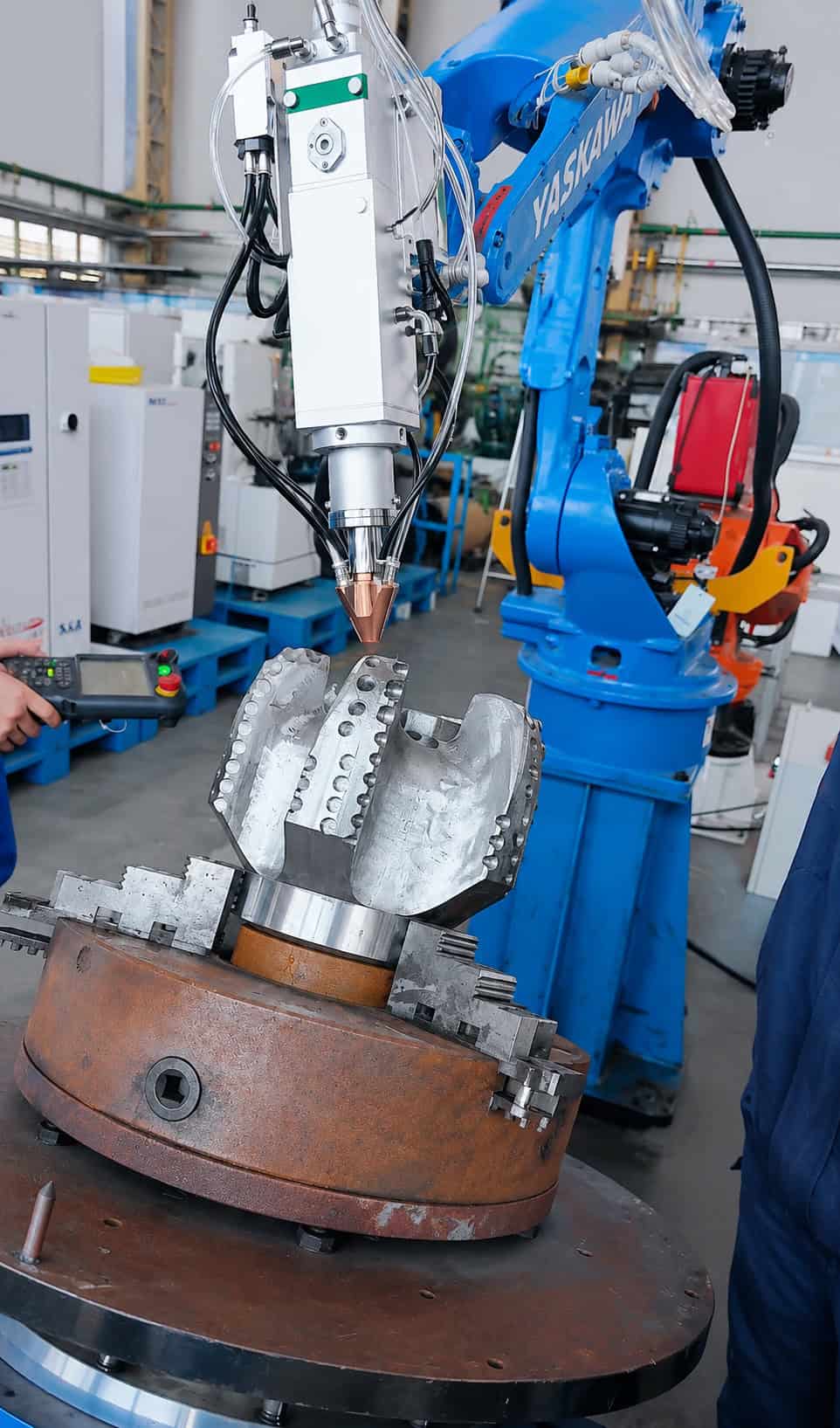
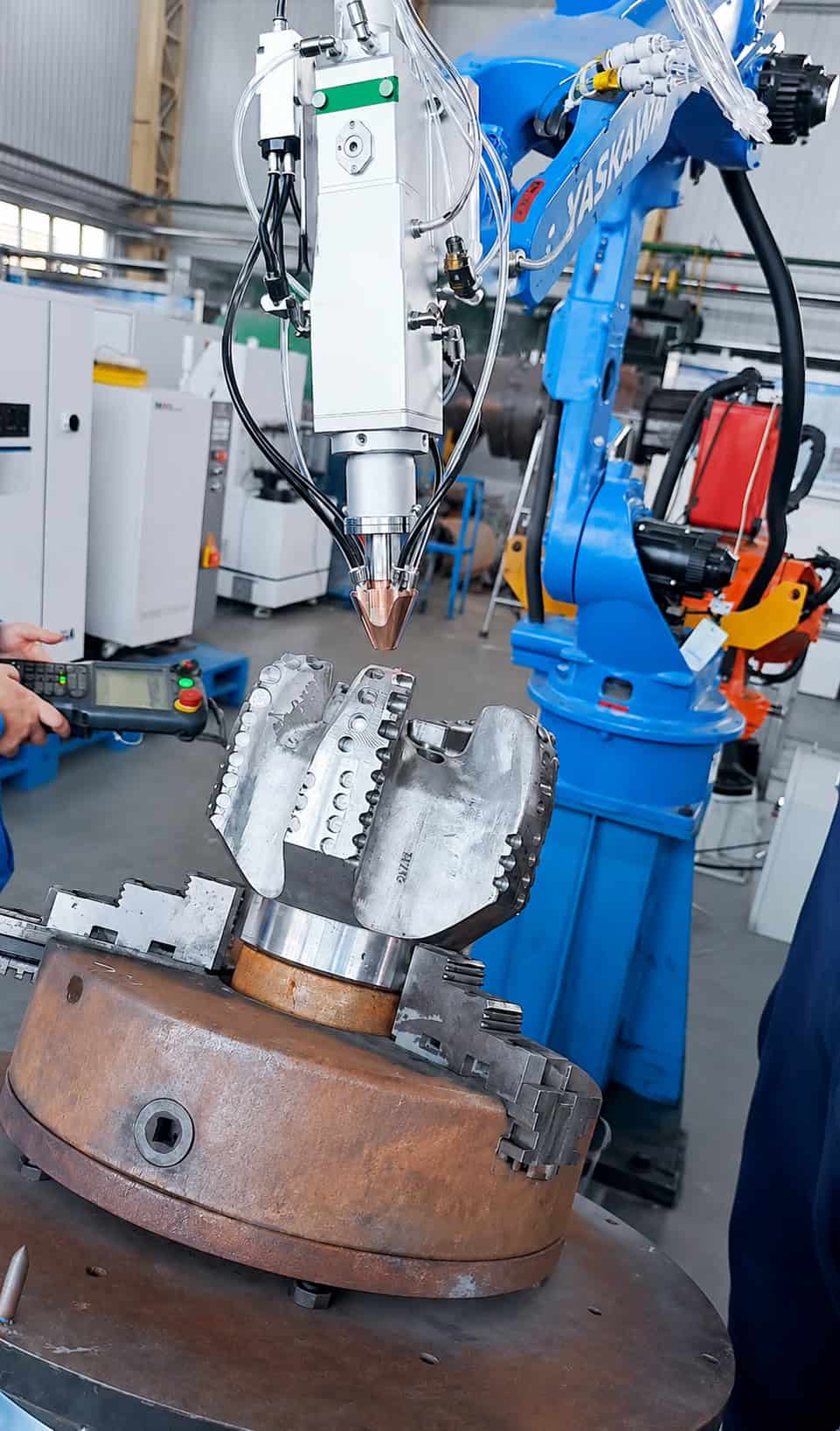
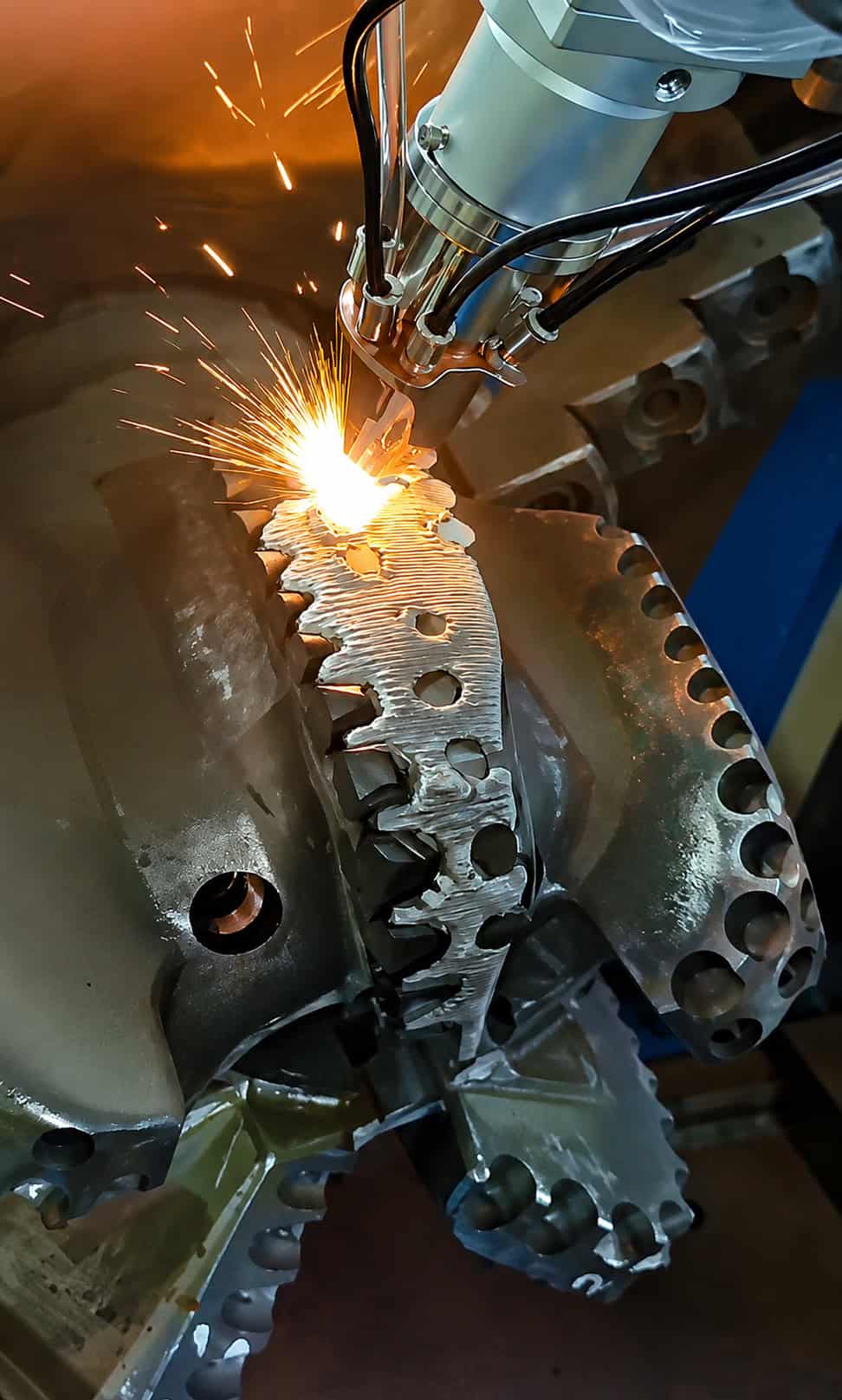
GREENSTONE 8-Axis Robotic Laser Cladding Solution
The delivered system integrates an industrial robot, coordinated external motion axes, laser cladding head, powder feeding system, laser source, cooling system, shielding gas system and integrated process control into a complete robotic repair platform.
The combination of robotic motion and external axes expands the accessible processing envelope compared with conventional fixed-axis cladding equipment.
During repair, the robot controls the position and orientation of the laser cladding head while the external axes coordinate the drill bit position. This allows the processing head to follow complex three-dimensional surfaces and maintain a suitable working relationship between the laser beam, powder stream and repair area.
For complex components such as oil drill bits, this coordinated movement is particularly important because the processing direction and surface angle can change continuously along the repair path.
Precision Laser Cladding of Worn Drill Bit Areas
Before delivery, GREENSTONE carried out equipment integration, motion coordination and laser cladding process verification using actual component geometries.
The repair process focuses on localized worn or damaged areas rather than unnecessary treatment of the entire drill bit. Material can be deposited along programmed paths to rebuild selected surfaces and restore material where required.
Compared with conventional manual repair methods, robotic laser cladding provides much greater control over the deposition path and heat input. The concentrated laser energy also enables metallurgical bonding between the deposited material and substrate while limiting the heat-affected region when an appropriate process window is used.
For irregular drill bit surfaces, the 8-axis configuration provides another important advantage: the workpiece and laser cladding head can move cooperatively instead of forcing all complex motion onto the robot alone. This improves accessibility and provides greater flexibility when processing different sides, angles and curved regions of the component.
Successful Commissioning and Delivery
Following system integration and process verification, the GREENSTONE robotic 8-axis laser cladding system was successfully commissioned and delivered to the customer for oil diamond drill bit repair applications.
The project verified stable multi-axis coordinated movement, accurate robotic path execution, reliable powder delivery and controlled laser deposition on complex three-dimensional component surfaces.
The completed system provides the customer with a flexible platform for the precision repair and restoration of high-value drilling components, while also allowing process programs and repair paths to be adapted for different component geometries and wear conditions.
From Complex Geometry to a Practical Repair Solution
This project demonstrates GREENSTONE’s capability beyond conventional cylindrical laser cladding.
By combining robotic laser cladding, coordinated multi-axis motion, powder delivery and application-specific process development, GREENSTONE can develop repair systems for complex components where conventional three-axis or rotary laser cladding machines cannot provide sufficient accessibility and flexibility.
The system delivered for this project is another example of GREENSTONE’s industrial laser cladding equipment already implemented for real customer applications.
For complex components requiring localized laser cladding or dimensional restoration, customers can provide workpiece drawings or 3D models, base material, worn-area information and repair requirements for technical evaluation by the GREENSTONE engineering team.
