
Laser Cladding for Coal Mining Machinery: Hydraulic Cylinder and Column Remanufacturing
Application Overview
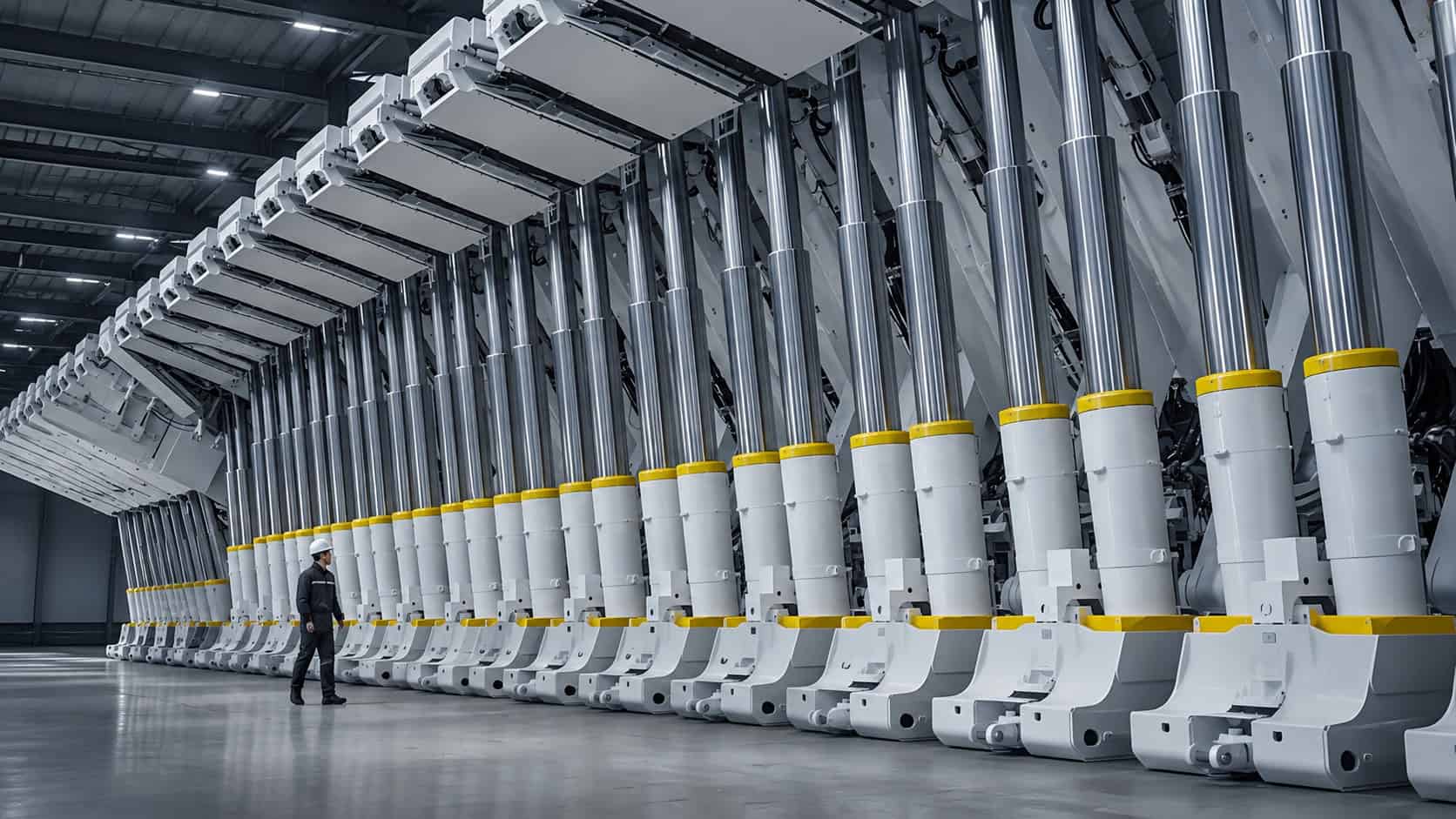
Hydraulic supports are critical load-bearing systems in mechanized coal mining. Their hydraulic columns, cylinders, piston rods and related components operate continuously under high pressure, heavy mechanical loads, abrasive contamination, moisture and corrosive underground environments.
Long-term operation can result in corrosion, scratching, abrasive wear, pitting and dimensional loss on both external and internal hydraulic surfaces. Once these surfaces deteriorate, sealing performance and hydraulic reliability can also be affected.
In this industrial application, laser cladding was used for the remanufacturing and surface enhancement of coal mining hydraulic components, including both outer cylindrical surfaces and internal cylinder bores.
The engineering objective was:
Dimensional Restoration + Wear Resistance + Corrosion Resistance + Metallurgical Bonding + Industrial-Scale Remanufacturing
1. Typical Coal Mining Machinery Components
The laser cladding process is particularly suitable for high-value hydraulic and mechanical components such as:
- Hydraulic support columns
- Hydraulic cylinders
- Piston rods
- Cylinder inner bores
- Heavy-duty shafts
- Pins
- Sleeves
- Bearing positions
- Guide components
- Wear rings
- Other cylindrical wear components
Among these applications, hydraulic columns and cylinders are especially important because their sealing and load-bearing surfaces directly affect hydraulic system reliability.
2. Operating Conditions and Failure Mechanisms
Coal mining hydraulic components operate under a combination of severe conditions:
- High hydraulic pressure
- Repeated extension and retraction
- Heavy axial loading
- Abrasive coal and mineral particles
- Underground moisture
- Corrosive media
- Mechanical impact
- Long-term sliding contact
Typical surface failure mechanisms include:
Corrosion
Exposure to moisture and corrosive underground environments can progressively damage exposed metallic surfaces.
Abrasive Wear
Coal dust, mineral particles and other contaminants can enter contact regions and accelerate surface wear.
Scratching and Scoring
Hard particles trapped between moving and sealing surfaces can produce longitudinal scratches and localized damage.
Pitting
Combined corrosion and mechanical loading can produce localized pits.
Dimensional Loss
Continuous wear eventually changes the original diameter or bore geometry, potentially affecting sealing and component fit.
For large hydraulic components whose structural bodies remain serviceable, complete replacement can be unnecessarily expensive.
Laser cladding provides a method of rebuilding only the damaged functional surface.
3. Why Laser Cladding Was Selected
Several technologies can be used for hydraulic-component surface engineering, including electroplating, arc hardfacing and thermal spray.
Laser cladding was selected for this application because it provides a combination of:
- Metallurgical bonding
- Low dilution
- Controlled coating thickness
- Localized thermal input
- High wear resistance
- High corrosion resistance
- Dimensional restoration
- High automation capability
- Good repeatability for batch remanufacturing
This is especially valuable when a component requires both material restoration and functional surface improvement.
4. Laser Cladding vs. Conventional Surface Treatments
| Comparison | Electroplating | Arc Surfacing / Hardfacing | Laser Cladding |
|---|---|---|---|
| Bonding Mechanism | Primarily physical/interfacial bonding | Metallurgical bonding | Metallurgical bonding |
| Typical Bond Strength | Relatively Low | Approx. 250–450 MPa* | Approx. 300–500 MPa* |
| Heat Input | Very Low | High | Localized and controlled |
| Thermal Distortion | Minimal | Relatively High | Relatively Low |
| Dilution | None | Typically Higher | Typically Low |
| Thickness Control | Excellent for thin coatings | Moderate | High |
| Dimensional Restoration | Limited | Good | Excellent |
| Wear Resistance | Material-dependent | Good | High with suitable alloy |
| Corrosion Resistance | Coating-dependent | Alloy-dependent | Alloy-dependent and highly tailorable |
| Automation | High | Moderate–High | High |
| Environmental Considerations | Depends strongly on plating chemistry | Fume and arc emissions require control | Powder/fume extraction and laser safety required |
*Bond strength is highly dependent on material system, substrate preparation and testing method; these figures should be treated as application-specific reference values rather than universal process constants.
This comparison does not mean laser cladding replaces every conventional surface treatment.
Electroplating remains suitable for many thin coating applications, while arc hardfacing can offer excellent economics for large, less precision-sensitive wear surfaces.
Laser cladding becomes particularly valuable when precision, metallurgical bonding, low dilution and dimensional restoration must be achieved simultaneously.
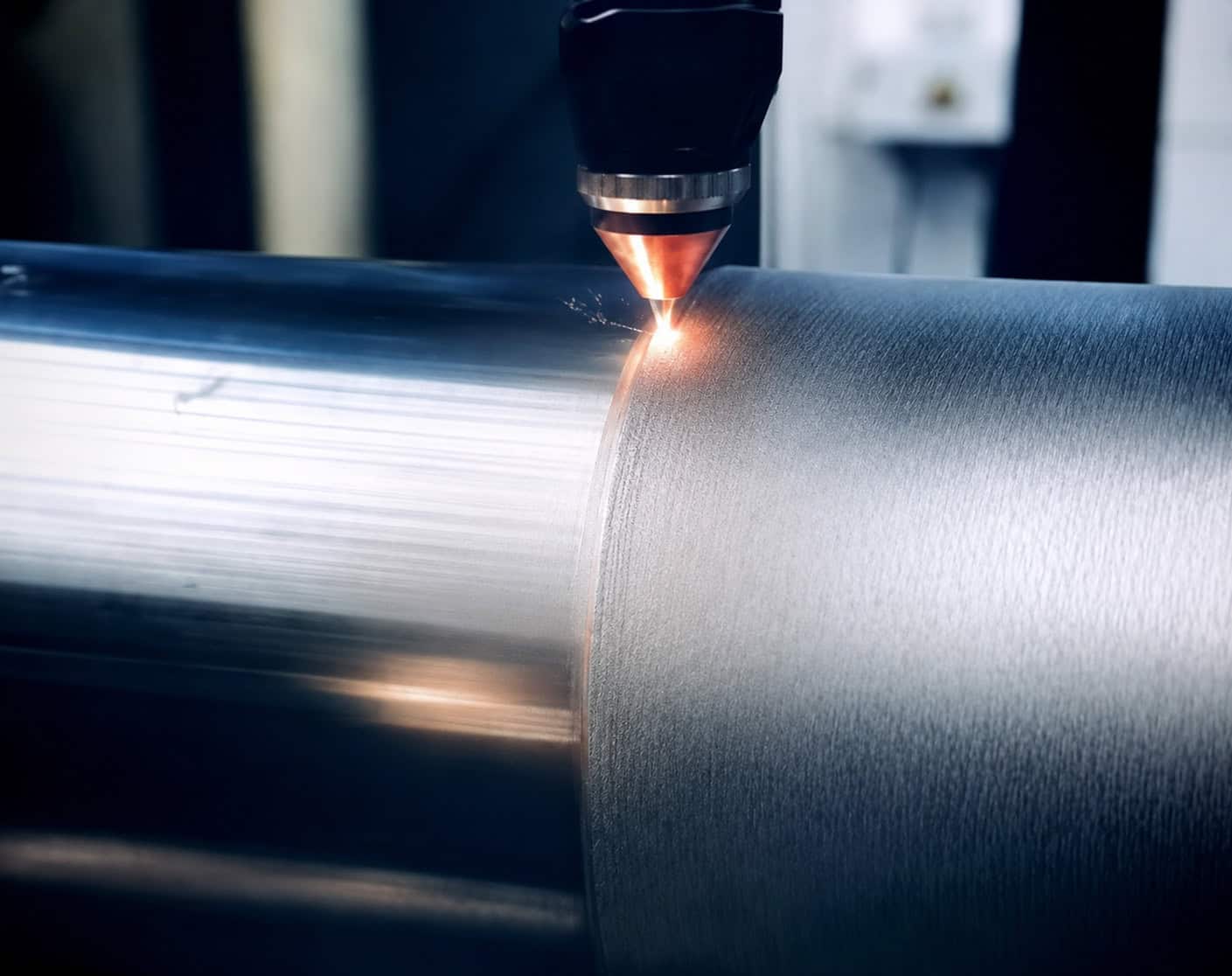
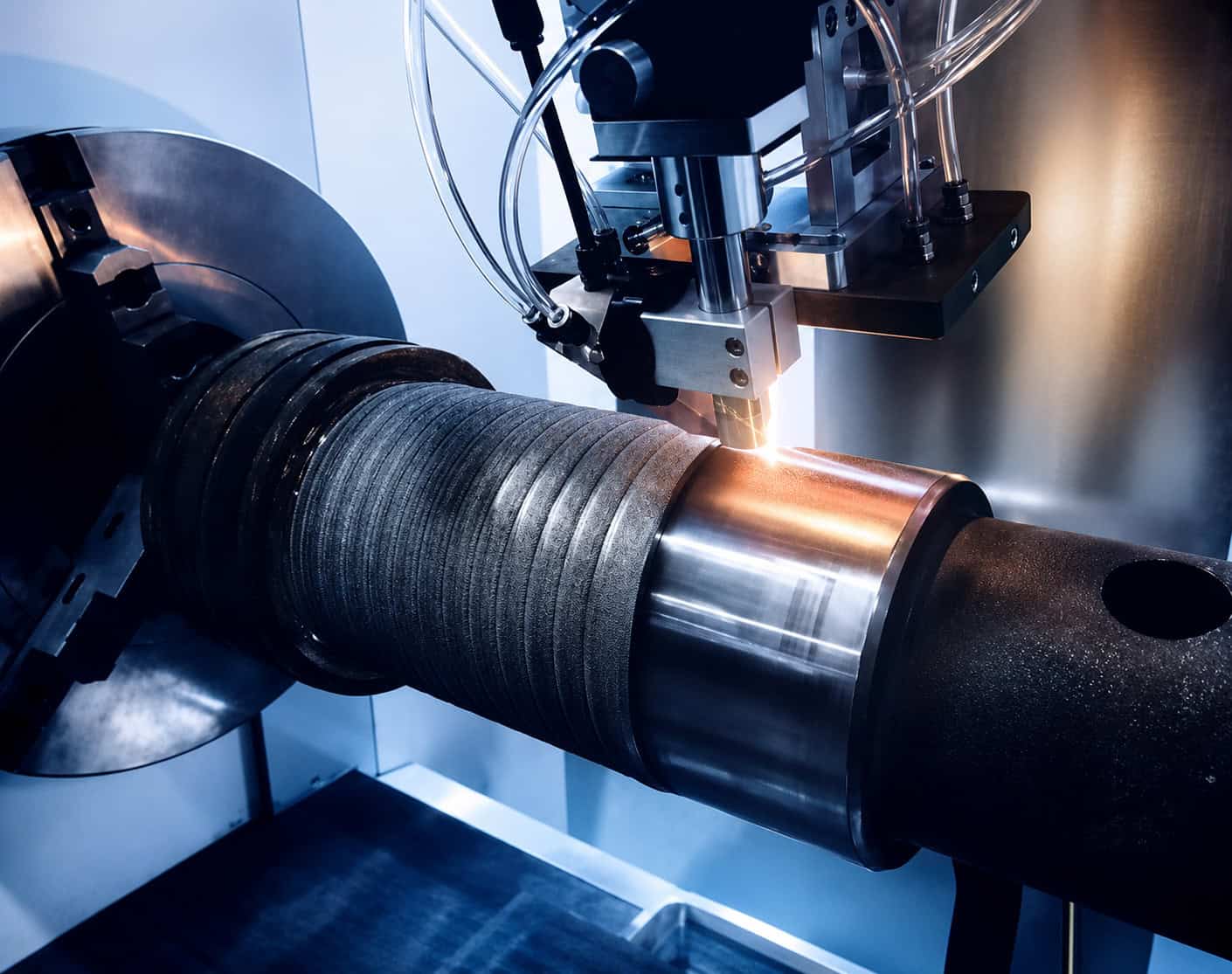
5. Outer-Surface Laser Cladding of Hydraulic Cylinders and Columns
External cylindrical surfaces are among the most mature laser cladding applications in coal mining machinery remanufacturing.
The workpiece is mounted on a heavy-duty rotary system. During processing, the component rotates continuously while the laser cladding head moves along the longitudinal direction.
This produces a controlled helical deposition path:
Workpiece Rotation + Axial Laser Movement → Continuous Overlapping Cladding Layer
The process can be used to restore worn external surfaces while simultaneously creating a corrosion- and wear-resistant functional layer.
6. Outer-Surface Processing Sequence
A typical industrial remanufacturing route includes:
Incoming Inspection
↓
Damage Evaluation
↓
Removal of Corrosion / Fatigue-Damaged Surface
↓
Pre-Machining
↓
Surface Cleaning
↓
Laser Cladding
↓
Coating Inspection
↓
Turning / Grinding
↓
Final Dimensional Inspection
↓
Surface Finishing
The cladding layer is normally deposited with sufficient machining allowance so that the final surface can be restored to the required diameter and finish.
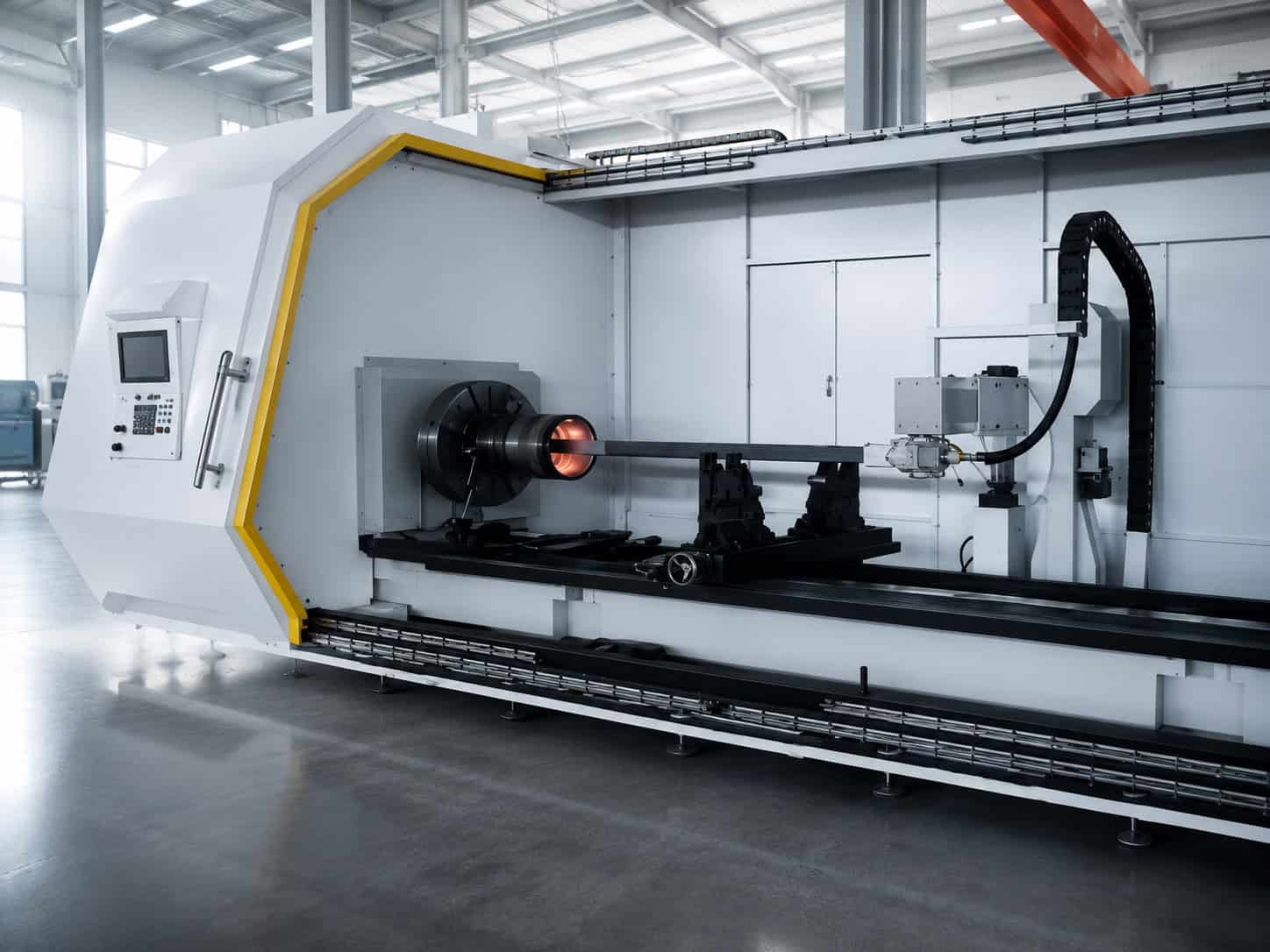
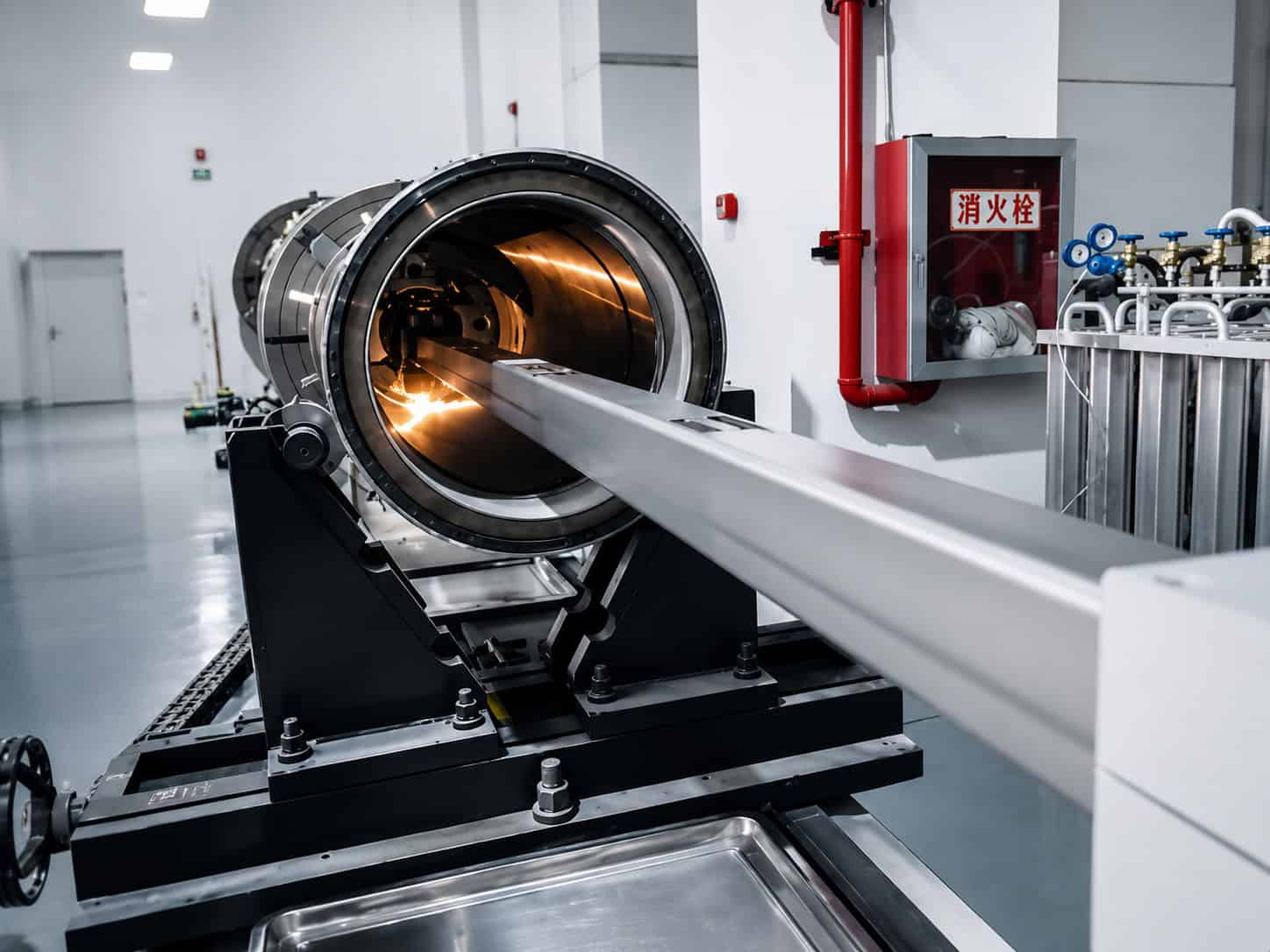
7. Internal-Diameter Laser Cladding of Hydraulic Cylinders
The internal wall of a hydraulic cylinder presents a more demanding processing problem.
Unlike external cladding, the processing head must enter the bore while maintaining controlled:
- Laser delivery
- Powder delivery
- Shielding gas
- Focal position
- Stand-off distance
- Melt-pool stability
- Thermal conditions
A specialized internal-diameter laser cladding head is therefore required.
Depending on equipment architecture, processing can be performed using synchronized:
Workpiece Rotation + Internal Cladding Head Axial Feed
This creates a continuous helical layer along the internal bore.
8. Why Internal Bore Remanufacturing Matters
Cylinder bores can develop:
- Scratches
- Corrosion
- Scoring
- Pitting
- Seal-contact wear
- Localized material loss
Once the internal surface deteriorates, sealing performance may decline even though the main cylinder structure remains usable.
Replacing the entire cylinder body can be expensive, particularly for large coal mining hydraulic components.
Internal-diameter laser cladding allows the damaged bore to be rebuilt while retaining the original structural component.
9. Cladding Material Composition
For this application, the deposited alloy system had the following measured chemical composition:
| Element | Content (wt.%) |
|---|---|
| Fe | Balance |
| Cr | 17.54 |
| Ni | 1.95 |
| Mo | 1.52 |
| Si | 1.02 |
| Mn | 0.33 |
| V | 0.10 |
| O | 0.033 |
| Other Elements | <2 |
Coating Hardness
HRC 53–57
This alloy system was selected to provide a combination of:
- Wear resistance
- Corrosion resistance
- Sufficient hardness
- Metallurgical compatibility
- Machinability after deposition
The relatively high chromium content contributes to corrosion and wear performance, while the overall alloy system is designed for the demanding service conditions of mining hydraulic components.
10. Actual Laser Cladding Process Parameters
The industrial processing window used for this coal mining machinery application was:
| Process Parameter | Actual Range |
|---|---|
| Laser Power | 6000–12000 W |
| Powder Feeding Rate | 50–85 g/min |
| Linear Processing Speed | 4–10 m/min |
| Step Distance / Track Pitch | 1.5–2.0 mm |
| Coating Hardness | HRC 53–57 |
| Deposition Method | Powder-Fed Laser Cladding |
| Processing Mode | Continuous Overlapping Helical Deposition |
| Main Application | Hydraulic Cylinder / Column Surface Remanufacturing |
These parameters demonstrate that coal mining hydraulic-component remanufacturing is not necessarily a low-power laser cladding application.
For large cylindrical surfaces and industrial production efficiency, multi-kilowatt laser power combined with relatively high travel speed and powder feed rate can significantly increase surface coverage.
11. Understanding the 6000–12000 W Power Range
The required laser power is determined by more than component diameter.
Important variables include:
- Required deposition rate
- Processing speed
- Beam size
- Powder feed rate
- Coating material
- Layer geometry
- Track overlap
- Substrate thermal mass
- Required dilution
- Target productivity
A 6000 W configuration may be sufficient for many conventional processing requirements, while higher-power configurations can be used where larger melt-pool capacity and higher production efficiency are required.
Therefore:
Higher Laser Power ≠ Automatically Better Coating
The objective is to establish a stable relationship between:
Laser Energy + Powder Feed + Travel Speed + Spot Geometry + Track Overlap + Substrate
12. Powder Feeding Rate: 50–85 g/min
Powder feeding directly influences deposition efficiency and melt-pool behavior.
In this application, the process operated within a:
50–85 g/min powder feed range
The correct value depends on laser power, travel speed, beam geometry and desired deposition characteristics.
Excessive powder feed can lead to incomplete melting and reduced powder utilization.
Insufficient powder feed can reduce deposition efficiency and alter coating geometry.
Therefore, powder delivery must be synchronized with the laser-processing window.
13. Processing Speed: 4–10 m/min
A linear processing speed of:
4–10 m/min
was used within the applicable industrial process window.
Higher travel speed can improve productivity and reduce local heat accumulation, but requires corresponding optimization of:
- Laser power
- Powder delivery
- Beam geometry
- Track spacing
- Melt-pool stability
For large quantities of hydraulic cylinders, processing speed becomes a major factor in overall remanufacturing economics.
14. Track Pitch: 1.5–2.0 mm
The step distance / track pitch used in this application was:
1.5–2.0 mm
Track spacing affects:
- Overlap ratio
- Surface uniformity
- Coating thickness
- Thermal accumulation
- Deposition efficiency
- Final machining allowance
If the spacing is too large, insufficient overlap may create uneven coating geometry.
If it is unnecessarily small, excessive overlap can increase heat accumulation and reduce processing efficiency.
The correct value must therefore be coordinated with the actual cladding-track width.
15. Coating Hardness: HRC 53–57
The resulting cladding layer achieved a hardness of approximately:
HRC 53–57
For coal mining hydraulic applications, this provides a strong wear-resistant surface while material selection must still consider toughness and crack resistance.
Hardness should never be evaluated independently.
The actual engineering objective is:
Hardness + Wear Resistance + Corrosion Resistance + Toughness + Bond Integrity
A harder coating is not automatically a better coating if it becomes too brittle for the actual loading conditions.
16. Conventional and High-Efficiency Laser Cladding
Coal mining hydraulic components can be processed using different laser cladding strategies.
Conventional Laser Cladding
More appropriate where:
- Greater material buildup is required
- Significant dimensional restoration is needed
- Multiple layers are required
- Repair geometry is irregular
High-Efficiency / High-Speed Laser Cladding
Particularly attractive for:
- Long cylindrical surfaces
- Relatively thin functional layers
- Large batch quantities
- High surface coverage requirements
- Low dilution requirements
- Reduced thermal input per unit area
For hydraulic cylinder production and remanufacturing, the process should therefore be selected according to both coating requirement and production target.
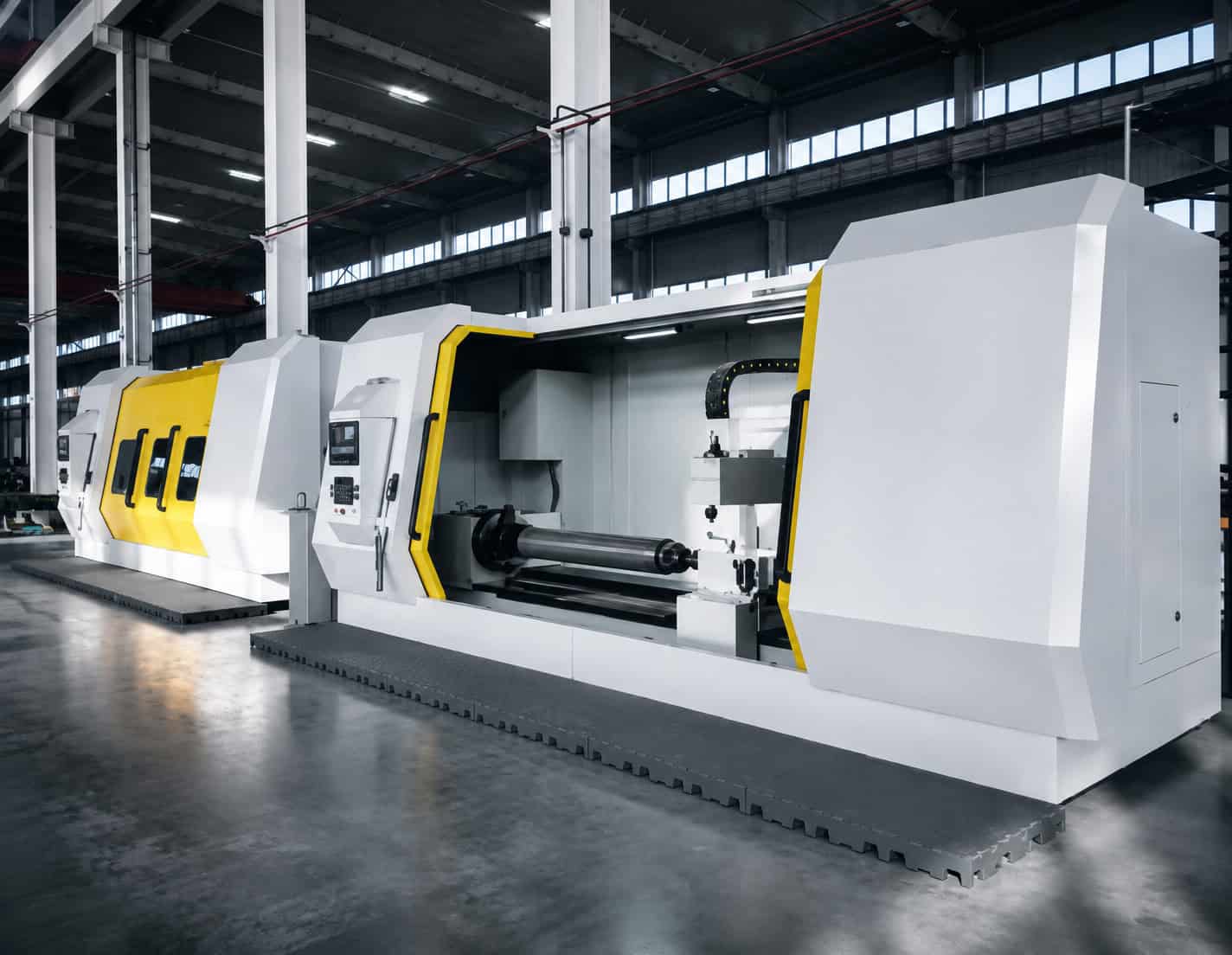
17. Equipment Architecture for Coal Mining Hydraulic Components
A complete automated system for these applications can be configured as:
High-Power Fiber Laser
↓
Powder Feeding System
↓
External / Internal Laser Cladding Head
↓
Heavy-Duty Rotary Motion System
↓
Long-Travel CNC Axis
↓
Integrated Process Control
A representative industrial configuration may include:
- 6–12 kW fiber laser
- External-diameter laser cladding head
- Internal-diameter cladding head
- High-capacity powder feeder
- Heavy-duty spindle / rotary positioner
- Long-travel linear axis
- CNC synchronized motion control
- Industrial water chiller
- Shielding gas system
- Powder recovery / extraction where appropriate
- Fume extraction
- Laser safety enclosure
- Process monitoring system
18. Equipment Selection Should Start with the Workpiece
Laser power alone cannot determine machine configuration.
For a coal mining hydraulic-cylinder project, the engineering team should first confirm:
Maximum Workpiece Diameter
Determines machine envelope and rotary-axis capacity.
Maximum Workpiece Length
Determines longitudinal travel.
Maximum Workpiece Weight
Determines spindle, support and machine-bed requirements.
Minimum Internal Diameter
Determines whether the internal cladding head can enter the bore.
Maximum Internal Processing Depth
Determines internal-head extension architecture.
Required Layer Thickness
Influences process strategy and number of layers.
Production Volume
Determines whether conventional or higher-efficiency processing provides better economics.
The system should therefore be designed around:
Diameter × Length × Weight × Bore Size × Processing Depth × Coating Requirement × Production Capacity
19. Recommended System Configuration for Similar Applications
For industrial coal mining hydraulic-component remanufacturing, a typical GREENSTONE solution can integrate:
Laser System
6–12 kW industrial fiber laser, selected according to production requirements.
Powder Feeding
Industrial powder feeder capable of stable delivery across the required deposition range.
External Cladding
Coaxial or application-specific laser cladding head for outer cylindrical surfaces.
Internal Cladding
Dedicated internal-diameter laser cladding head for cylinder bore processing.
Motion System
Heavy-duty rotary spindle combined with a long-travel CNC linear axis.
Support System
Adjustable workpiece supports for long and heavy hydraulic components.
Control
Integrated control of:
Laser Power + Powder Feeding + Rotation + Axial Speed + Shielding
This allows repeatable processing recipes to be established for batch remanufacturing.
20. Process Quality Control
Industrial remanufacturing requires repeatable quality rather than simply achieving one successful coating.
Quality control can include:
- Visual inspection
- Dimensional inspection
- Coating thickness measurement
- Hardness testing
- Metallographic evaluation
- Bonding evaluation where required
- Crack inspection
- Surface-finish measurement
- Final diameter / bore measurement
For hydraulic sealing surfaces, final machining and surface finish are especially important.
Laser cladding is only one stage of the complete remanufacturing process.
21. Final Machining
The as-clad surface is normally not the final functional surface.
After deposition, the component can undergo:
- Turning
- Grinding
- Honing for suitable internal surfaces
- Polishing
- Dimensional inspection
The coating is therefore deposited with controlled machining allowance.
The final objective is not merely to produce a visually uniform cladding layer, but to restore the component to its required functional geometry and surface condition.
22. Processing Result
The completed laser cladding process provides a dense, metallurgically bonded functional layer over the worn or prepared surface.
The application achieved:
- Dimensional restoration
- HRC 53–57 coating hardness
- Improved wear resistance
- Improved corrosion resistance
- Controlled metallurgical bonding
- Automated processing of long cylindrical surfaces
- Compatibility with subsequent precision machining
For internal cylinder applications, the process also enables restoration of functional surfaces that are difficult to access using conventional external cladding equipment.
23. Economic Value of Laser Remanufacturing
Large coal mining hydraulic components contain substantial quantities of high-strength steel and require significant machining and manufacturing resources.
When only the functional surface has deteriorated, discarding the entire component may waste much of its remaining structural value.
Laser remanufacturing follows a different strategy:
Retain Serviceable Component Body
Remove Damaged Surface
Deposit New Functional Material
Restore Final Dimensions
This can reduce the need to manufacture a complete replacement component while allowing the surface material to be upgraded according to the operating environment.
24. Other Coal Mining Machinery Applications
The same laser cladding engineering principles can be extended to other suitable mining components, including:
- Piston rods
- Heavy-duty shafts
- Pins
- Sleeves
- Bearing positions
- Guide shafts
- Rollers
- Wear rings
- Pump shafts
- Hydraulic components
- Other high-value wear surfaces
However, material system, coating thickness and equipment architecture should always be developed according to the individual component.
25. Why This Application Is Well Suited to Automated Laser Cladding
Coal mining hydraulic components have several characteristics that make them particularly suitable for industrial automation:
- Repetitive cylindrical geometry
- Long continuous processing surfaces
- Large quantities of similar components
- Predictable wear locations
- Standardized remanufacturing routes
- Strong demand for consistent coating quality
Once the process window has been validated, recipes can be stored and reused through CNC control.
This transforms laser cladding from an individual repair technique into a repeatable industrial remanufacturing production process.
26. Engineering Information Required for a Similar Project
For a new coal mining hydraulic-component project, the following information should be provided:
- Workpiece drawing
- Component type
- Base material
- Maximum diameter
- Overall length
- Workpiece weight
- Minimum internal diameter
- Internal processing depth
- Existing coating or surface condition
- Wear depth
- Required restoration thickness
- Required hardness
- Corrosion environment
- Final surface-finish requirement
- Production quantity
- Required cycle time
For internal-diameter processing, photographs or drawings showing the bore structure are strongly recommended.
27. From Process Development to Complete Equipment Solution
A successful coal mining machinery laser cladding project requires more than selecting a laser source.
The complete engineering chain is:
Workpiece Analysis
↓
Failure Mechanism Evaluation
↓
Powder / Alloy Selection
↓
Laser Process Development
↓
External / Internal Cladding Head Selection
↓
Motion System Design
↓
Fixture and Support Design
↓
Automation Integration
↓
Process Validation
↓
Final Machining Strategy
GREENSTONE can develop the laser cladding system around the actual component rather than forcing the application into a predetermined standard machine configuration.
Technical Data Summary
| Item | Technical Data |
|---|---|
| Application | Coal Mining Hydraulic Component Remanufacturing |
| Main Components | Hydraulic Cylinders / Columns |
| Processing Surface | Outer Diameter + Inner Diameter |
| Deposition Technology | Powder-Fed Laser Cladding |
| Laser Power | 6000–12000 W |
| Powder Feed Rate | 50–85 g/min |
| Processing Speed | 4–10 m/min |
| Track Pitch | 1.5–2.0 mm |
| Coating Hardness | HRC 53–57 |
| Main Alloy Base | Fe-based |
| Chromium | 17.54 wt.% |
| Nickel | 1.95 wt.% |
| Molybdenum | 1.52 wt.% |
| Silicon | 1.02 wt.% |
| Manganese | 0.33 wt.% |
| Vanadium | 0.10 wt.% |
| Oxygen | 0.033 wt.% |
| Other Elements | <2 wt.% |
| Motion Principle | Rotation + Synchronized Axial Movement |
| Post-Processing | Turning / Grinding / Honing as Required |
| Main Objective | Wear + Corrosion Resistance + Dimensional Restoration |
Confidentiality Notice
This case is based on actual industrial laser cladding applications for coal mining machinery. The technical process parameters presented on this page are publishable application data. Customer identity, proprietary drawings, project-specific equipment information and other confidential commercial information remain undisclosed. Representative images may be used where original customer images cannot be published.
Have a Similar Coal Mining Machinery Component?
For hydraulic cylinders, columns, piston rods, internal bores and other high-value mining machinery components, equipment selection should begin with the workpiece rather than laser power alone.
Send us your workpiece drawings, base material, diameter, length, weight, minimum internal diameter, processing depth, wear condition, required coating thickness, surface properties and production target. GREENSTONE’s engineering team can evaluate the process and develop a customized laser cladding and automated remanufacturing solution.
