
Laser Cladding Technology for Precision Component Repair and Surface Enhancement in Wind Energy and Industrial Equipment
October 5, 2025


Advanced Remanufacturing Solutions for Wind Turbine Components and High-Value Industrial Parts
Introduction
Laser cladding technology is one of the most advanced manufacturing processes in modern surface engineering, additive manufacturing, and industrial remanufacturing. By depositing metallic materials onto damaged or functional surfaces through precise laser energy, laser cladding restores component dimensions while simultaneously improving wear resistance, corrosion resistance, fatigue performance, and service life.
As global industries pursue higher equipment reliability, lower maintenance costs, and more sustainable manufacturing, laser cladding has become a key technology for extending the operational life of high-value industrial components. Today, it is widely adopted in wind energy, power generation, oil and gas, mining, metallurgy, marine engineering, heavy machinery, and precision manufacturing.
Unlike conventional welding or electroplating, laser cladding provides highly localized heat input, excellent metallurgical bonding, and outstanding dimensional control, making it particularly suitable for restoring complex precision components with minimal thermal distortion.
1. Typical Application Scenarios
Industrial rotating equipment frequently operates under demanding service conditions involving cyclic loading, corrosion, vibration, abrasive particles, and long-term mechanical stress. Over time, localized damage inevitably develops on critical metal components, reducing operating efficiency and increasing maintenance costs.
Laser cladding provides an effective remanufacturing solution by restoring damaged surfaces while improving overall component performance.
Typical applications include:
- Wind turbine blade root metal inserts
- Blade bearing seats
- Pitch bearing components
- Gearbox gears
- Main shafts
- Generator shafts
- Hydraulic cylinders
- Valve components
- Pump shafts
- Industrial rollers
- Precision rotating assemblies
- Heavy-duty transmission components
Wind Turbine Blade Root Components
Although modern wind turbine blades are primarily manufactured from composite materials, their structural connection to the hub relies on high-strength metallic components that operate under continuous cyclic loading.
Typical failure mechanisms include:
Fretting Wear
Small-amplitude cyclic movement between mating surfaces gradually removes material around blade root interfaces and fastening systems.
Corrosion
Offshore wind farms and humid environments accelerate corrosion on exposed metallic components.
Fatigue Damage
Long-term cyclic loading generated by wind fluctuations may initiate micro-cracks at stress concentration areas.
Installation Wear
Repeated assembly and maintenance may produce localized wear on precision mating surfaces.
Laser cladding effectively restores these damaged regions while improving wear resistance and extending maintenance intervals.
Gearbox and Transmission Components
Wind turbine gearboxes operate continuously under fluctuating torque and variable wind loads.
Typical failure modes include:
Contact Fatigue
Repeated rolling contact causes pitting and surface spalling.
Abrasive Wear
Contaminated lubricants gradually wear tooth surfaces.
Adhesive Wear
Insufficient lubrication produces localized metal-to-metal contact, accelerating material loss.
Corrosion
Moisture contamination may lead to localized corrosion on gears and shafts.
Laser cladding restores worn gear teeth and bearing journals while significantly improving wear resistance and surface durability.
Main Shafts and Rotating Components
Large rotating shafts are subjected to combined bending, torsion, vibration, and bearing loads.
Typical defects include:
- Journal wear
- Bearing seat damage
- Corrosion pits
- Surface scoring
- Fretting damage
- Localized dimensional loss
Laser cladding restores original dimensions with minimal thermal deformation while maintaining excellent concentricity after finish machining.
2. Precision Laser Cladding Remanufacturing Process
Laser cladding is a comprehensive digital remanufacturing technology that combines materials engineering, thermal control, precision manufacturing, and intelligent automation.
Rather than simply adding material, the process reconstructs damaged regions according to engineering specifications while ensuring reliable metallurgical performance.
Digital Damage Assessment
The repair process begins with accurate inspection and digital measurement.
Typical inspection technologies include:
- Coordinate Measuring Machines (CMM)
- Blue-light 3D scanning
- Laser scanning
- Optical measurement
- Reverse engineering
The scanned geometry is compared with the original CAD model to determine:
- Wear depth
- Material loss
- Repair volume
- Deposition path
- Final machining allowance
Digital assessment significantly improves repair precision while reducing unnecessary material deposition.
Material Selection and Engineering
Selecting the appropriate cladding material is one of the most important steps in laser remanufacturing.
The deposited alloy must provide excellent metallurgical compatibility while satisfying the required mechanical and environmental performance.
Common laser cladding materials include:
Nickel-Based Alloys
Typical applications:
- Corrosion-resistant components
- High-temperature industrial equipment
- Precision rotating assemblies
Representative materials:
- Inconel 625
- Inconel 718
- Hastelloy series
Cobalt-Based Alloys
Suitable for:
- Severe wear environments
- Sliding components
- Valve sealing surfaces
Representative materials:
- Stellite 6
- Stellite 12
- Stellite 21
Iron-Based Alloys
Widely used for:
- Gear repair
- Shaft restoration
- Roll rebuilding
- Heavy industrial equipment
Metal Matrix Composite Powders
For severe wear conditions, composite powders reinforced with tungsten carbide or chromium carbide provide exceptional hardness and abrasion resistance.
Material selection is optimized according to operating conditions, loading characteristics, corrosion environment, and expected service life.
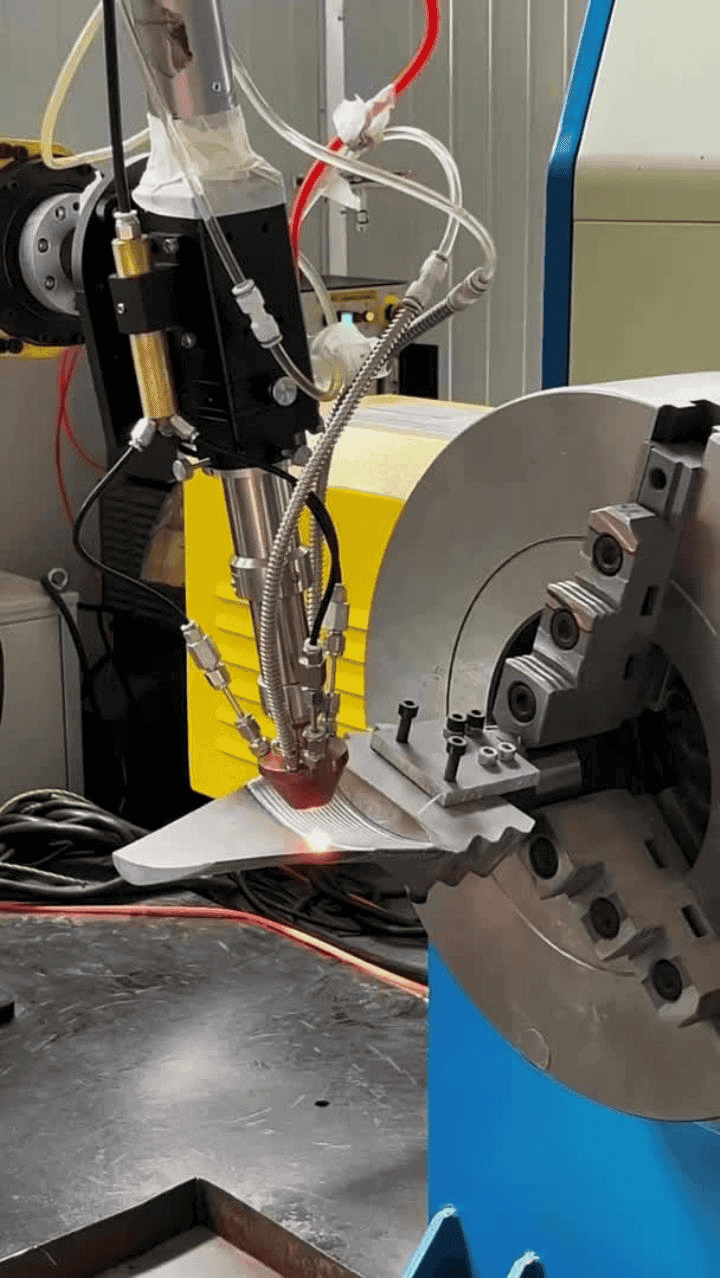
Precision Laser Cladding Process
Laser cladding systems combine advanced laser sources with intelligent motion control to achieve highly accurate material deposition.
Typical equipment configuration includes:
- Fiber laser or semiconductor laser
- Laser power: 1–6 kW
- Robotic motion system
- Multi-axis positioning platform
- Coaxial powder feeder
- Closed-loop shielding gas system
Coaxial powder delivery enables uniform deposition regardless of component orientation, making it particularly suitable for complex geometries such as blade root components, bearing seats, shaft journals, and gear profiles.
Intelligent Process Monitoring
Modern laser cladding systems increasingly incorporate intelligent monitoring technologies to improve manufacturing consistency.
Typical monitoring systems include:
- Thermal imaging
- High-speed vision cameras
- Melt pool monitoring
- Temperature sensing
- Layer height measurement
- Closed-loop adaptive control
Real-time monitoring continuously adjusts laser power, scanning speed, and powder feed rate to maintain stable deposition quality while minimizing defects such as porosity, cracking, and excessive dilution.

Post-Processing and Precision Machining
After laser cladding, post-processing is essential to achieve the final dimensional accuracy, surface integrity, and mechanical performance required for long-term industrial service.
Depending on the material system and application requirements, the following operations may be performed:
Stress-Relief Heat Treatment
Residual stresses generated during rapid heating and cooling can be reduced through appropriate stress-relief annealing or heat treatment. This improves structural stability and enhances long-term fatigue performance.
Precision CNC Machining
Following cladding, excess material is removed through high-precision machining to restore the original component geometry.
Typical finishing operations include:
- Five-axis CNC machining
- Cylindrical grinding
- Surface grinding
- Precision turning
- Polishing
These processes ensure accurate dimensional restoration while achieving the required surface roughness and assembly tolerances.
Final Surface Engineering
Depending on service requirements, additional surface treatments may be applied to further improve:
- Wear resistance
- Corrosion resistance
- Surface finish
- Fatigue strength
- Operational reliability
Repair Performance and Technical Advantages
Laser cladding provides multiple technical advantages over conventional repair technologies, making it one of the preferred remanufacturing processes for high-value industrial components.
Strong Metallurgical Bonding
Unlike thermal spraying or electroplating, laser cladding creates a fully metallurgical bond between the deposited material and the substrate.
This provides:
- High bonding strength
- Excellent load transfer capability
- Outstanding long-term durability
- Reduced risk of coating delamination
Low Heat Input
The highly concentrated laser energy minimizes the heat-affected zone, typically remaining below approximately 0.5 mm depending on material and process parameters.
Benefits include:
- Reduced thermal distortion
- Improved dimensional stability
- Lower residual stress
- Better preservation of substrate properties
Refined Microstructure
Rapid solidification during laser cladding produces fine dendritic or equiaxed grain structures.
Compared with conventional welding, refined microstructures generally provide:
- Higher hardness
- Improved toughness
- Better wear resistance
- Enhanced fatigue performance
- Increased structural uniformity
Excellent Dimensional Accuracy
Combined with digital inspection and CNC finish machining, laser cladding restores components to their original engineering dimensions while maintaining high geometric accuracy.
This is particularly important for:
- Shaft journals
- Bearing seats
- Gear profiles
- Blade root interfaces
- Precision sealing surfaces
Flexible Material Selection
Laser cladding supports a wide range of engineering materials suitable for different operating environments.
Typical material systems include:
- Nickel-based alloys
- Cobalt-based alloys
- Iron-based alloys
- Stainless steels
- Tool steels
- Metal matrix composite powders
- Tungsten carbide reinforced alloys
This flexibility enables customized solutions according to wear mechanisms, corrosion conditions, and service requirements.
Representative Industrial Applications
Laser cladding has become a mature industrial technology across multiple sectors beyond wind energy.
Wind Energy Equipment
Representative repair applications include:
- Blade root metal inserts
- Main shafts
- Gearbox gears
- Bearing journals
- Pitch bearing rings
- Coupling components
- Generator shafts
- Hydraulic cylinders
These repairs improve wear resistance, restore dimensional accuracy, and reduce maintenance costs while extending component service life.
Power Generation Equipment
Typical applications include:
- Steam turbine shafts
- Valve stems
- Valve seats
- Pump shafts
- Bearing journals
- Seal rings
- Rotating sleeves
Laser cladding enables efficient restoration of localized damage without replacing complete components.
Oil & Gas Equipment
Representative components include:
- Drilling tool joints
- Hydraulic piston rods
- Plunger rods
- Valve components
- Pump sleeves
- Flow-control parts
Wear-resistant cobalt-based or nickel-based alloys significantly improve resistance to abrasion and corrosion under demanding operating conditions.
Heavy Industrial Equipment
Laser cladding is also widely used for:
- Rolling mill rolls
- Crusher shafts
- Mining gears
- Conveyor rollers
- Hydraulic cylinders
- Large transmission shafts
The process extends maintenance intervals while reducing material consumption and equipment downtime.
Typical Engineering Results
Representative industrial applications demonstrate several consistent benefits:
- Significant extension of component service life
- Reduced maintenance frequency
- Lower replacement costs
- Improved wear resistance
- Enhanced corrosion resistance
- Better dimensional recovery
- Reduced thermal deformation
- Improved production efficiency
Because only damaged regions require restoration, laser cladding minimizes material consumption while maintaining the integrity of the original component.
This combination of technical performance and economic value has made laser cladding one of the most important remanufacturing technologies for modern industrial equipment.
Future Development
As intelligent manufacturing continues to evolve, laser cladding is rapidly expanding beyond conventional repair applications. The integration of automation, digital manufacturing, advanced materials, and artificial intelligence is transforming laser cladding into a comprehensive manufacturing technology capable of supporting the entire lifecycle of high-value industrial components.
Future development will focus on higher precision, greater efficiency, smarter process control, and broader industrial applications.
Intelligent Manufacturing and Digital Integration
Digital manufacturing has become one of the most important development directions for laser cladding.
Modern manufacturing systems are increasingly integrating:
- Artificial Intelligence (AI)
- Digital Twin technology
- Industrial Internet of Things (IIoT)
- Robotic automation
- 3D scanning
- CAD/CAM integration
- Real-time process monitoring
- Manufacturing Execution Systems (MES)
These technologies enable a fully digital workflow covering:
- Component inspection
- Damage evaluation
- Reverse engineering
- Toolpath generation
- Laser cladding
- Quality inspection
- Digital documentation
AI-assisted parameter optimization can continuously analyze process data, automatically adjust manufacturing parameters, and improve production consistency while reducing operator intervention.
High-Precision Micro Laser Cladding
As precision manufacturing continues advancing, demand is increasing for micro-scale laser cladding capable of restoring extremely small functional surfaces.
Future developments include:
- Ultra-small laser spot sizes
- High-precision powder delivery
- Micron-level deposition accuracy
- Stable micro-melt pool control
- Multi-axis synchronized motion
Micro laser cladding is expected to support applications such as:
- Precision molds
- Medical instruments
- Semiconductor tooling
- Optical manufacturing equipment
- Precision mechanical assemblies
- Micro wear-resistant structures
These capabilities will enable localized restoration while minimizing machining allowance and preserving component geometry.
Large-Scale Additive Manufacturing
High-power laser systems combined with robotic automation are expanding laser cladding from localized repair toward large-scale additive manufacturing.
Modern Directed Energy Deposition (DED) systems are capable of producing or rebuilding large engineering structures through near-net-shape manufacturing.
Representative applications include:
- Large rotating shafts
- Heavy-duty rollers
- Hydraulic cylinders
- Pressure vessel components
- Industrial frames
- Structural supports
- Heavy equipment assemblies
Near-net-shape manufacturing reduces material waste while shortening production cycles for large metal components.
Functionally Graded Materials (FGMs)
Future laser cladding systems will increasingly support Functionally Graded Materials (FGMs).
Instead of depositing a single alloy throughout an entire component, powder composition can be continuously adjusted during processing to produce gradual transitions in material properties.
Typical examples include:
- Wear-resistant outer surfaces
- Tough inner structures
- Corrosion-resistant flow channels
- High-strength bearing regions
- Impact-resistant transition zones
This approach allows individual areas of a component to be optimized according to their specific operating conditions, improving overall performance and extending service life.
Advanced Alloy Development
Material innovation continues to expand the capabilities of laser cladding.
Emerging material systems include:
- High-entropy alloys (HEAs)
- Amorphous alloys
- Nano-reinforced composite powders
- Metal matrix composites (MMCs)
- Carbide-reinforced alloys
- Customized engineering alloys
These advanced materials offer improved combinations of:
- Wear resistance
- Corrosion resistance
- Thermal stability
- Fatigue resistance
- Mechanical strength
Future material development will increasingly focus on application-specific performance optimization.
Integration with Additive Manufacturing
Laser cladding has become one of the most mature Directed Energy Deposition (DED) technologies within metal additive manufacturing.
Rather than replacing other additive manufacturing processes, laser cladding increasingly complements them.
Typical integrated manufacturing strategies include:
- Near-net-shape additive manufacturing
- Localized dimensional restoration
- Functional surface enhancement
- Hybrid CNC and additive manufacturing
- Component modification
- Engineering redesign
This hybrid manufacturing approach combines the efficiency of additive processes with the precision of conventional machining, providing greater flexibility for complex industrial components.
Greenstone Laser Cladding Processing Services
Greenstone provides professional laser cladding processing services for high-value industrial components across a wide range of industries.
Our processing capabilities include:
- Laser cladding manufacturing
- Component remanufacturing
- Surface enhancement
- Wear-resistant coatings
- Corrosion-resistant coatings
- Dimensional restoration
- Directed Energy Deposition (DED) processing
- Prototype manufacturing
- Process development
- Customized engineering solutions
Typical processed components include:
- Wind turbine components
- Industrial shafts
- Gear components
- Hydraulic cylinders
- Valve components
- Pump components
- Rollers
- Mold components
- Heavy-duty mechanical parts
- Precision rotating assemblies
Based on component geometry, material characteristics, operating conditions, and performance requirements, customized laser cladding processes are developed to achieve reliable metallurgical bonding, excellent surface quality, and long-term service performance.
Conclusion
Laser cladding has evolved into one of the most important technologies in modern advanced manufacturing, combining surface engineering, remanufacturing, additive manufacturing, and precision repair within a single process.
Through precise material deposition, strong metallurgical bonding, refined microstructures, and minimal thermal distortion, laser cladding provides an efficient and reliable solution for restoring high-value industrial components while enhancing their operational performance and extending service life.
As intelligent manufacturing, digital process control, advanced alloy development, and robotic automation continue to advance, laser cladding will play an increasingly significant role in sustainable manufacturing and lifecycle management.
Today, laser cladding is widely applied across wind energy, power generation, oil and gas, mining, metallurgy, marine engineering, mold and tooling, heavy equipment, transportation, and precision manufacturing. Beyond component repair, it has become a core manufacturing technology supporting high-performance surface engineering, additive manufacturing, and next-generation industrial production.
With continued innovation in materials, equipment, and digital manufacturing technologies, laser cladding will remain a key enabling process for improving equipment reliability, reducing maintenance costs, increasing resource efficiency, and supporting the long-term development of advanced industrial manufacturing.
Thomas Tong
Laser Cladding Equipment Engineering Director & Industrial System Integration Expert Thomas Tong serves as Greenstone’s Laser Cladding Equipment Engineering Director, focusing on laser processing equipment development, manufacturing integration, automation systems, and turnkey industrial solution implementation. With comprehensive experience in industrial equipment engineering and advanced manufacturing systems, Thomas leads the design, integration, and optimization of Greenstone’s laser cladding equipment platforms, including robotic laser cladding systems, multi-axis processing systems, automated production solutions, and customized industrial equipment. His expertise covers the complete equipment development process, from mechanical structure design, laser system integration, motion control coordination, electrical engineering, automation programming, and final commissioning. Through…