
Laser Cladding for Tire Extruder Screws: Wear Protection and Screw Flight Repair
April 18, 2026


Extruder screws used in tire and rubber production operate continuously under high mechanical load, friction and abrasive material flow. Over long-term service, the screw flights and other high-contact regions gradually lose material, changing the original geometry and reducing extrusion stability.
Laser cladding provides an effective method for rebuilding worn screw flights and applying wear-resistant metallic surfaces to critical areas of tire extruder screws.
The technology can be used for both remanufacturing worn screws and reinforcing new components before service.
Why Tire Extruder Screws Wear
During rubber extrusion, the rotating screw continuously transports, compresses and mixes material inside the barrel.
The combination of mechanical contact, friction, pressure and abrasive compounds produces progressive wear, particularly on the screw flights.
Typical deterioration includes:
- Screw flight edge wear
- Reduction in flight height
- Localized material loss
- Increased clearance between screw and barrel
- Uneven wear along the screw length
- Surface scoring and abrasion
- Dimensional deviation after extended operation
As wear progresses, the working clearance between the screw and barrel increases. This can affect material transport, pressure development, extrusion efficiency and process consistency.
When the main screw body remains structurally sound, replacing the entire component may not be necessary.
Laser Cladding for Screw Flight Restoration
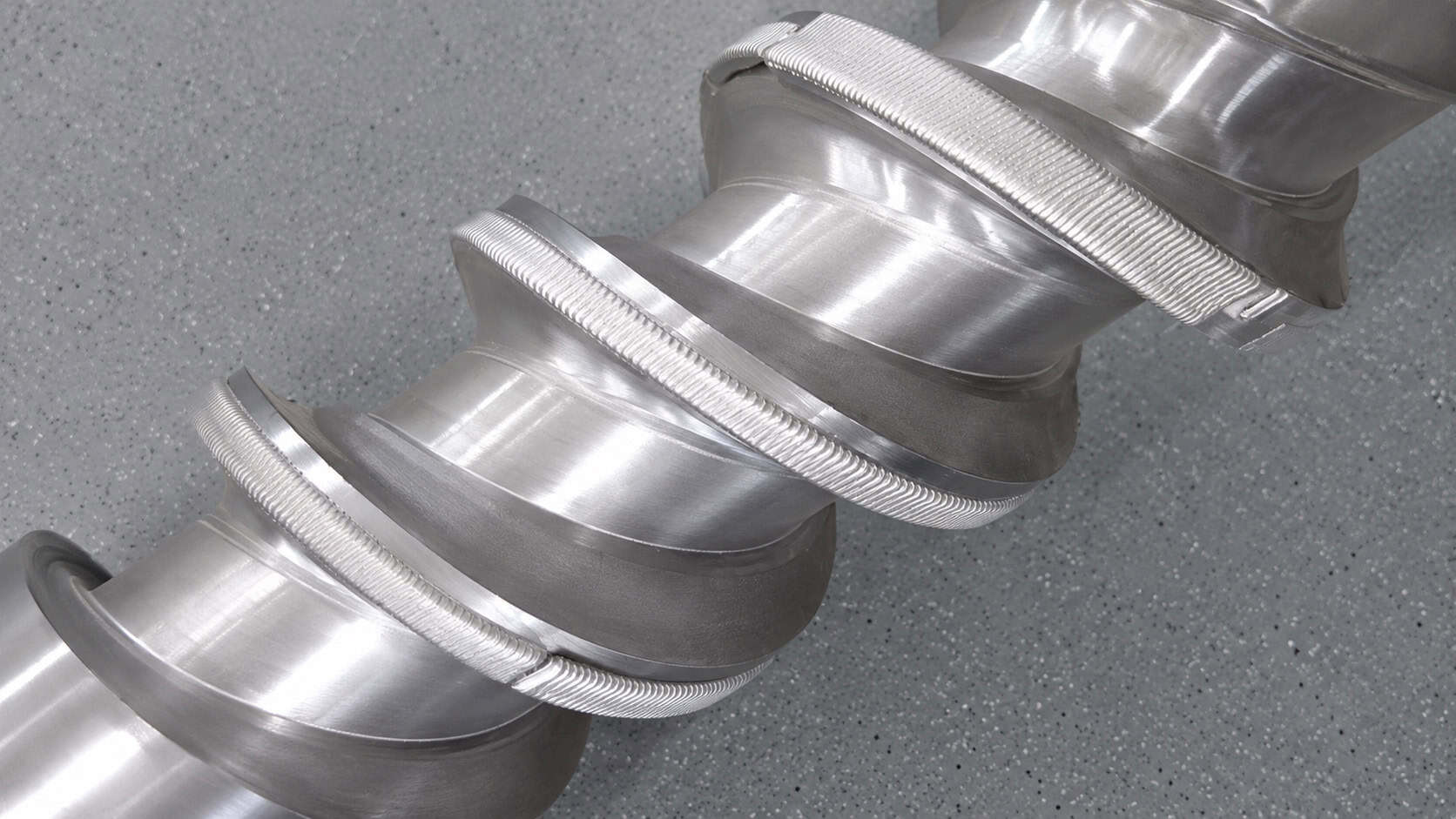
Laser cladding rebuilds material directly onto worn regions of the screw.
Metallic powder is delivered into a controlled laser-generated melt pool, producing a metallurgically bonded deposited layer on the substrate.
For screw flight repair, the process typically follows:
Inspection → surface preparation → laser cladding → dimensional rebuilding → machining/grinding → dimensional inspection
The deposited material provides sufficient allowance for subsequent finishing, allowing the screw flight profile to be restored close to its original geometry.
Following the Helical Geometry
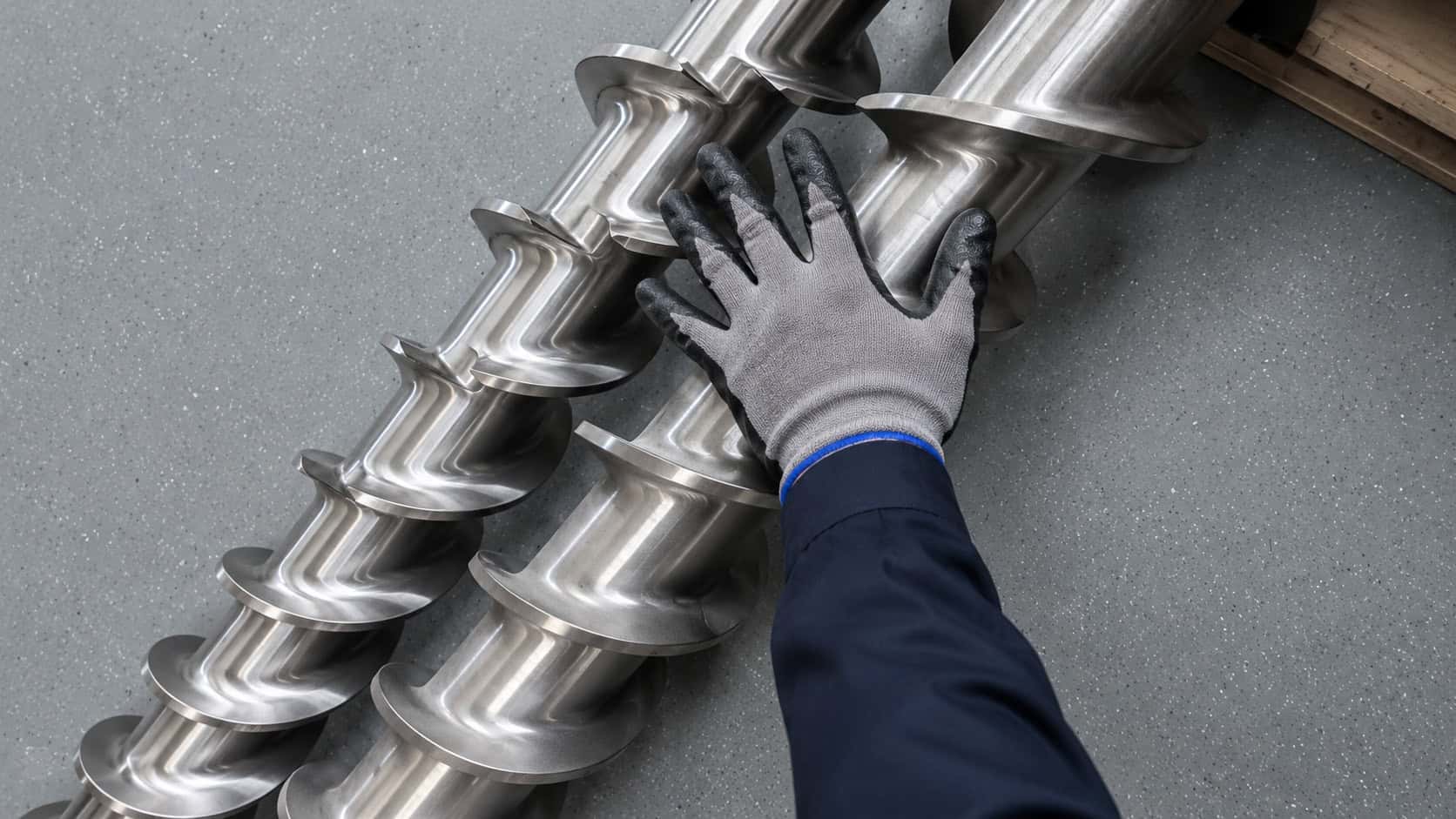
Unlike conventional cylindrical shafts, extruder screws contain continuous helical features.
Successful laser cladding therefore requires coordinated motion between workpiece rotation and longitudinal movement of the processing head or machine axis.
The laser must follow the screw helix while maintaining appropriate:
- Processing position
- Travel speed
- Stand-off distance
- Powder delivery
- Track overlap
- Laser orientation
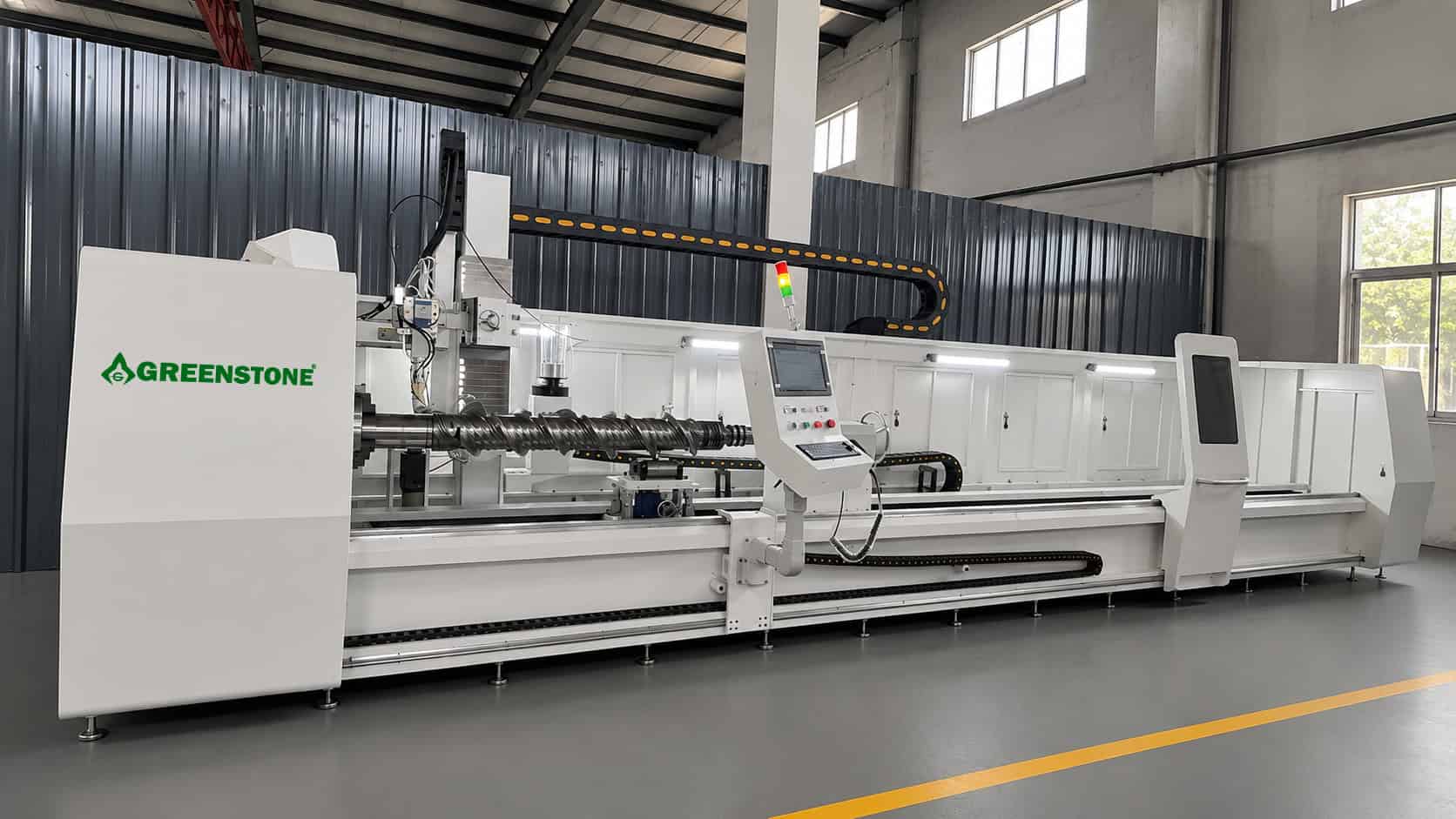
For large or long extruder screws, CNC-controlled multi-axis systems provide the repeatability required for continuous processing over extended helical paths.
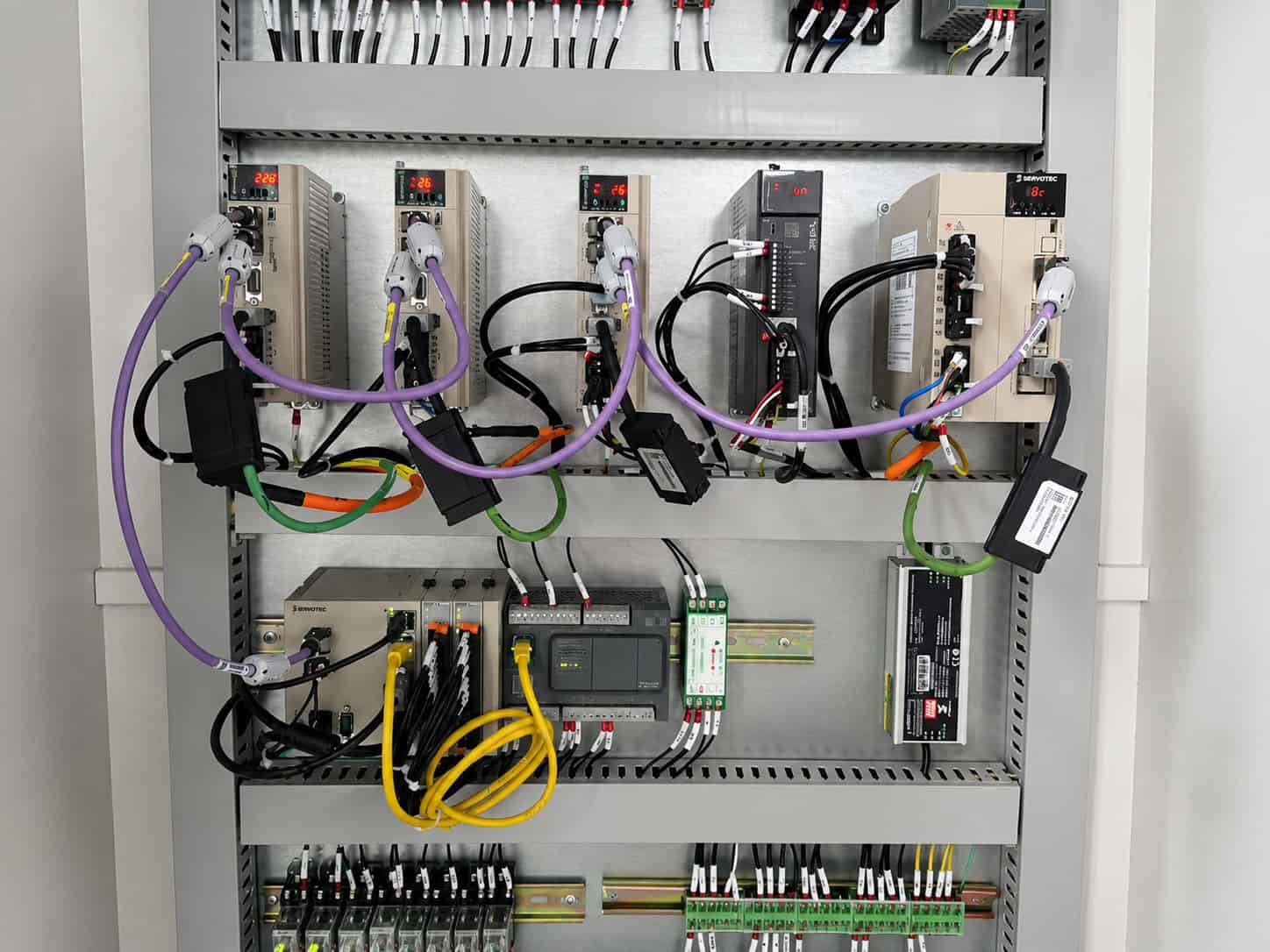
This motion-control capability is a critical part of the process—not simply an accessory to the laser source.
Localized Repair Instead of Full-Surface Deposition
Wear is not always uniform across the complete screw.
In many applications, the most severe material loss occurs on the outer edges and working surfaces of the screw flights.
Laser cladding allows material to be deposited specifically on these high-wear regions rather than coating the entire screw body.
This selective approach can reduce:
- Powder consumption
- Heat input
- Processing time
- Unnecessary machining
- Overall remanufacturing cost
For heavily worn sections, additional layers can be deposited to rebuild the required material volume.
Wear-Resistant Material Selection
The cladding alloy should be selected according to the substrate material, wear mechanism and required finishing characteristics.
Depending on operating conditions, suitable material systems may include nickel-based, iron-based or other wear-resistant alloys, with additional hard phases considered where severe abrasive wear resistance is required.
However, maximum hardness is not automatically the best solution.
The deposited layer must provide an appropriate balance between:
Wear resistance + toughness + crack resistance + metallurgical compatibility + machinability
For screw repair, this balance is particularly important because the deposited region normally requires subsequent machining or grinding to restore the final flight profile.
Process Control for Screw Laser Cladding
The quality of a repaired screw depends on the complete process window.
Important parameters include:
- Laser power
- Beam size
- Travel speed
- Rotational speed
- Powder feed rate
- Track overlap
- Layer thickness
- Shielding gas
- Preheating strategy when required
These variables must be coordinated with the screw diameter, pitch, substrate material, cladding alloy and required rebuilding thickness.
The objective is to obtain stable deposition, reliable metallurgical bonding, controlled dilution and sufficient rebuilding thickness without introducing unnecessary thermal distortion or cracking.
Managing Heat Input on Large Screws
Extruder screws can be long, heavy and geometrically complex. During continuous cladding, thermal accumulation must therefore be considered.
Processing strategy may involve controlling deposition sequence, laser energy input, interpass temperature and workpiece rotation to manage heat distribution.
For certain substrate and coating combinations, appropriate preheating or controlled cooling may also be required.
The correct thermal strategy depends on the material system and should be determined during process development rather than applying a single fixed parameter to every screw.
Automated Cladding for Long Extruder Screws
Industrial screw remanufacturing requires more than a laser source and cladding head.
A practical system must coordinate:
Laser processing + powder feeding + screw rotation + longitudinal travel + CNC control
For large workpieces, the machine structure must also provide sufficient load capacity, travel length and positioning stability.
Automated programming allows the cladding path to follow different screw diameters, pitches and repair zones while maintaining repeatable deposition conditions.
This makes laser cladding suitable for both individual high-value screw repair and repetitive industrial remanufacturing.
Post-Machining and Dimensional Restoration
Laser cladding is normally followed by precision machining or grinding.
Excess deposited material is removed until the required screw flight diameter, profile and clearance are restored.
Final inspection may include:
- Screw outside diameter
- Flight height and profile
- Dimensional consistency along the screw
- Surface condition
- Cladding integrity
- Required hardness or coating properties
The finished component must meet the mechanical and dimensional requirements of the extrusion system rather than simply exhibit a visually complete cladding layer.
Repair of Worn Screws and Protection of New Screws
Laser cladding can be applied at two different stages of the screw lifecycle.
For worn extruder screws, damaged flight surfaces can be rebuilt and subsequently machined back to the required dimensions.
For new screws, selected high-wear areas can be reinforced before entering service to improve surface durability.
This makes laser cladding both a remanufacturing technology and a preventive surface-engineering process.
Applications Beyond Tire Extrusion
The same processing principle can be applied to other industrial screw components exposed to severe wear, including:
- Rubber extruder screws
- Plastic extruder screws
- Twin-screw extruder components
- Injection-moulding screws
- Feed screws
- Industrial conveying screws
- Other large helical wear components
The appropriate cladding strategy depends on the actual wear mechanism, screw geometry, substrate material and operating conditions.
GREENSTONE Laser Cladding Solutions for Extruder Screws
GREENSTONE provides laser cladding process and equipment solutions for extruder screws, large shafts and other industrial components requiring wear-resistant surface engineering or dimensional restoration.
For screw applications, systems can integrate CNC-controlled rotation, longitudinal motion, precision powder feeding and automated helical-path laser cladding according to the dimensions and geometry of the workpiece.
The solution should be configured around the actual component rather than selected only according to laser power.
For a screw laser cladding project, provide the screw drawing, overall length, maximum diameter, pitch, base material, worn position, required rebuilding thickness, cladding material if specified and target production capacity. These parameters can then be used to evaluate the appropriate process, material and equipment configuration.
Thomas Tong
Laser Cladding Equipment Engineering Director & Industrial System Integration Expert Thomas Tong serves as Greenstone’s Laser Cladding Equipment Engineering Director, focusing on laser processing equipment development, manufacturing integration, automation systems, and turnkey industrial solution implementation. With comprehensive experience in industrial equipment engineering and advanced manufacturing systems, Thomas leads the design, integration, and optimization of Greenstone’s laser cladding equipment platforms, including robotic laser cladding systems, multi-axis processing systems, automated production solutions, and customized industrial equipment. His expertise covers the complete equipment development process, from mechanical structure design, laser system integration, motion control coordination, electrical engineering, automation programming, and final commissioning. Through…