
Laser Cladding Solutions for Metallurgical Equipment and Rolling Components
Wear-Resistant Surface Engineering for Rolling Mills, Guide Wheels, and Industrial Processing Equipment
Application Overview
Metallurgical equipment and metal processing machinery operate under demanding service conditions involving high temperatures, cyclic thermal loading, heavy mechanical stress, abrasion, corrosion, and repeated impact. Critical components such as rolling mill rolls, guide wheels, conveyor rollers, support rollers, shafts, and transmission parts are continuously exposed to severe wear and surface degradation, resulting in reduced production efficiency, increased maintenance frequency, and higher operating costs.
Traditional surface restoration methods—including arc welding, thermal spraying, and electroplating—often suffer from limited coating life, higher heat input, inconsistent coating quality, or environmental concerns. Laser cladding provides an advanced surface engineering solution by depositing high-performance wear-resistant alloys directly onto component surfaces through metallurgical bonding. This process significantly improves wear resistance, impact resistance, and service life while minimizing thermal distortion and reducing post-processing requirements.
Today, laser cladding is widely applied to rolling equipment, continuous production lines, material handling systems, and other heavy-duty industrial machinery where long-term reliability and stable surface performance are essential.
Typical Components
Laser cladding is suitable for manufacturing, repair, and performance enhancement of various metallurgical and industrial processing components, including:
- Rolling mill rolls
- Backup rolls
- Work rolls
- Guide wheels
- Conveyor rollers
- Pinch rolls
- Support rollers
- Drive shafts
- Transmission gears
- Bearing journals
- Roller sleeves
- Industrial wear components
Laser Cladding Solution
Greenstone provides customized laser cladding services for metallurgical equipment manufactured from cast iron, cast steel, carbon steel, alloy steel, and other engineering materials.
Laser cladding restores worn functional surfaces while producing dense metallurgically bonded coatings with outstanding wear resistance, impact resistance, and dimensional stability.
Scene 1 – Laser Cladding for Rolling Mill Rolls
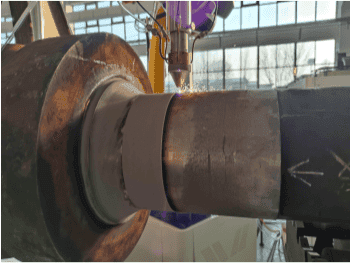
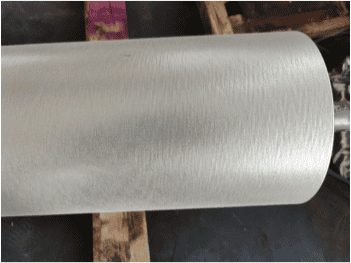
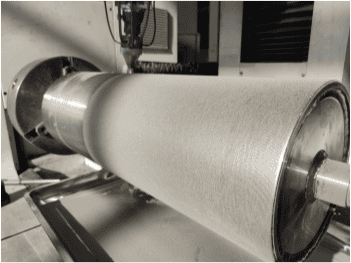
Rolling mill rolls are among the most critical wear components in metal processing lines. Their surface condition directly influences production efficiency, product quality, and equipment reliability. Long-term operation under rolling pressure, elevated temperatures, and cyclic loading often results in abrasive wear, thermal fatigue, surface cracking, and localized material loss.
Laser cladding enables customized alloy selection according to roll material, operating conditions, and performance requirements. The deposited coating forms a dense metallurgical bond with the substrate, providing excellent resistance to wear, impact, and thermal fatigue.
Compared with conventional repair methods, laser cladding offers significantly lower heat input, reducing thermal distortion while maintaining dimensional accuracy. Typical coating hardness reaches 50–60 HRC, with excellent hardness uniformity that helps prevent localized surface defects and extends roll service life.
Typical benefits include:
- Improved wear resistance
- Enhanced thermal fatigue resistance
- Increased impact resistance
- Reduced maintenance frequency
- Extended roll service life
- Lower lifecycle operating costs
Scene 2 – Laser Cladding for Guide Wheels
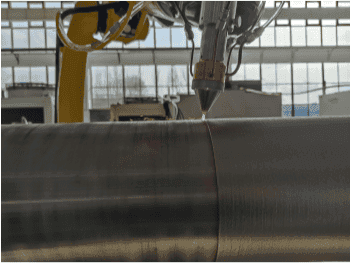
Guide wheels are critical components in rolling, conveying, and continuous production systems, where they maintain material guidance and production stability. Continuous exposure to elevated temperatures, mechanical loading, friction, and scale often results in severe wear, thermal fatigue, and surface damage.
Laser cladding provides an effective solution by producing dense, wear-resistant coatings with minimal dilution and excellent metallurgical bonding. Optimized alloy selection significantly improves resistance to abrasion, corrosion, cracking, and thermal fatigue.
Typical coating characteristics include:
- Coating thickness: 1–3 mm
- Surface hardness: typically above 60 HRC
- Low heat-affected zone
- Excellent dimensional stability
- High coating density
- Uniform coating quality
After laser cladding, guide wheels can be restored to service with substantially improved durability, helping reduce maintenance downtime and increase production efficiency.


Technical Advantages
Compared with conventional repair technologies, laser cladding provides several important advantages for metallurgical equipment:
- Strong metallurgical bonding between coating and substrate
- Minimal heat-affected zone and low thermal distortion
- Excellent wear, corrosion, and impact resistance
- Uniform hardness distribution
- Flexible coating thickness control
- High process repeatability
- Reduced machining allowance
- Environmentally friendly processing
- Lower lifecycle maintenance costs
Typical Service Workflow
Greenstone provides complete laser cladding services including:
- Component inspection
- Wear assessment
- Surface preparation
- Material selection
- Process development
- Robotic laser cladding
- Heat treatment (when required)
- Precision finish machining
- Final quality inspection
- Technical support
Each process is optimized according to component material, geometry, operating environment, and customer performance requirements.
Conclusion
Laser cladding has become a highly effective solution for restoring and enhancing rolling mill rolls, guide wheels, conveyor rollers, and other metallurgical equipment components operating under severe wear and thermal loading conditions.
By combining advanced laser processing with high-performance wear-resistant alloys, Greenstone provides reliable laser cladding services that improve wear resistance, extend component service life, reduce maintenance costs, and increase production efficiency.
Whether for rolling equipment, continuous production systems, material handling machinery, or other heavy-duty industrial applications, laser cladding delivers a sustainable and cost-effective approach to modern industrial remanufacturing and surface engineering.
