


Semprotan dingin
Provide customers with one-stop cold spray technology overall solutions to meet customers’ higher demands for advanced manufacturing technology
Ikhtisar layanan
Semprotan dingin is a technique for depositing powder particles in the solid state by accelerating them towards a surface within a supersonic gas flow. Cold spray can be used to coat a variety of materials (metals, glass, ceramics, polymers), for repair of worn or damaged metal components, and to build large components layer-by-layer.
We offer comprehensive cold spray technology services and one-stop equipment solutions, covering the entire process from coating preparation and repair to customized equipment supply. By utilizing high-speed particle impact to achieve material deposition at low temperatures, cold spray technology is suitable for a variety of materials, including metals, alloys, and ceramics, avoiding issues such as oxidation and thermal stress caused by high temperatures. This makes it particularly ideal for surface treatment of heat-sensitive materials and precision components. Our services are widely applied in industries such as aerospace, automotive, and electronics, and we are committed to providing customers with efficient, environmentally friendly, and high-quality coating solutions as well as customized equipment support to meet diverse needs.
Keuntungan teknis
Cold spray technology achieves material deposition through low-temperature, high-speed particle impact, avoiding oxidation and thermal stress. It is suitable for a variety of materials, including metals, ceramics, and polymers, making it particularly ideal for heat-sensitive components and precision repairs, delivering efficient, environmentally friendly, and high-quality coating solutions.
Low-Temperature Processing
Prevents material oxidation and thermal stress, ideal for heat-sensitive components.
Wide Applicability
Supports coating of various materials, including metals, ceramics, and polymers.
High Efficiency Deposition
High-speed particle impact enables fast and uniform material deposition.
Eco-Friendly
No high-temperature heating required, reducing energy consumption and environmental impact.
Precision Repair
Suitable for repairing precision components while maintaining original performance.
High-Quality Coating
Dense coatings with high bonding strength, extending component lifespan.
Fitur teknologi pencetakan 3D logam laser
Introduction to Cold Spray Technology
In the cold spray process, powder particles (typically ranging in size from 10 to 40 µm) are accelerated to very high velocities (200 to 1200 m/s) using a supersonic compressed gas jet at temperatures below their melting point. Upon impact with the substrate, these particles undergo extreme and rapid plastic deformation, which disrupts the thin surface oxide films present on all metals and alloys. This deformation enables intimate conformal contact between the exposed metal surfaces under high local pressure, promoting adhesion and facilitating the rapid formation of thick deposited material layers. Cold spray technology has a wide range of applications, including repair, functional coatings, and additive manufacturing across various industrial sectors.
Features and advantages of cold spraying
Cold Spray is an advanced additive manufacturing and coating technology that uses high-velocity gas streams to deposit metal or composite powders onto a substrate. Unlike traditional thermal spray methods, cold spray operates at relatively low temperatures, typically below the melting point of the material being deposited. In this process, a high-pressure gas (such as nitrogen or helium) is heated and accelerated through a de Laval nozzle, reaching supersonic speeds. Powder particles are injected into the gas stream and impact the substrate at high velocity, bonding through plastic deformation rather than melting. This results in dense, low-porosity coatings with excellent adhesion and minimal thermal stress.
Cold spray is valued for its ability to work with a wide range of materials, including metals like aluminum, copper, titanium, and nickel, as well as composites. It is widely used in industries such as aerospace (for repairing turbine blades and engine components), automotive (for wear-resistant coatings), defense (for equipment repair), and electronics (for conductive layers). Key advantages of cold spray include high deposition efficiency, minimal oxidation, and the ability to repair or restore components without compromising their structural integrity. Additionally, it is environmentally friendly, as it produces no harmful emissions and consumes less energy compared to traditional methods.

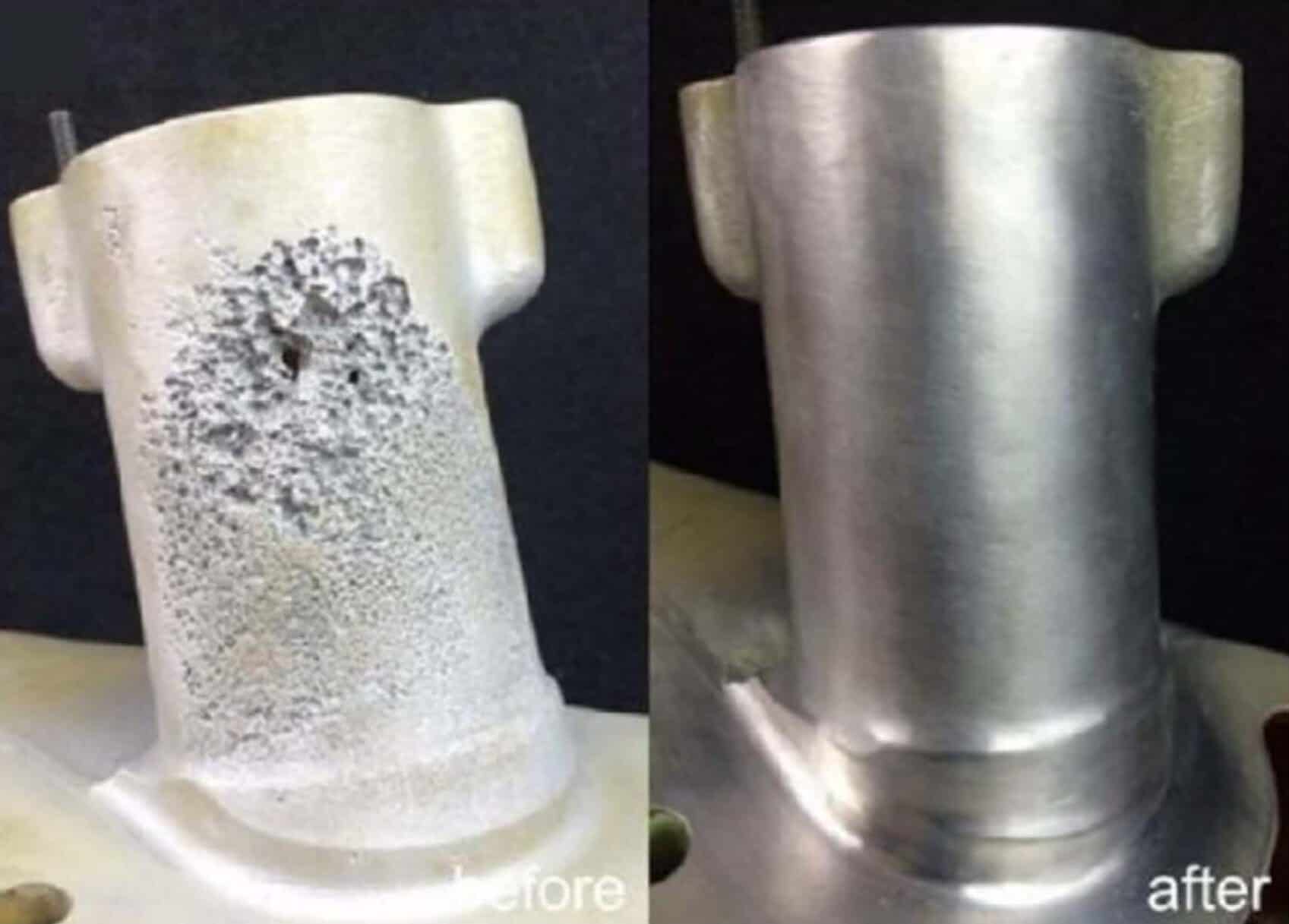
Before and after comparison of parts repaired by cold spraying
Prinsip semprotan dingin
bidang layanan
Cold spray technology is widely applied in multiple high-end fields of high-performance metal components, including aircraft engine blade repair, gas turbine high-temperature component coatings, automotive high-performance piston coatings, rocket engine nozzle repair, nuclear reactor component protection, high-performance bearing surface enhancement, marine propeller repair, and high-end mold surface repair and strengthening. These applications demonstrate the exceptional capabilities of cold spray technology in enhancing component performance, extending service life, and achieving efficient repairs.

Perbaikan Bilah Mesin Pesawat Terbang

Pelapisan Komponen Suhu Tinggi Turbin Gas

Pelapis Piston Berkinerja Tinggi Otomotif

Perbaikan Nozzle Mesin Roket

Perlindungan Komponen Reaktor Nuklir

Peningkatan Permukaan Bantalan Berkinerja Tinggi

Perbaikan Baling-baling Laut
