
Wire-Fed Laser Cladding of Babbitt Alloys: Applications in Journal Bearings and Thrust Bearing Manufacturing
November 2, 2026


Technical Applications | Laser Cladding | Bearing Manufacturing & Repair
1. Introduction
Babbitt alloys, also known as white metals, are widely used as bearing lining materials in industrial sliding bearings. Their low-friction characteristics under suitable lubrication conditions, conformability, embeddability, and compatibility with rotating shaft surfaces make them particularly suitable for heavy-duty rotating machinery.
Common applications include journal bearings, radial bearing pads, circular thrust bearings, sector-shaped thrust pads, and annular thrust bearing surfaces used in turbines, generators, compressors, pumps, marine propulsion systems, and other industrial equipment.
Traditionally, Babbitt bearing surfaces have been manufactured or repaired using centrifugal casting, static casting, and other thermal deposition methods.
Wire-fed laser cladding offers an alternative manufacturing and restoration process by depositing Babbitt alloy directly onto prepared bearing substrates using controlled laser energy and continuous wire feeding.
Greenstone has established mature wire-fed Babbitt alloy laser cladding processes and accumulated practical project experience in industrial bearing applications, including different bearing geometries and automated deposition configurations.
The technology can be adapted to workpieces ranging from small bearing pads to large industrial bearing assemblies.
2. How Wire-Fed Babbitt Alloy Laser Cladding Works
Wire-fed laser cladding is a directed energy deposition process in which a laser beam provides localized thermal energy while Babbitt alloy wire is continuously delivered into the processing zone.
The deposited material forms a metallurgically bonded or otherwise process-dependent bonded layer on a compatible substrate. The bonding mechanism and resulting interface properties must be confirmed for the specific alloy and substrate combination.
Unlike powder-fed laser cladding, wire-fed deposition uses solid filler wire as the feedstock material.
The main process consists of several coordinated operations:
Surface Preparation: The bearing substrate is cleaned, machined, and prepared to achieve suitable surface conditions for deposition.
Laser Energy Control: Laser power, beam characteristics, and processing speed are adjusted according to the Babbitt alloy composition and substrate properties.
Continuous Wire Feeding: Babbitt alloy wire is introduced into the laser interaction zone at a controlled feeding rate.
Coordinated Motion: CNC axes, industrial robots, or rotary positioners guide the deposition process along the bearing surface.
Layer-by-Layer Deposition: Multiple deposition passes or layers are applied when necessary to achieve the required material thickness.
Finish Machining and Inspection: The deposited bearing surface is machined to its final dimensions and inspected according to the applicable technical requirements.
Because Babbitt alloys generally have relatively low melting temperatures compared with common steel bearing substrates, precise thermal management is particularly important.
Excessive heat input may lead to substrate dilution, undesirable microstructural changes, interfacial defects, or distortion.
Therefore, successful Babbitt alloy laser cladding depends on the coordinated control of laser energy, wire feed rate, deposition speed, shielding conditions, and workpiece temperature.
3. Major Bearing Applications
Wire-fed Babbitt alloy laser cladding can be adapted to several bearing structures with different surface geometries and motion requirements.
3.1 Journal Bearings and Radial Bearing Pads
Journal bearings support rotating shafts and primarily carry radial loads.
Their functional bearing surfaces are generally cylindrical or partially cylindrical, requiring deposition along curved internal surfaces.
Typical applications include:
Steam turbine journal bearings
Generator bearings
Industrial compressor bearings
Centrifugal pump bearings
Marine shaft bearings
Heavy-duty machinery bearing shells
For internal cylindrical bearing surfaces, laser cladding may be performed through coordinated rotation of the workpiece and controlled axial movement of the cladding head.
Depending on the bearing diameter, geometry, and accessibility, robotic systems or specialized CNC configurations may also be used.
The deposition path must account for surface curvature, working distance, wire feeding direction, and overlapping between adjacent tracks.
For split bearing shells or individual radial bearing pads, specialized fixtures can be used to position the component during deposition.
This technology is applicable to both the manufacturing of new Babbitt-lined bearing surfaces and the restoration of worn bearing components.
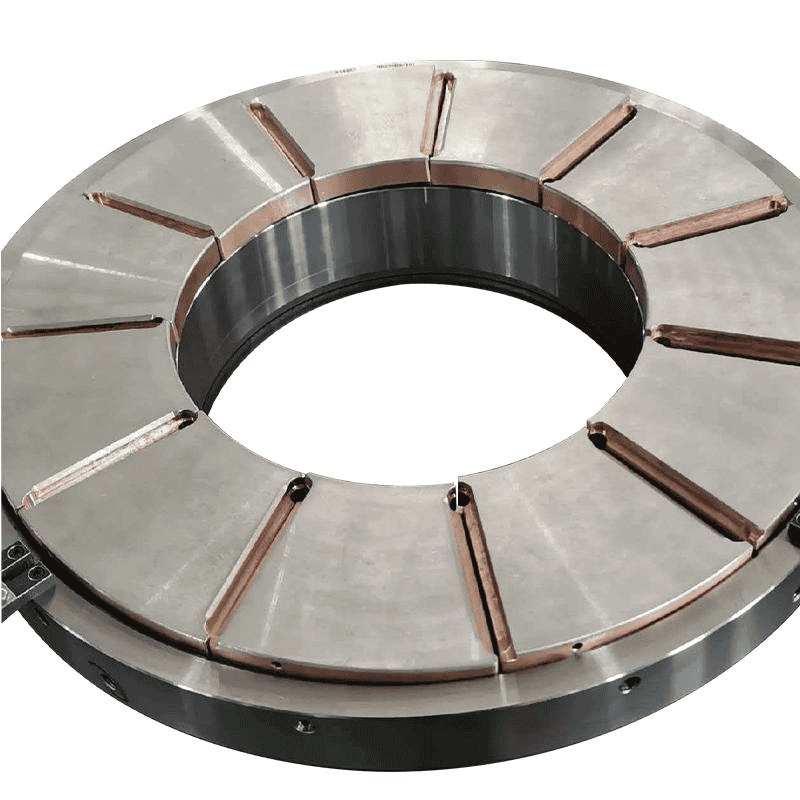
3.2 Circular Thrust Bearings – Full Flat Surfaces
Circular thrust bearings are designed to support axial loads generated during the operation of rotating machinery.
Unlike journal bearings, their working surfaces are predominantly flat.
Wire-fed laser cladding can be applied across these surfaces using coordinated planar motion.
For circular bearing components, deposition paths may be arranged as concentric circles, spiral trajectories, or other optimized scanning patterns.
Typical applications include:
Circular thrust bearing plates
Turbine thrust bearing components
Industrial axial bearing surfaces
Heavy-duty thrust bearing assemblies
Circular Babbitt-lined components
The process requires controlled overlap between deposition tracks to achieve adequate coverage and sufficient machining allowance.
CNC motion systems and robotic laser cladding platforms can be configured according to the bearing diameter, workpiece weight, and required production capacity.
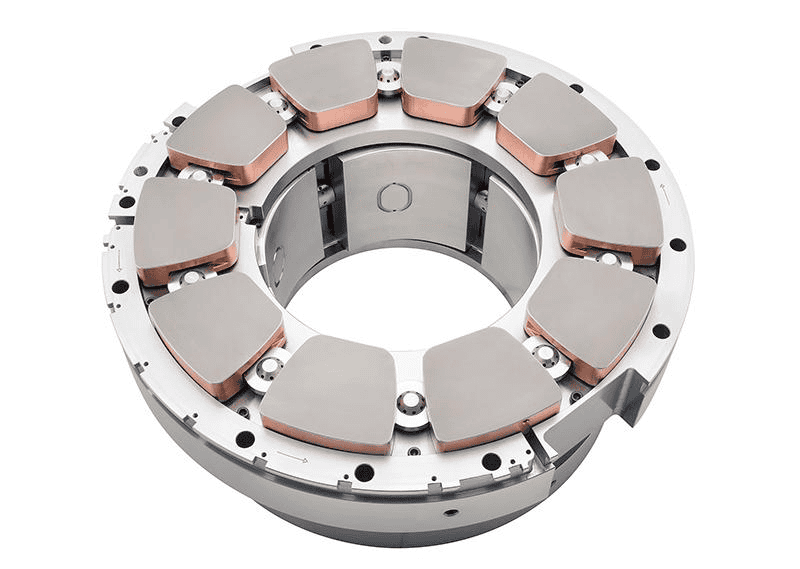
3.3 Sector-Shaped Thrust Pads – Profiled Flat Surfaces
Sector-shaped thrust pads are widely used in tilting-pad thrust bearings, particularly in high-load rotating machinery.
These components have sector-shaped working areas and may incorporate specific geometric features associated with the bearing design.
Compared with full circular bearing surfaces, sector-shaped pads require deposition trajectories adapted to their boundaries.
Wire-fed laser cladding can be applied using robotic motion or multi-axis CNC systems with customized path planning.
Typical applications include:
Tilting-pad thrust bearings
Turbine thrust bearing pads
Generator thrust bearing pads
Industrial compressor thrust pads
Customized sector-shaped bearing components
For batch manufacturing, the deposition program can be adapted to repeated pad geometries, allowing multiple components to be processed using standardized fixtures and validated process parameters.
Where required, the deposited Babbitt layer can subsequently be machined to achieve the specified bearing surface profile.
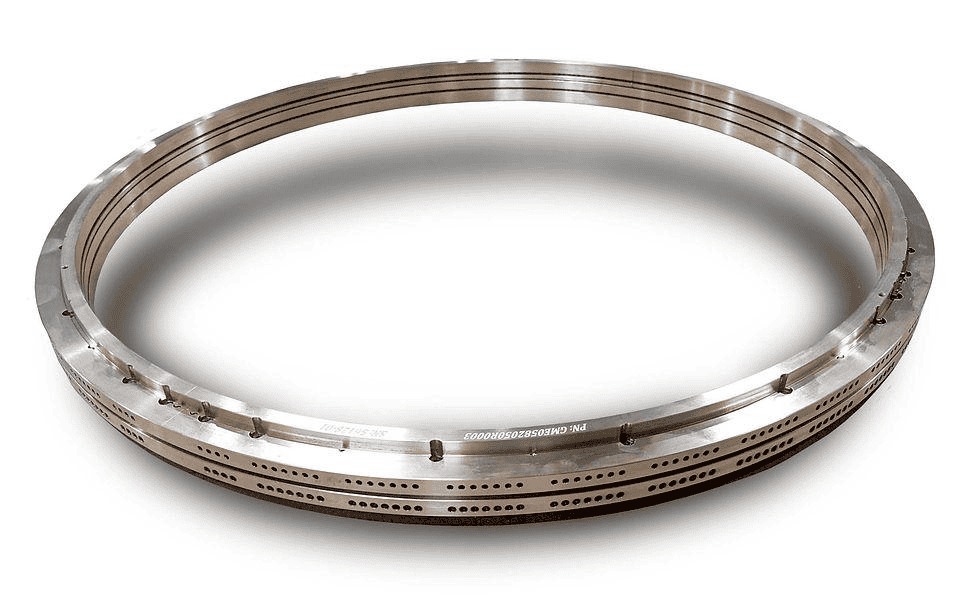
3.4 Annular Thrust Bearings – Ring-Shaped Flat Surfaces
Annular thrust bearings feature ring-shaped working surfaces designed to support axial loads.
These components are commonly used in large rotating machinery and specialized industrial bearing assemblies.
Wire-fed laser cladding can deposit Babbitt alloy onto annular surfaces using coordinated rotary and linear motion.
Typical applications include:
Annular thrust bearing rings
Large industrial thrust bearing assemblies
Marine propulsion bearing components
Heavy machinery axial bearing surfaces
Ring-shaped bearing restoration
For large-diameter annular components, a robotic laser cladding system combined with a rotary positioner can provide flexible deposition coverage.
The motion system can be programmed to maintain a suitable deposition trajectory and processing orientation across the annular surface.
For larger workpieces, equipment configuration must also consider load capacity, rotational stability, clamping requirements, and accessibility.
4. Processing Capability and Technical Parameters
Greenstone develops wire-fed Babbitt alloy laser cladding solutions for bearing components with different dimensions, geometries, and production requirements.
The following parameters represent a typical engineering design range for customized bearing cladding projects.
| Technical Parameter | Design Range / Configuration |
| Deposition Process | Wire-Fed Laser Cladding |
| Cladding Material | Babbitt Alloy / White Metal |
| Workpiece Weight | 10–2,500 kg |
| Target Deposition Rate | 3–5 kg/h |
| Finished Cladding Thickness | 2–10 mm |
| Applicable Surfaces | Internal Cylindrical, Circular, Sector-Shaped, Annular |
| Motion Systems | CNC, Industrial Robot, Rotary Positioner |
| Manufacturing Applications | New Bearing Production and Repair |
| Automation | Coordinated Laser, Wire Feed and Motion Control |
Technical Note: The deposition rate refers to deposited material mass per unit time, rather than the weight of the finished bearing. Actual production performance depends on wire composition, deposition geometry, process stability, and operating conditions.
The finished cladding thickness of 2–10 mm is achieved through an appropriate combination of deposited material thickness, machining allowance, and final surface machining.
The required number of deposition layers depends on the selected process parameters and target thickness.
The 10–2,500 kg workpiece range is accommodated through different equipment and workholding configurations rather than a universal fixed machine design.
5. Equipment Configurations for Different Bearing Geometries
Different bearing structures require different deposition strategies and mechanical configurations.
For internal cylindrical bearing surfaces, coordinated rotary and axial motion is commonly used.
For circular thrust pads, planar CNC motion or robotic scanning can provide controlled surface coverage.
For sector-shaped thrust pads, robotic or CNC path planning can follow the component boundaries and deposition requirements.
For annular thrust bearings, rotary positioning combined with robotic or linear motion may offer a practical configuration.
Greenstone’s customized systems can integrate industrial laser sources, wire-fed cladding heads, precision wire feeding systems, CNC controllers, industrial robots, rotary positioners, and application-specific fixtures.
The appropriate configuration is determined by the bearing dimensions, substrate material, workpiece weight, accessibility, deposition thickness, and production requirements.
6. Technical Advantages and Process Considerations
Wire-fed Babbitt alloy laser cladding offers several potential advantages for bearing manufacturing and repair.
Controlled Material Placement
Wire-fed deposition allows Babbitt alloy to be applied directly to designated bearing surfaces, including localized repair areas and complex geometries.
Localized Thermal Processing
Laser energy is concentrated in the deposition area, potentially reducing overall thermal exposure compared with certain conventional manufacturing processes.
However, localized thermal input does not eliminate the risk of distortion or substrate damage. Process parameters must be validated for each material combination.
Flexible Deposition Geometry
With suitable motion systems, wire-fed laser cladding can accommodate cylindrical, flat, sector-shaped, and annular bearing surfaces.
Automated Production
Coordinated laser control, wire feeding, and motion programming support repeatable deposition paths and the development of automated manufacturing processes.
Repair and Remanufacturing
For suitable components, worn Babbitt bearing surfaces can be prepared and rebuilt through controlled material deposition, followed by finish machining and inspection.
Process Quality Requirements
The quality of a Babbitt alloy cladding layer depends on more than its appearance or deposited thickness.
Important evaluation criteria include:
Bonding integrity between the Babbitt alloy and substrate
Porosity, cracks, and other deposition defects
Dilution and chemical composition control
Layer thickness and dimensional consistency
Thermal effects on the substrate
Final bearing surface geometry and finish
Performance under the intended lubrication and loading conditions
These factors should be assessed through process qualification, inspection, and application-specific testing.
7. Industrial Applications and Market Opportunities
Wire-fed Babbitt alloy laser cladding is relevant to a broad range of industrial sectors where sliding bearings are used.
Power Generation
Manufacturing and restoration of journal bearings and thrust bearing components used in steam turbines, generators, and related rotating equipment.
Marine Engineering
Babbitt alloy deposition for marine shaft bearings, thrust bearing assemblies, and suitable propulsion-related bearing components.
Oil and Gas
Bearing manufacturing and repair for compressors, pumps, and other rotating machinery.
Heavy Industrial Equipment
Restoration and manufacturing of sliding bearing surfaces used in large industrial machinery.
Bearing Manufacturing and Remanufacturing
Production of new Babbitt-lined bearing components and restoration of existing bearing surfaces through automated deposition processes.
8. Greenstone’s Experience in Babbitt Alloy Laser Cladding
Greenstone has developed mature wire-fed Babbitt alloy laser cladding processes and accumulated practical project experience in industrial bearing applications.
Our technical approach combines process development with customized equipment engineering, allowing different bearing geometries and workpiece sizes to be addressed through suitable motion configurations.
Rather than applying one fixed equipment design to every application, Greenstone evaluates the bearing structure, substrate material, Babbitt alloy composition, cladding thickness, and production requirements before determining the appropriate technical solution.
Our capabilities cover process development, equipment configuration, laser and wire feeding integration, motion coordination, and customized bearing cladding applications.
This approach supports manufacturers and maintenance specialists seeking to introduce wire-fed laser cladding into Babbitt bearing production and restoration.
9. Conclusion
Wire-fed laser cladding provides a flexible approach to Babbitt alloy deposition for industrial sliding bearings.
Its applications extend beyond conventional journal bearing surfaces to include radial bearing pads, circular thrust bearings, sector-shaped thrust pads, and annular thrust bearing components.
By combining controlled laser energy, continuous wire feeding, and coordinated CNC or robotic motion, the technology can be adapted to different bearing geometries and manufacturing requirements.
With project design targets covering workpieces from 10 to 2,500 kg, deposition rates of 3–5 kg/h, and finished cladding thicknesses of 2–10 mm, customized wire-fed laser cladding systems offer opportunities for both new bearing manufacturing and industrial bearing restoration.
Greenstone continues to develop and apply wire-fed Babbitt alloy laser cladding technology, supported by established process experience and practical industrial projects.
For technical discussions or customized bearing cladding applications, contact Greenstone.
Website: www.greenstone-tech.com
Email: [email protected]
Thomas Tong
Laser Cladding Equipment Engineering Director & Industrial System Integration Expert Thomas Tong serves as Greenstone’s Laser Cladding Equipment Engineering Director, focusing on laser processing equipment development, manufacturing integration, automation systems, and turnkey industrial solution implementation. With comprehensive experience in industrial equipment engineering and advanced manufacturing systems, Thomas leads the design, integration, and optimization of Greenstone’s laser cladding equipment platforms, including robotic laser cladding systems, multi-axis processing systems, automated production solutions, and customized industrial equipment. His expertise covers the complete equipment development process, from mechanical structure design, laser system integration, motion control coordination, electrical engineering, automation programming, and final commissioning. Through…