
Laser Cladding for Metallurgical Machinery: Rollers, Steel Mill Guides and Continuous Casting Molds
Application Overview
Metallurgical and steel-production equipment operates under some of the most demanding surface conditions found in heavy industry.
Rollers, guide components, continuous casting equipment and other production-line parts may be continuously exposed to combinations of:
High Temperature + Heavy Mechanical Load + Abrasive Wear + Corrosion + Thermal Cycling + Water and Scale Impact
Progressive surface degradation can affect dimensional accuracy, strip or billet quality, production stability and ultimately plant availability.
In this industrial application, laser cladding was applied to several representative metallurgical components:
- Conveyor rolls
- Pinch rolls
- Laminar cooling rolls
- Furnace bottom rolls
- Steel mill guides
- Side guide plates
- Continuous casting molds
- Hot rolling mandrels and related wear components
The engineering objective was not simply to increase surface hardness, but to develop functional surfaces according to the actual failure mechanism of each component.
1. Why Metallurgical Machinery Requires Surface Engineering
Steel and metallurgical production lines contain a large number of components that operate continuously under severe service conditions.
Depending on the production stage, a component may experience:
- Abrasive wear
- Adhesive wear
- High-temperature oxidation
- Corrosion
- Water and scale erosion
- Repeated thermal cycling
- Thermal fatigue
- Heavy contact pressure
- Impact loading
- Localized dimensional loss
These mechanisms often occur simultaneously.
For example, a laminar cooling roll may experience water, scale, corrosion and mechanical wear, while a furnace roll must withstand elevated temperatures and repeated contact with hot material.
This means that surface engineering for metallurgical machinery cannot rely on one universal coating.
The coating material and laser process must be matched to the actual component and failure mechanism.
2. Components Covered by This Industrial Application
The actual application covered three major groups.
Roller Components
Including:
- Conveyor rolls
- Pinch rolls
- Laminar cooling rolls
- Furnace bottom rolls
- Other metallurgical production rollers
Guide and Wear Components
Including:
- Steel mill guides
- Side guide plates
- Related production-line wear surfaces
Continuous Casting Components
Including:
- Continuous casting molds
- Related mold and guide surfaces
Hot rolling mandrels and other cylindrical metallurgical components can also be processed using similar laser cladding architectures.
3. Roller Laser Cladding
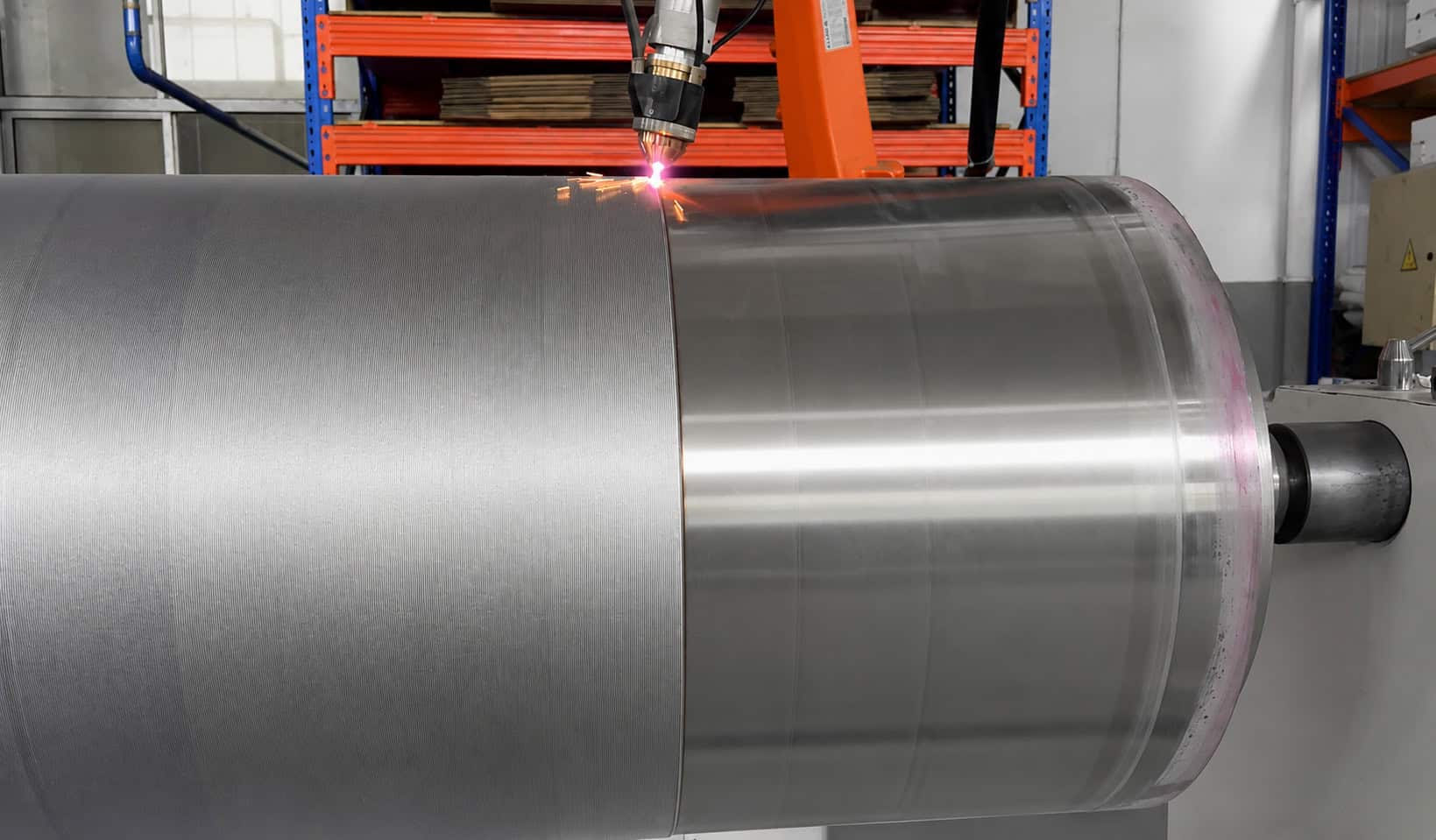
Rollers are among the most suitable metallurgical components for automated laser cladding because their rotational geometry allows highly repeatable deposition.
The actual application included both:
New Roller Manufacturing
and
Worn Roller Repair / Remanufacturing
This distinction is important.
Laser cladding is not limited to repairing damaged rollers. A functional alloy layer can also be deposited during the manufacture of a new roller to provide the required surface properties from the beginning of its service life.
4. Roller Failure Mechanisms
Different steel mill rollers experience different combinations of degradation.
Typical mechanisms include:
- Surface wear
- Scale abrasion
- Corrosion
- Thermal fatigue
- Oxidation
- Contact fatigue
- Localized material loss
- Surface roughening
Once the roller diameter or surface condition moves outside the acceptable operating range, production quality may be affected.
For a high-value roller, restoring the functional surface can therefore be economically preferable to replacing the complete component.
5. Actual Roller Cladding Material Strategy
The original industrial application specifies the use of:
High-Hardness Iron-Based Alloys
or:
Nickel-Based Alloys
for the outer surfaces of metallurgical rollers.
The material family is selected according to the operating environment.
| Coating Family | Typical Engineering Objective |
|---|---|
| High-Hardness Iron-Based Alloy | Wear resistance and economical large-area surface reinforcement |
| Nickel-Based Alloy | Wear, corrosion and elevated-temperature resistance |
| Application-Specific Alloy | Selected for particular thermal, corrosion or mechanical conditions |
The exact chemical composition must be determined according to the specific roller.

6. Roller Laser Cladding Motion Principle
For cylindrical rollers, the typical processing strategy is:
Workpiece Rotation + Axial Laser Head Movement
This generates a continuous helical cladding track along the roller surface.
The synchronized relationship is:
Rotation Speed + Axial Travel Speed + Track Width + Track Overlap
which determines the final surface coverage.
A representative equipment architecture is:
Fiber Laser
Powder Feeder
Laser Cladding Head
Heavy-Duty Rotary System
Long-Travel Linear Axis
CNC Process Control
7. New Roller Manufacturing
For new roller production, laser cladding can be incorporated into the manufacturing process before final machining.
A typical route is:
Roller Body Manufacturing
↓
Surface Preparation
↓
Laser Cladding
↓
Controlled Cooling
↓
Final Machining / Grinding
↓
Dimensional Inspection
This allows the structural roller body and functional surface to be designed separately.
Instead of manufacturing the entire roller from an expensive wear-resistant alloy, high-performance material can be concentrated at the working surface.
8. Worn Roller Repair and Remanufacturing
For worn rollers, the objective changes from initial surface enhancement to:
Dimensional Restoration + Functional Surface Reconstruction
A representative repair route is:
Wear Inspection
↓
Damage Evaluation
↓
Removal of Defective Surface Material
↓
Surface Preparation
↓
Laser Cladding
↓
Multi-Track / Multi-Layer Buildup if Required
↓
Machining / Grinding
↓
Final Inspection
This can allow a structurally sound roller body to return to service instead of being scrapped because of localized surface wear.
9. Laminar Cooling Roll Laser Cladding
Laminar cooling rolls operate in a particularly challenging environment because they may be exposed simultaneously to:
- Cooling water
- Steel scale
- Mechanical contact
- Abrasive particles
- Corrosion
- Repeated thermal variation
The coating therefore requires more than simple hardness.
Important properties can include:
Wear Resistance + Corrosion Resistance + Thermal Stability + Crack Resistance
Iron-based or nickel-based alloy systems can be evaluated according to the actual operating conditions.
10. Pinch Roll and Conveyor Roll Laser Cladding
Pinch and conveyor rolls continuously interact with moving steel products.
Their surfaces can gradually lose material because of:
- Friction
- Scale abrasion
- Mechanical pressure
- Surface fatigue
Laser cladding can restore the working diameter and provide a new wear-resistant functional surface.
For long rollers, maintaining consistent cladding geometry over the complete working length is particularly important.
11. Furnace Bottom Roll Laser Cladding
Furnace bottom rolls operate under elevated temperatures and therefore present a different engineering challenge.
Surface requirements may include:
- High-temperature wear resistance
- Oxidation resistance
- Thermal fatigue resistance
- Dimensional stability
The coating alloy must therefore be selected according to the actual furnace temperature and atmosphere.
A coating designed for a water-cooled roller should not automatically be used for a furnace roll.
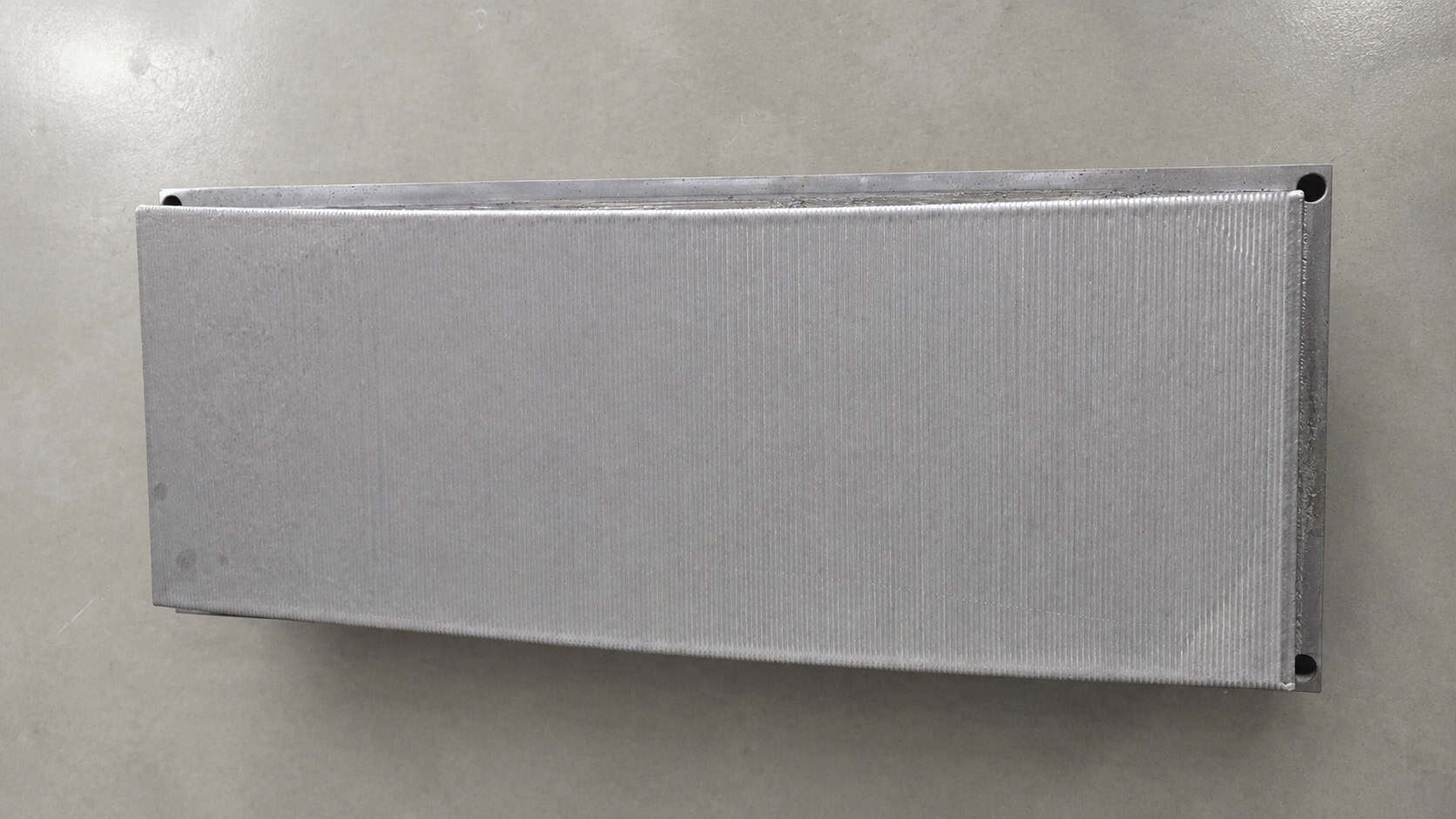
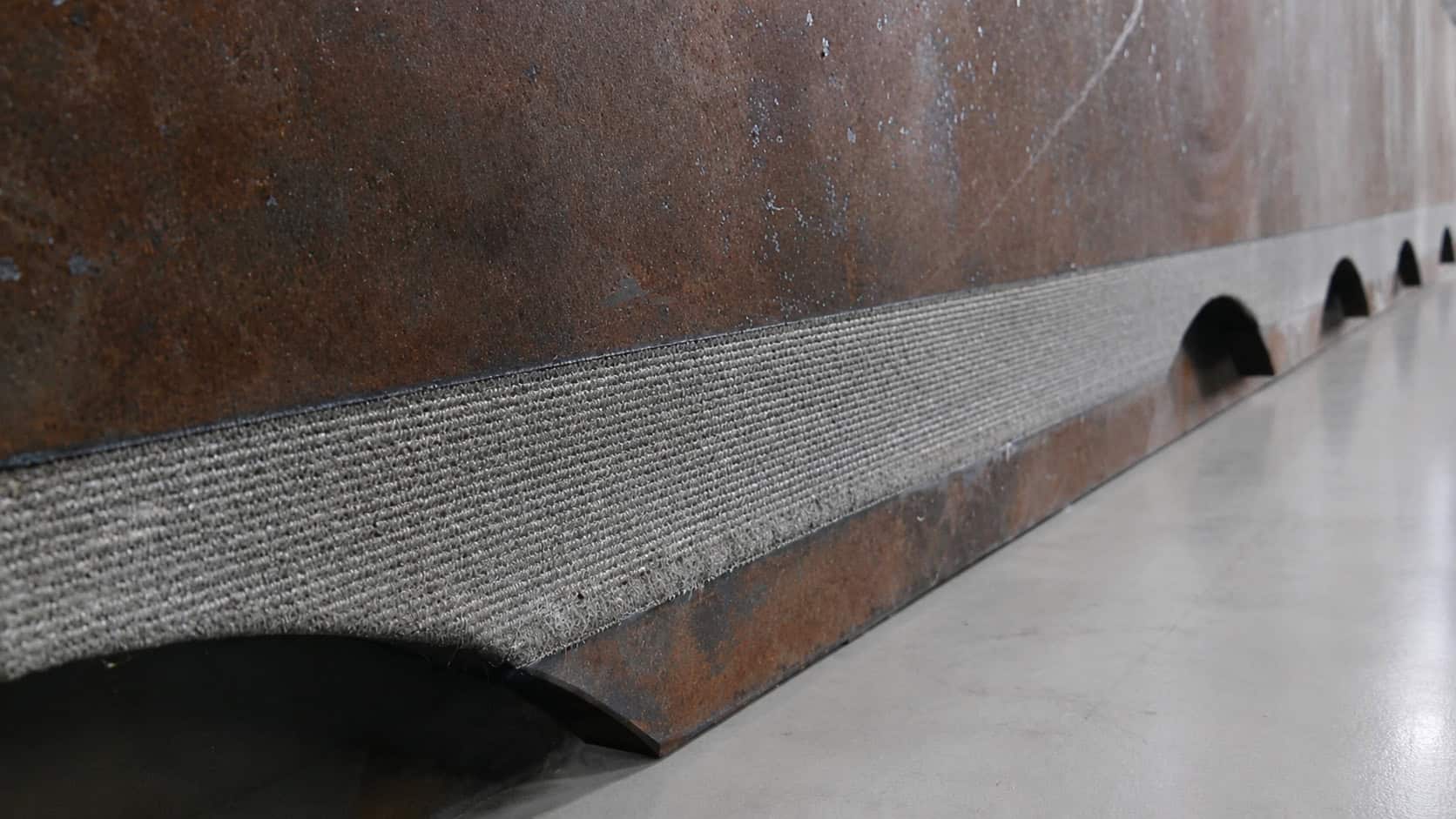
12. Steel Mill Guide and Side Guide Plate Laser Cladding
Guide components control the movement and positioning of material through metallurgical production lines.
Repeated contact can cause severe localized wear.
The actual application included laser cladding of:
Steel Mill Guides and Side Guide Plates
Unlike cylindrical rollers, these components generally require linear or multi-axis surface processing.
The laser cladding system deposits material only onto the functional wear region.
This provides:
- Localized reinforcement
- Dimensional restoration
- Wear resistance
- Reduced unnecessary material consumption
13. Processing Strategy for Guide Plates
A representative guide-plate processing route is:
Surface Preparation
↓
Workpiece Positioning
↓
Programmed Linear Laser Cladding
↓
Parallel Overlapping Tracks
↓
Multi-Layer Deposition if Required
↓
Machining / Grinding
↓
Dimensional Inspection
For long guide surfaces, track straightness and uniform overlap become important process-control factors.
14. Continuous Casting Mold Laser Cladding
Continuous casting molds operate under severe thermal conditions and are critical to steel production.
Their working surfaces can experience:
- Thermal cycling
- Thermal fatigue
- Wear
- Corrosion
- Surface degradation
The original industrial application used special alloy materials to produce dense functional cladding layers on continuous casting mold surfaces.
The engineering objective was to improve:
Thermal Fatigue Resistance + Wear Resistance + Surface Stability
and consequently support stable continuous casting operation.
15. Why Continuous Casting Molds Require Different Process Development
A continuous casting mold is fundamentally different from a roller.
The coating must interact with:
- Repeated thermal loading
- Heat extraction
- Mold surface conditions
- Mechanical wear
- Cooling conditions
Therefore, simply maximizing coating hardness is not appropriate.
Material selection must consider:
Thermal Properties + Bonding + Wear Resistance + Thermal Fatigue + Substrate Compatibility
This is why the original application uses application-specific alloy materials rather than treating every metallurgical component with the same powder.
16. Hot Rolling Mandrel Laser Cladding
Hot rolling mandrels and similar cylindrical components can also be processed using laser cladding.
Typical degradation includes:
- High-temperature wear
- Friction
- Surface fatigue
- Dimensional loss
Depending on component dimensions, processing can use:
Rotary CNC Laser Cladding
or:
Robot + Positioner
The final architecture should be selected according to workpiece diameter, length, weight and cladding area.
17. Actual Technical Information from the Industrial Application
The technical information directly supported by the actual case is summarized below.
| Technical Item | Actual Application Information |
|---|---|
| Industry | Metallurgical / Steel Production |
| Process | Powder-Fed Laser Cladding |
| Roller Applications | Conveyor / Pinch / Laminar Cooling / Furnace Bottom Rolls |
| Roller Project Type | New Manufacturing + Repair |
| Roller Coating Materials | High-Hardness Iron-Based / Nickel-Based Alloys |
| Guide Components | Steel Mill Guides / Side Guide Plates |
| Continuous Casting Application | Continuous Casting Mold Surface Cladding |
| CC Mold Material Strategy | Application-Specific Special Alloy Material |
| Additional Application | Hot Rolling Mandrel |
| Roller Processing | Automated Cylindrical Surface Cladding |
| Guide Processing | Automated Linear / Surface Cladding |
| Main Properties | Wear / Corrosion / Thermal Fatigue Resistance |
| Bonding Mechanism | Metallurgical Bonding |
These are the parameters and process characteristics that can be directly supported by the source application.
18. Project-Specific Laser Cladding Parameters
The original industrial case does not disclose fixed numerical values for laser power, powder-feed rate, travel speed, coating thickness, hardness or dilution.
These should therefore be developed according to the actual workpiece rather than presented as universal parameters.
| Process Parameter | Engineering Consideration |
|---|---|
| Laser Power | Selected according to component size, alloy and deposition target |
| Powder Feed Rate | Matched to laser power and required deposition |
| Travel Speed | Balanced between productivity and coating quality |
| Roller Rotation Speed | Synchronized with axial movement |
| Spot / Track Width | Selected according to required coverage |
| Track Overlap | Controls coating continuity and surface uniformity |
| Layer Thickness | Determined by wear allowance or surface requirement |
| Number of Layers | Determined by restoration amount |
| Shielding Gas | Selected according to powder and process |
| Preheating | Evaluated according to substrate and crack sensitivity |
| Interpass Temperature | Controlled for multi-layer processing |
| Cooling Strategy | Selected according to workpiece size and thermal behavior |
The complete process window is therefore:
Laser + Powder + Substrate + Motion + Thermal Management
19. Why Deposition Thickness Depends on the Application
Metallurgical laser cladding generally serves two different purposes.
Surface Enhancement
When the original component dimensions remain acceptable, only a functional layer is required.
Dimensional Restoration
When a roller, guide or mandrel has already lost material, additional buildup is required before final machining.
Therefore:
Required Cladding Thickness = Functional Layer Requirement + Restoration Allowance + Final Machining Allowance
There is no technically correct universal thickness for all metallurgical components.
20. Why Dilution Must Be Controlled
Laser cladding creates metallurgical bonding by melting both the deposited alloy and a controlled region of the substrate.
Excessive substrate melting can change the chemistry and properties of the functional layer.
The process should therefore achieve:
Sufficient Fusion for Strong Bonding
while maintaining:
Controlled Substrate Dilution
This is particularly important for nickel-based and application-specific high-performance alloys.
21. Heat Input and Distortion Control
Large metallurgical rollers and guide components may have substantial dimensions, but heat management remains important.
Excessive heat accumulation can cause:
- Distortion
- Residual stress
- Unstable melt-pool behavior
- Changes in microstructure
- Cracking in susceptible materials
Laser cladding provides localized energy input, but the complete thermal strategy must still consider:
- Component mass
- Base material
- Processing length
- Layer count
- Interpass temperature
- Preheating requirements
22. Quality Control
A metallurgical laser cladding component should not be accepted based only on surface appearance.
Depending on the application, quality evaluation can include:
- Visual inspection
- Dimensional inspection
- Coating thickness
- Hardness
- Metallographic examination
- Dilution evaluation
- Porosity
- Crack inspection
- Bond integrity
- Final surface roughness
For continuous casting components, thermal performance and service-specific requirements may also require additional validation.
23. Final Machining
Laser cladding is normally followed by final machining when dimensional precision is required.
Possible finishing methods include:
- Turning
- Grinding
- Milling
- Polishing
The cladding process must therefore include sufficient machining allowance while avoiding unnecessary material deposition.
This is especially important for roller remanufacturing.
24. Equipment Architecture for Metallurgical Rollers
A dedicated roller system can include:
Industrial Fiber Laser
Powder Feeder
Laser Cladding Head
Heavy-Duty Rotary Drive
Tailstock / Roller Supports
Long-Travel Linear Axis
CNC Control
Cooling and Extraction
For long or heavy rollers, machine design must consider:
- Workpiece weight
- Diameter
- Length
- Rotational stability
- Deflection
- Loading and unloading
The motion system is therefore just as important as the laser itself.
25. Equipment Architecture for Guides and Flat Components
Guide plates and similar components can use:
Laser Source + Powder Feeder + CNC/Gantry Motion + Fixture + Process Control
For large or irregular components, robotic systems can also be considered.
The equipment should follow the geometry of the component rather than forcing every application onto the same standard machine.
26. Equipment Architecture for Continuous Casting Components
Continuous casting molds and related components may require:
- CNC multi-axis motion
- Large-area processing
- Dedicated fixtures
- Controlled heat management
- Application-specific cladding paths
The system should be developed around the actual mold geometry and functional surface.
27. Laser Cladding vs. Conventional Surfacing
Conventional arc surfacing remains an important process in metallurgical maintenance.
It can offer high deposition rates and attractive economics for suitable heavy components.
Laser cladding becomes particularly valuable where the project requires:
- Lower dilution
- More localized heat input
- Greater deposition precision
- Controlled dimensional restoration
- Automated repeatability
- High-value functional alloy deposition
The correct process should be selected according to component value, coating requirement and production economics rather than assuming one technology is universally superior.
28. New Manufacturing vs. Remanufacturing
One of the important features of this application is that the same laser cladding technology can serve two different production strategies.
New Manufacturing
Structural Component + Functional Laser-Cladded Surface
Remanufacturing
Worn Component + Dimensional Restoration + New Functional Surface
This makes laser cladding particularly relevant to metallurgical equipment where large structural components may remain serviceable even after the working surface has worn.
29. Engineering Information Required for a Similar Project
For roller projects, GREENSTONE would normally evaluate:
- Roller type
- Drawing
- Base material
- Diameter
- Length
- Weight
- Working surface length
- Existing wear depth
- Operating temperature
- Failure mechanism
- Required hardness or surface properties
- Required final dimensions
- Production quantity
For guides and continuous casting components:
- Component drawing / 3D model
- Base material
- Dimensions
- Coating area
- Existing damage
- Operating temperature
- Cooling conditions
- Wear mechanism
- Required functional properties
- Production volume
These parameters determine both the laser process and the machine architecture.
30. Technical Data Summary
| Item | Application Data |
|---|---|
| Industry | Metallurgical / Steel Production |
| Technology | Powder-Fed Laser Cladding |
| Roller Types | Conveyor / Pinch / Laminar Cooling / Furnace Bottom Rolls |
| Roller Application | New Manufacturing + Repair / Remanufacturing |
| Roller Coating | High-Hardness Iron-Based / Nickel-Based Alloy |
| Guide Components | Steel Mill Guides / Side Guide Plates |
| Casting Component | Continuous Casting Mold |
| Additional Component | Hot Rolling Mandrel |
| Roller Motion | Rotation + Axial Linear Motion |
| Guide/Mold Motion | CNC / Multi-Axis / Gantry according to geometry |
| Main Bonding | Metallurgical Bonding |
| Main Surface Requirements | Wear / Corrosion / Thermal Fatigue Resistance |
| Laser Power | Project-specific; not disclosed in original case |
| Powder Feed Rate | Project-specific; not disclosed |
| Travel Speed | Project-specific; not disclosed |
| Coating Thickness | Project-specific; not disclosed |
| Dilution | Process-controlled; original numerical value not disclosed |
| Hardness | Selected according to component; original numerical value not disclosed |
| Automation | CNC / Rotary / Gantry / Robotic according to component |
31. From Metallurgical Component Repair to Automated Remanufacturing
A successful metallurgical laser cladding project should follow the complete engineering chain:
Component Failure Analysis
↓
Base Material Evaluation
↓
Functional Alloy Selection
↓
Laser Process Development
↓
Motion Architecture
↓
Fixture and Support Design
↓
Thermal Management
↓
Automated Laser Cladding
↓
Final Machining
↓
Quality Validation
The key point is that a laminar cooling roll, furnace roll, steel mill guide and continuous casting mold should not all receive the same coating or equipment configuration simply because they belong to the steel industry.
GREENSTONE can develop the process around the actual component, combining laser cladding, powder delivery, motion control, tooling and automation into a customized metallurgical surface engineering solution.
Confidentiality Notice
This application case is based on actual industrial laser cladding applications for metallurgical machinery. The component categories, new roller manufacturing and repair applications, iron-based and nickel-based roller coating strategies, steel mill guide applications, continuous casting mold applications and associated process architectures presented here are derived from actual industrial applications. Customer identities, proprietary drawings, undisclosed material formulations, numerical process parameters and commercial information remain confidential. Representative images may be used where original customer project images cannot be published.
Have a Similar Metallurgical Machinery Application?
Whether the project involves laminar cooling rolls, pinch rolls, conveyor rolls, furnace bottom rolls, hot rolling mandrels, steel mill guides, continuous casting molds or other high-wear metallurgical components, process selection should begin with the actual failure mechanism and operating conditions.
Send us your workpiece drawings, base material, dimensions, weight, wear condition, operating temperature, required cladding area, target surface properties, final machining requirements and production volume. GREENSTONE’s engineering team can evaluate the appropriate cladding alloy, laser process and automated equipment architecture for your application.
