


Laser Cladding Technology for Precision Component Repair and Strengthening in the Aerospace and Energy Sectors
Laser cladding technology, an advanced additive manufacturing and surface engineering process, plays an irreplaceable role in remanufacturing and extending the service life of high-end equipment. Particularly in aerospace engines and energy drilling equipment, where performance demands are extremely high, laser cladding has become a core method for “value regeneration” of critical components.
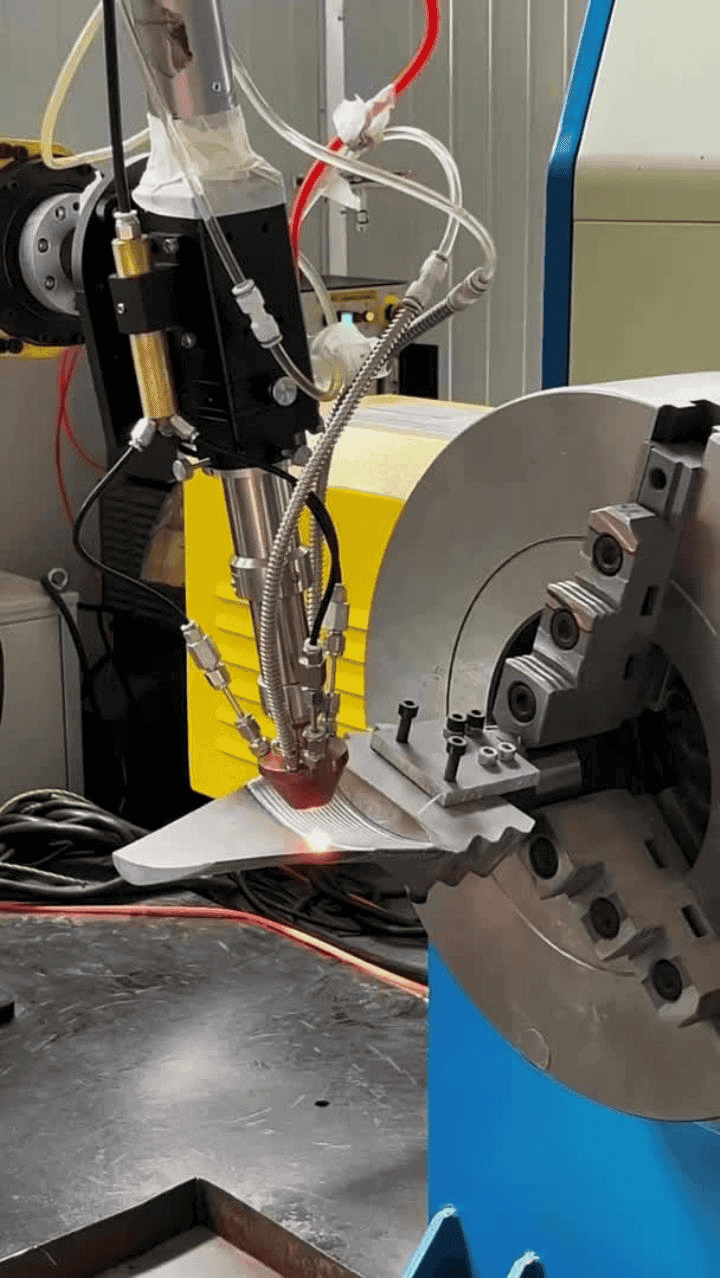

1. Application Scenarios: Component Failures in Extreme Operating Conditions
Aerospace and energy equipment operate under extreme conditions, including high temperatures, high pressures, high rotational speeds, and exposure to corrosive media. The failure of their core precision components directly threatens the safety and efficiency of the entire system.
Aerospace Engine Blades: Turbine and guide blades endure high-temperature gas erosion that exceeds the melting point of the base material, along with significant centrifugal stress. Common failure modes include:
High-Temperature Oxidation and Thermal Corrosion: Leading edges and tips experience the breakdown of protective coatings due to high temperatures, which causes base material erosion and defect formation.
Foreign Object Damage: Particles (e.g., sand, dust) ingested into the air intake impact the blades at high speeds, causing pitting or tip damage.
Fatigue Cracking: Under alternating stress, micro-cracks initiate at stress concentration points.
Gears and Transmission Components: Whether in aircraft engine gearboxes or energy sector wind turbines and drilling equipment, the failure of gears is typically due to:
Contact Fatigue: Pitting and spalling of tooth surfaces under cyclic contact stresses.
Abrasive Wear: Gear tooth surfaces are worn away by hard particles in conditions with poor lubrication or contaminants.
Adhesion: High loads lead to high local temperatures that break down the oil film, causing metal adhesion and tearing.
2. Solution: Precision Laser Cladding Repair Process
Laser cladding repair is not just about “filling material”; it is a comprehensive remanufacturing process that involves materials science, thermodynamics, and precision control.
Core Technology Process:
Digital Damage Assessment and 3D Modeling:
High-precision 3D digital scans of damaged components are performed using coordinate measuring machines (CMM) or blue light scanners. The geometry of the damaged area is captured and compared to the original CAD model to accurately calculate the material volume and shape that need to be cladded.
Material System Design and Selection:
This step is critical for the success of the repair. The repair material must have good metallurgical compatibility with the base material while meeting or exceeding the required performance, such as high-temperature strength, wear resistance, and corrosion resistance.
Aerospace Blades: Nickel-based or cobalt-based high-temperature alloy powders (e.g., Inconel 718, Hastelloy X) are typically used. For the blade tips, specialized high-temperature wear-resistant alloys are selected.
Gear Teeth: Cobalt-based Stellite series or nickel-based alloys are common, known for their excellent high-temperature red hardness and wear resistance. Iron-based gears are repaired using high-performance iron-based alloys or metal-ceramic composites.
Precision Cladding Process Control:
Laser Selection: Semiconductor lasers or fiber lasers with high beam quality are typically used, with power ranging from 1 kW to 6 kW.
Powder Delivery: Coaxial powder delivery ensures that the powder stream is surrounded by the laser beam, enabling cladding in any direction. This is especially useful for complex surfaces such as blade tips and gear profiles.
Process Monitoring: Thermal imaging and visual monitoring systems are integrated to track the melt pool temperature and shape in real time. Closed-loop control systems dynamically adjust laser power and scanning speed to ensure stable and defect-free cladding layers (such as avoiding porosity or cracks).
Post-Processing and Precision Machining:
After cladding, components undergo stress-relieving annealing to remove residual stress. Then, five-axis CNC machining or precision grinding is performed to achieve the final dimensions and surface finish required, ensuring that aerodynamic performance (for blades) or tooth meshing precision (for gears) is met.
Repair Effects and Advantages:
Metallurgical Bonding: The cladded layer forms a dense metallurgical bond with the base material, ensuring high bonding strength and preventing delamination.
Low Dilution Rate: Laser energy is highly focused, and the heat-affected zone is minimal (typically <0.5mm), ensuring that the base material’s performance is largely preserved while maintaining the purity and performance of the cladded layer.
Microstructure Refinement: Due to the rapid melting and cooling of laser cladding, the cladded layer features fine dendritic or equiaxed crystals, significantly improving material hardness, toughness, and fatigue resistance.
3. Typical Cases
Aerospace: Leading global aerospace engine maintenance companies, such as MTU and Lufthansa Technik, have widely adopted laser cladding for repairing high-pressure turbine blade tips. For instance, a single-crystal blade that lost 0.8 mm due to wear was repaired using a laser cladding process with a specific nickel-based high-temperature alloy, restoring its dimensions and undergoing subsequent heat treatment to recover its single-crystal structure, making it serviceable again. This repair saved an expensive component worth hundreds of thousands of dollars, with repair costs only 30%-50% of a new part.
Energy Sector: In oil drilling, worn-out threads on drill pipe connections are a common issue. By using laser cladding with a thick cobalt-based wear-resistant alloy, the service life of the threaded seal surface is extended 2-3 times compared to new carburized layers. Similarly, large planetary gear teeth in wind turbines have their wear resistance significantly enhanced after laser cladding, effectively reducing the failure rate of the main transmission system and minimizing economic losses caused by downtime.
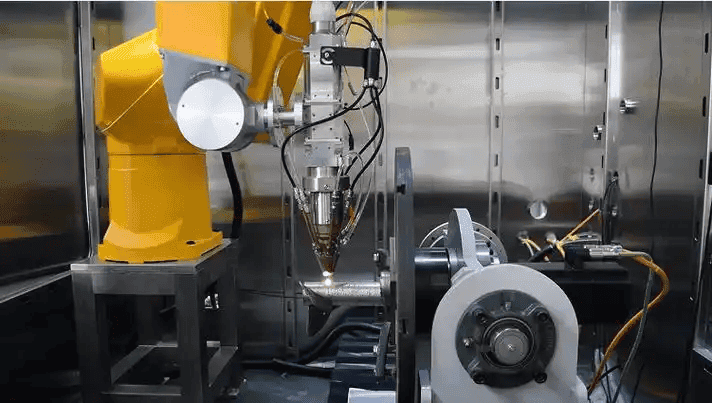

4. Future Trends
Laser cladding technology is evolving towards more intelligent, efficient, and macro-micro integration:
Intelligent and Digital Integration: Combining AI and digital twin technology will create a fully automated closed-loop system for “scanning-modeling-path planning-cladding-inspection.” AI will optimize process parameters in real-time based on historical data, predicting and avoiding defects.
High-Precision and Micro Cladding: Using higher-quality beam lasers (ultraviolet/green lasers) combined with precise powder feeding systems will enable micro-cladding with feature sizes below 100 microns, ideal for repairing precision molds, microstructures in optical communication devices, and remanufacturing cooling holes in aerospace engine airfoils.
Large-Scale Components and Hybrid Manufacturing: As high-power (kilowatt-level) lasers and robotic technologies mature, laser cladding applications will extend beyond repair to “high-performance manufacturing” of large components. For example, in aerospace, it can be used for the direct manufacturing or repair of large titanium alloy wing spars and airplane skin molds, achieving “near-net shaping” to reduce material and processing costs.
New Material Development and Functionally Graded Materials: Custom alloy powders, amorphous alloys, high-entropy alloys, and metal matrix composites are being developed for specific operating conditions. Real-time adjustments to powder composition will allow functionally graded materials (FGMs) to be produced on a single part, with different performance characteristics in different regions (e.g., wear resistance on one end, corrosion resistance on another).
Collaboration with 3D Printing: As a representative of directed energy deposition (DED) 3D printing, laser cladding will increasingly work alongside powder bed fusion (SLM) technology, playing a dual role in “macro construction” and “micro repair” to provide lifecycle manufacturing and maintenance solutions for complex components in industries like aerospace and nuclear power.
Lydia Liu
Dr. Lydia Liu – Senior Researcher, Expertin für Markt- und Lösungsintegration. Dr. Lydia Liu ist eine einzigartige Expertin, die erstklassiges technisches Know-how im Bereich der additiven Fertigung mit einem ausgeprägten Gespür für Markt- und Ressourcenintegration verbindet. Als promovierte Wissenschaftlerin und Senior Researcher im Bereich AM verfügt sie über fundiertes technisches Wissen und fungiert gleichzeitig als wichtige Brücke zwischen Spitzentechnologie und Marktbedürfnissen. Ihr besonderer Wert liegt in ihrer Fähigkeit, die komplexesten technischen Herausforderungen ihrer Kunden zu verstehen und, basierend auf einem umfassenden Überblick über das globale AM-Ökosystem, die besten technischen Ressourcen und Lösungen präzise zu integrieren.


