


الكسوة بالليزر is an advanced technology that has revolutionized the way we repair and restore components. It is an additive manufacturing process where high-power laser beams are used to fuse layers of material onto a substrate. This process helps create protective coatings that improve functionality and restore worn surfaces.
ال التكسية بالليزر process has been widely applied in industries such as aerospace, automotive, and medical fields, thanks to its numerous advantages. It plays a significant role in extending the lifespan of machinery, especially those exposed to wear, impact, and corrosion.
In this article, we will explore the various aspects of التكسية بالليزر, including its benefits, applications, and future prospects. Let’s dive in!
Overview of Laser Cladding Technology
الكسوة بالليزر (also known as laser metal deposition) is a method where one material is deposited onto another. As the laser beam scans the sample surface, metal powder or wire is introduced into the molten pool generated by the laser, creating a layer of the selected material.
Laser technology ensures precise and selective deposition of materials with minimal heat input to the underlying substrate. It can improve the surface properties of parts, such as wear resistance, and repair damaged or worn surfaces. One of the most precise التكسية بالليزر welding methods is used to establish mechanical bonds between the substrate and the deposited layer.
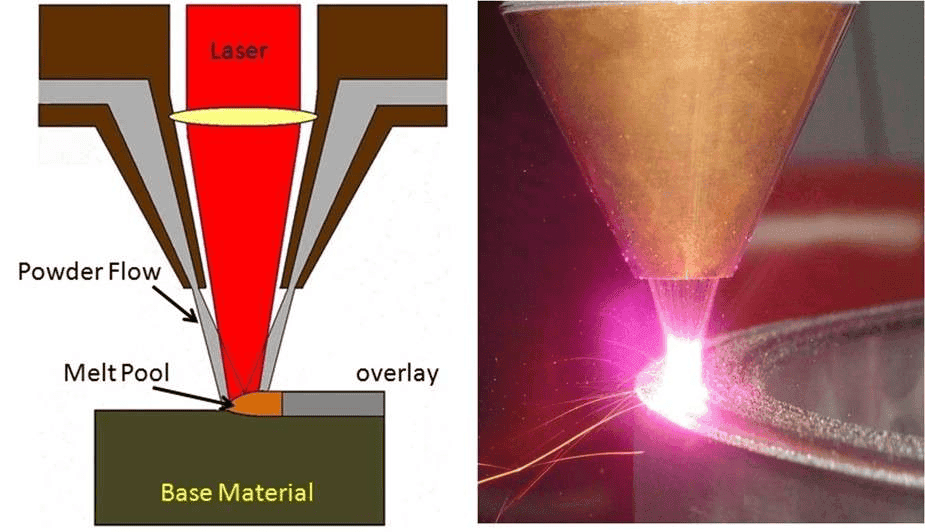
Laser Cladding Process Summary
الكسوة بالليزر is a method where a laser is used as a heat source to apply a metallic coating on a part’s surface. This technology typically produces protective coatings that enhance efficiency and repair damaged or worn surfaces. The application of التكسية بالليزر is not limited to components exposed to corrosion, wear, or impact in machinery and equipment. For example, the construction equipment industry uses التكسية بالليزر to increase wear resistance and extend the service life of equipment.
عادةً, التكسية بالليزر involves melting metal powder using a laser (such as IPG’s high-power multimode fiber lasers) and applying the coating to the substrate. Alloy steels or stainless steels can be protected with coatings made of tungsten carbide, nickel alloys, or cobalt alloys. This method creates a strong metallurgical bond with minimal dilution of the base material, enhancing the metal’s corrosion resistance, wear resistance, and toughness.
Types of Lasers Used for Cladding
ال التكسية بالليزر process uses different types of lasers depending on the requirements of the coating process and specific applications. Some common types include:
CO2 Lasers: These gas lasers can generate very high power and are typically used in cladding applications that require deep penetration. CO2 lasers operate by discharging carbon dioxide gas molecules, which emit photons at a specific wavelength of around 10.6 microns.
Fiber Lasers: These are solid-state lasers that use optical fibers as the medium to deliver the laser beam. Fiber lasers can provide high-quality coatings with smooth surface finish. They are widely used in various التكسية بالليزر applications due to their high power output, excellent beam quality, and efficient operation.
Nd:YAG Lasers: Nd:YAG (Neodymium-doped Yttrium Aluminum Garnet) lasers are solid-state lasers often used in التكسية بالليزر. They offer a wide range of power densities and have a high pulse repetition rate, making them suitable for precise and effective cladding applications.
Diode Lasers: These semiconductor-based lasers are typically used for low-power التكسية بالليزر applications. PN junction diodes are used as the lasing medium in these lasers.
Materials Used in Laser Cladding
الكسوة بالليزر uses various materials, including metal powders, ceramic powders, and composite powders. The selection of materials depends on the desired coating properties, such as thermal stability, corrosion resistance, and wear resistance. Common materials used in التكسية بالليزر تشمل:
مساحيق المعادن: Common metal powders used in التكسية بالليزر include titanium, aluminum, cobalt-based alloys, and nickel-based alloys.
مساحيق السيراميك: Ceramic particles such as aluminum oxide, zirconium oxide, and carbides like tungsten carbide are used for التكسية بالليزر.
المساحيق المركبة: Coatings with special properties can be made from composite powders, which are combinations of metal and ceramic powders.
Advantages of Laser Cladding Over Other Coating Methods
Compared to other coating methods, التكسية بالليزر offers many advantages. Some of the key benefits include:
Superior coating quality: الكسوة بالليزر offers high adhesion strength and integrity with improved surface quality.
Precision deposition: الكسوة بالليزر allows for precise placement of customized performance-enhancing materials, ensuring that the coatings are selectively deposited where needed.
Minimal heat input: The process uses minimal heat, reducing the heat-affected zone (HAZ) and minimizing the deformation of the base material.
Material flexibility: الكسوة بالليزر can be used on a wide variety of materials, including custom alloys and metal matrix composites (MMCs).
Low porosity: The deposited material in التكسية بالليزر is typically more than 99.9% dense, with minimal porosity.
Shorter manufacturing time: The integration of التكسية بالليزر with CAD/CAM systems and the ability to control laser output reduces manufacturing time compared to traditional coating methods.
Reduced material waste: الكسوة بالليزر only applies material where it is needed, reducing material waste and providing a more environmentally friendly solution.
Benefits of Laser Cladding
This surface modification technology offers several key benefits, including:
Enhanced durability and wear resistance: الكسوة بالليزر improves the wear resistance of materials by depositing harder substances onto softer substrates.
Extended component lifespan: By improving the surface properties of components, التكسية بالليزر extends their lifespan, allowing them to resist wear, corrosion, and other types of degradation.
Reduced downtime and maintenance costs: Other surface treatments, such as electroplating or thermal spraying, can be more expensive than التكسية بالليزر. الكسوة بالليزر requires fewer materials and can be completed quickly, reducing maintenance costs.
Improved component functionality and performance: الكسوة بالليزر improves the strength, hardness, and toughness of materials, enhancing their performance in demanding environments.
Eco-friendly and sustainable: الكسوة بالليزر minimizes material waste by only applying material where it is needed, reducing the overall amount of material used.
تطبيقات التكسية بالليزر
الكسوة بالليزر is a versatile technology with many applications across various industries. Some common applications include:
Repair of damaged components: One of the primary uses of التكسية بالليزر is to repair damaged parts. It restores the original shape and functionality of components by adding material to the worn or damaged areas.
Wear-resistant surface modification: Manufacturers use التكسية بالليزر to apply hard, wear-resistant coatings to metal parts, such as hydraulic cylinders, gears, and engine components. These coatings also provide corrosion protection, extending the life of the parts.
Custom coatings: The process can also be used to change the surface characteristics of parts, such as adding patterns or textures to improve grip or reduce friction for better performance.
High-value component repair: الكسوة بالليزر is especially useful for repairing expensive or hard-to-replace parts, such as molds, shafts, blades, and turbines.
Aerospace and defense applications: In aerospace and defense, التكسية بالليزر helps enhance the performance and reliability of components in missiles, aircraft, and other high-performance systems.
Automotive applications: The automotive industry benefits from التكسية بالليزر in applications ranging from enhancing engine components’ performance and durability to extending the lifespan of high-wear parts.
Proleantech, an expert in التكسية بالليزر technology, offers التكسية بالليزر services for agricultural harvesting machine parts, significantly reducing wear and extending the lifespan of customer equipment. If you require التكسية بالليزر services for your products, feel free to contact us anytime.
خاتمة
الكسوة بالليزر is an effective method for improving the surface performance of various materials. By using laser beams to deposit a material onto a substrate, it enhances wear and corrosion protection, as well as overall functionality. This process extends component lifespan, reduces maintenance costs, and boosts efficiency.
كما التكسية بالليزر becomes more accessible and cost-effective, it is increasingly attractive for a wide range of applications. Contact ProLean Tech for the best خدمات التكسية بالليزر tailored to your specific needs.
ويندي وانج
ويندي وانغ - مستشارة تقنية، خبيرة حلول التكسية بالليزر والتصنيع المضاف بالليزر ويندي وانغ هي مستشارة تقنية متخصصة للغاية في شركة Greenstone، حيث تجمع بين الخبرة المتقدمة في التكسية بالليزر والتصنيع المضاف للمعادن DED وهندسة الأسطح الصناعية وحلول التصنيع عالية القيمة مع قدرات استراتيجية قوية في تكامل السوق العالمية وتنسيق الموارد التقنية. تلعب ويندي دوراً حاسماً في الربط بين التقنيات الهندسية المتطورة والتطبيقات الصناعية العملية، وذلك بفضل معرفتها العميقة في مجال معالجة المواد بالليزر وأنظمة التصنيع المضافة وتحسين المعدات الصناعية وتسويق التصنيع المتقدم. تُمكِّن خبرتها عملاء Greenstone العالميين من التعامل بنجاح مع التحديات التقنية المعقدة مع زيادة كفاءة التصنيع والمعدات إلى أقصى حد...