


Technologia napawania laserowego: Kompleksowe porównanie procesów podawania proszku i podawania drutu
czerwiec 28, 2024


1. Przegląd technologii
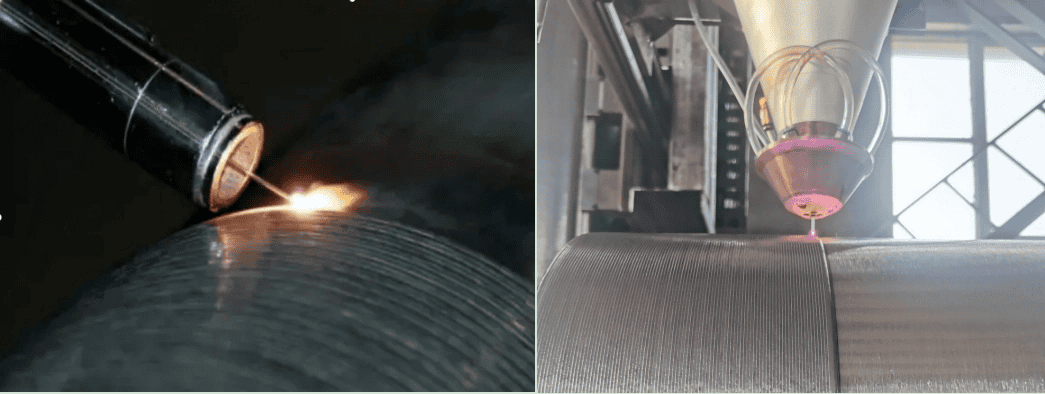
Laser cladding technology is an advanced surface engineering technique that uses a high-energy laser beam to simultaneously melt both the coating material (powder or wire) and a thin layer of the substrate. The rapid solidification process forms a metallurgical bond between the coating and the substrate. The coatings created by this method have extremely low dilution rates and significantly enhance the substrate’s wear resistance, corrosion resistance, heat resistance, oxidation resistance, and specific electrical properties.
2. Key Characteristics of Laser Cladding Technology
- Szybkie krzepnięcie: The cooling rate can reach 10⁶ °C/s, producing typical fine-grained structures.
- Excellent Bonding Quality: With minimal heat deformation, the cladding has a dilution rate of less than 5%, ensuring a true metallurgical bond.
- Szeroka kompatybilność materiałowa: Supports various material systems, including iron-based, nickel-based, cobalt-based, copper-based, and titanium-based alloys.
- Precise Thickness Control: Cladding thickness ranges from 0.2–2mm, making it suitable for precision wear repairs.
- High Precision Processing: Capable of processing complex geometries and small workpiece areas.
- Automation Compatibility: The process can be easily integrated with automated control systems.
3. Classification of Laser Cladding Technologies
Based on the material form and laser coupling method, laser cladding technologies are typically divided into the following four categories:
1. Coaxial Powder Feeding Laser Cladding (High-Speed Laser Cladding)
Technology Principle:
The combination of a fiber laser and an air-powered powder feeder delivers a coaxial output of both the laser beam and powder. The system uses a specialized cladding head with configurations such as center-out light and ring-shaped powder feeding, equipped with a dedicated gas protection system to ensure accurate convergence of the laser, powder, and airflow at the processing focal point.
Technological Advantages:
- Omnidirectional Processing Capability: The cladding head supports multi-angle rotation and can be paired with robotic arms for complex surface processing.
- Superior Surface Quality: The surface flatness of the cladding layer achieves Ra < 10μm, with minimal machining allowances for post-processing.
- Precise Thermal Control: The molten pool size is accurately controlled, with low heat input, making it ideal for thin-walled and small workpiece cladding.
2. Off-Axis Powder Feeding Laser Cladding (Pre-Positioned Powder Laser Cladding)
Technology Principle:
Using a rectangular spot laser combined with a gravity-fed powder system, alloy powder is first pre-positioned onto the workpiece surface, then melted and formed through laser scanning.
Technology Features:
- Wysokie wykorzystanie materiału: Powder utilization can reach over 95%.
- Larger Heat-Affected Zone: Laser energy directly acts on the substrate, resulting in higher heat input.
- Limited Surface Flatness: A larger machining allowance is required, leading to higher post-machining costs.
3. High-Speed Wire Feeding Laser Cladding
Technology Principle:
A high-power laser, combined with a precision wire feeding system, melts the metal wire in the laser’s focal area to form a cladded layer. This technology includes both center wire feeding and lateral wire feeding approaches.
Center Wire Feeding Technology Advantages:
- Omnidirectional Flexibility: The cladding head can move in any direction, with no path restrictions.
- Beam Integrity: Avoids the interference from lateral feeding, ensuring beam quality is maintained.
- Wide Wire Diameter Compatibility: Supports wire diameters from 1.0–3.0mm, accommodating various cladding needs.
4. Core Features of High-Speed Wire Feeding Laser Cladding
1. Outstanding Environmental Performance
By using solid wire instead of powder, this process completely eliminates dust pollution during processing. The material utilization rate reaches 100%, complying with green manufacturing standards.
2. Significant Cost Advantages
The cost of wire materials is 50% lower than that of powder materials. With 100% material utilization, the overall cost is significantly more favorable than traditional powder cladding methods.
3. Efficient Processing Capabilities
Wire is pre-melted before entering the molten pool, improving energy efficiency. Cladding rates are 30% faster than traditional powder processes.
4. Precyzyjna kontrola termiczna
By precisely controlling the relative position of the wire and laser, the energy distribution is finely tuned, achieving a line energy density as low as 0.29 KJ/cm, resulting in minimal deformation of the workpiece.
5. Excellent Coating Quality
- Single Layer Cladding Thickness: 1-4mm
- Cladding Density: Approaching theoretical density
- Surface Flatness: Significantly better than traditional welding processes
- Dilution Rate: Controlled below 3%
5. Technology Summary
Greenstone-Tech’s laser cladding technology platform encompasses both powder feeding and wire feeding processes, each with unique advantages and applications:
- Współosiowe podawanie proszku is ideal for high-precision, thin coating applications on complex surfaces.
- Podawanie proszku poza osią offers cost advantages in large-area, thick coating repairs.
- High-Speed Wire Feeding excels in environmental sustainability, cost-effectiveness, and thick coating quality.
Companies can choose the most suitable solution based on their specific product requirements, quality demands, and budget constraints.
Michael Shea
Michael Shea - dyrektor ds. zagranicznych, globalny lider rozwoju biznesu i starszy ekspert ds. inżynierii technicznej Michael Shea pełni funkcję dyrektora ds. zagranicznych Greenstone i jest bardzo wszechstronnym starszym ekspertem ds. inżynierii technicznej, łącząc globalne przywództwo biznesowe z głęboką multidyscyplinarną wiedzą specjalistyczną w zakresie napawania laserowego, produkcji dodatków do metali DED, czyszczenia laserowego, hartowania laserowego, modernizacji urządzeń przemysłowych i integracji zaawansowanych systemów produkcyjnych. Dzięki bogatemu doświadczeniu zarówno w rozwoju rynków międzynarodowych, jak i wdrażaniu technologii przemysłowych o pełnym spektrum, Michael odgrywa kluczową rolę w napędzaniu globalnej ekspansji Greenstone, zapewniając jednocześnie doskonałość techniczną w różnych zastosowaniach klientów. Jego wyjątkowa siła zawodowa polega na płynnej integracji strategii handlowej, wiedzy inżynierskiej i...